. 2023 Mar;66(3):508-519.
doi: 10.1007/s00125-022-05836-w. Epub 2022 Dec 2.

The effect of age on longitudinal measures of beta cell function and insulin sensitivity during the progression of early stage type 1 diabetes

Affiliations

The effect of age on longitudinal measures of beta cell function and insulin sensitivity during the progression of early stage type 1 diabetes

Ele Ferrannini et al. Diabetologia. 2023 Mar.

Abstract

Aim/hypothesis: The risk of progressing from autoantibody positivity to type 1 diabetes is inversely related to age. Separately, whether age influences patterns of C-peptide loss or changes in insulin sensitivity in autoantibody-positive individuals who progress to stage 3 type 1 diabetes is unclear.

Methods: Beta cell function and insulin sensitivity were determined by modelling of OGTTs performed in 658 autoantibody-positive participants followed longitudinally in the Diabetes Prevention Trial-Type 1 (DPT-1). In this secondary analysis of DPT-1 data, time trajectories of beta cell function and insulin sensitivity were analysed in participants who progressed to type 1 diabetes (progressors) to address the impact of age on patterns of metabolic progression to diabetes.

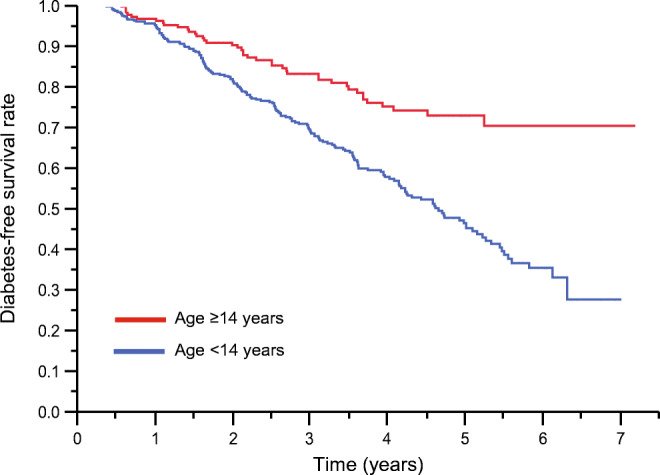
Results: Among the entire DPT-1 cohort, the highest discriminant age for type 1 diabetes risk was 14 years, with participants aged <14 years being twice as likely to progress to type 1 diabetes as those aged ≥14 years. At study entry, beta cell glucose sensitivity was impaired to a similar extent in progressors aged <14 years and progressors aged ≥14 years. From study entry to stage 3 type 1 diabetes onset, beta cell glucose sensitivity and insulin sensitivity declined in both progressor groups. However, there were no significant differences in the yearly rate of decline in either glucose sensitivity (-13.7 [21.2] vs -11.9 [21.5] pmol min-1 m-2 [mmol/l]-1, median [IQR], p=0.52) or insulin sensitivity (-22 [37] vs -14 [40] ml min-1 m-2, median [IQR], p=0.07) between progressors aged <14 years and progressors aged ≥14 years.

Conclusions/interpretation: Our data indicate that during progression to stage 3 type 1 diabetes, rates of change in declining glucose and insulin sensitivity are not significantly different between progressors aged <14 years and progressors aged ≥14 years. These data suggest there is a predictable course of declining metabolic function during the progression to type 1 diabetes that is not influenced by age.

Keywords: Age; Beta cell glucose sensitivity; C-peptide; Type 1 diabetes.


Figures

Fig. 1
Fig. 1
Diabetes-free survival function of study participants by the discriminant age of 14 years (p=2.0×10⁻⁷). Age <14 years, n=448; age ≥14 years, n=210; 295 prepubertal, 221 peripubertal and 142 adults
Fig. 2
Fig. 2
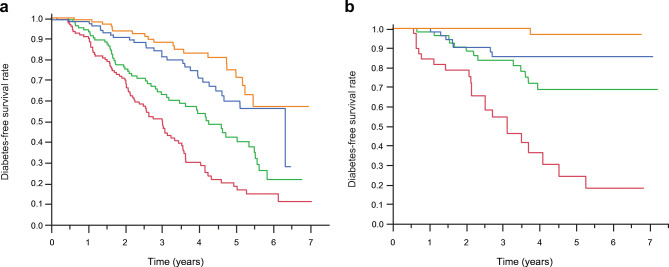
Diabetes-free survival function by sex-specific quartiles of beta cell glucose sensitivity in participants aged <14 years (a) (n=448, p=3.4×10⁻¹⁵) or ≥14 years (b) (n=210, p=2.4×10⁻¹²). Colours indicate glucose sensitivity quartiles (red, green, blue and orange, from the lowest to the highest quartile). Each quartile includes 112 participants aged <14 years and 53 participants aged ≥14 years; progressors, n=227; non-progressors n=431
Fig. 3
Fig. 3
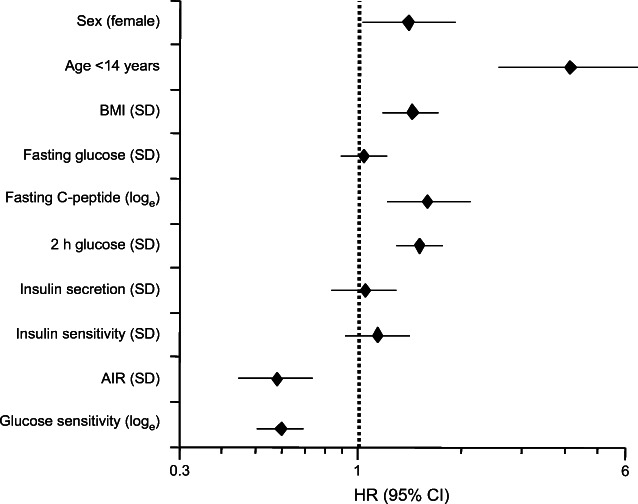
Multivariate Cox proportional hazard model of diabetes progression in the entire cohort (n=658). Plots show HR and 95% CI. Insulin secretion represents total insulin output over the 2 h of the OGTT; AIR represents the AIR to i.v. injection of glucose
Fig. 4
Fig. 4
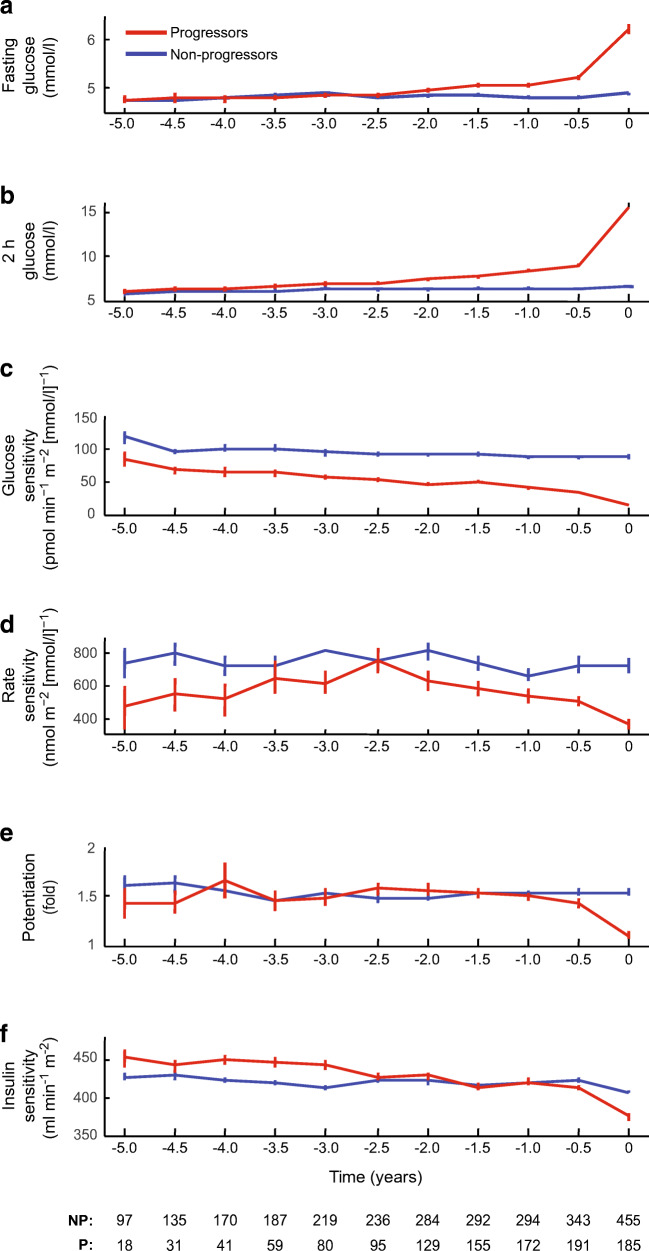
Time course of plasma glucose levels, beta cell function variables and insulin sensitivity by outcome (progressors vs non-progressors). Time 0 is the time of diabetes diagnosis or study end. Numbers of participants are given at the bottom of the figure. NP, non-progressors; P, progressors
Fig. 5
Fig. 5
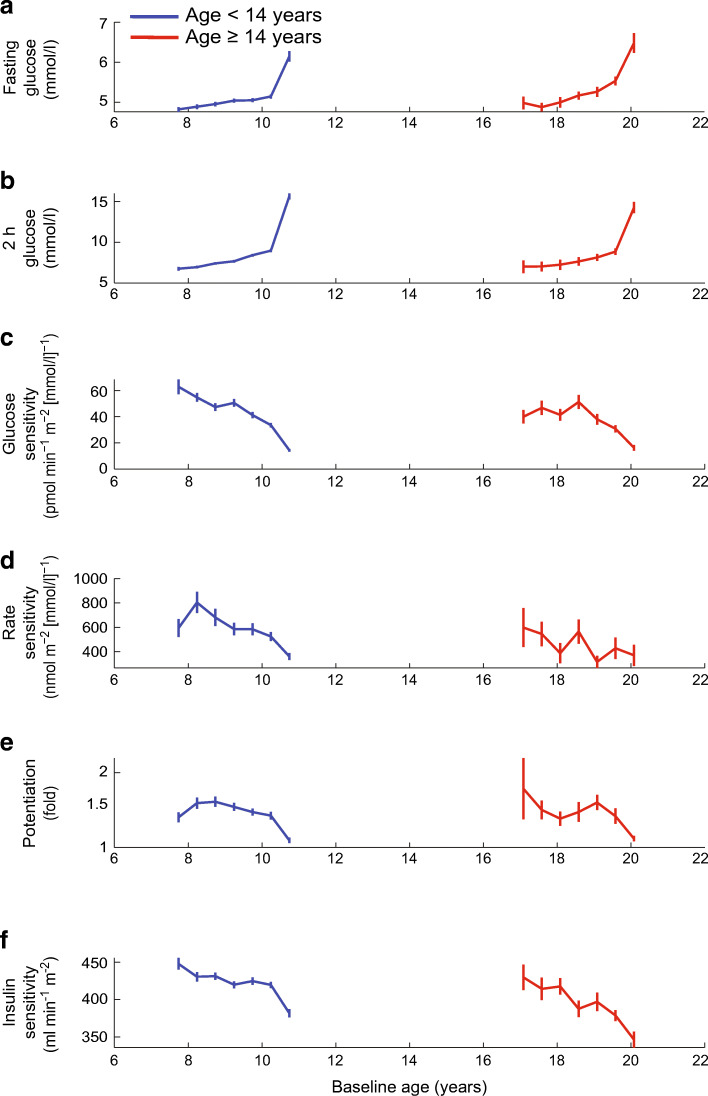
Time course of plasma glucose levels, beta cell function variables and insulin sensitivity by baseline age in progressors aged <14 years (n=184) and ≥14 years (n=43). Within each age group, trajectories are first aligned to the age of diagnosis (as in Fig. 4). Then, trajectories are shifted by the median group-specific age at diagnosis (last time point is the median age at diagnosis in the group)
Fig. 6
Fig. 6
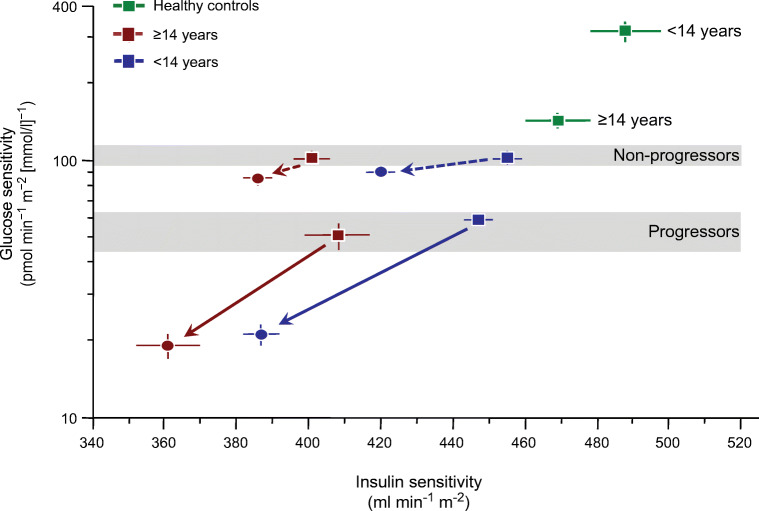
Scattergram of glucose sensitivity against insulin sensitivity in progressors and non-progressors by age <14 or ≥14 years (progressors aged <14 years, n=184; progressors aged ≥14 years, n=43; non-progressors aged <14 years, n=264; non-progressors aged ≥14 years, n=167). Historical data from healthy control groups of participants aged ≥14 years (n=72; age 30 ± 2 years, BMI 24.2 ± 5.0 kg/m2, mean ± SD) and younger individuals (n=68; age 9 ± 2 years, BMI 23.6 ± 1.1 kg/m2, mean ± SD) are also plotted. Squares, baseline values; circles, follow-up values; dashed arrows connect non-progressors; solid arrows connect progressors. Plots are mean ± SEM

References

    1. DiMeglio LA, Evans-Molina C, Oram RA. Type 1 diabetes. Lancet. 2018;391(10138):2449–2462. doi: 10.1016/S0140-6736(18)31320-5. - DOI - PMC - PubMed
    1. Insel RA, Dunne JL, Atkinson MA, et al. Staging presymptomatic type 1 diabetes: a scientific statement of JDRF, the Endocrine Society, and the American Diabetes Association. Diabetes Care. 2015;38(10):1964–1974. doi: 10.2337/dc15-1419. - DOI - PMC - PubMed
    1. Ziegler AG, Rewers M, Simell O, et al. Seroconversion to multiple islet autoantibodies and risk of progression to diabetes in children. JAMA. 2013;309(23):2473–2479. doi: 10.1001/jama.2013.6285. - DOI - PMC - PubMed
    1. Anand V, Li Y, Liu B, et al. Islet autoimmunity and HLA markers of presymptomatic and clinical type 1 diabetes: joint analyses of prospective cohort studies in Finland, Germany, Sweden, and the U.S. Diabetes Care. 2021;44(10):2269–2276. doi: 10.2337/dc20-1836. - DOI - PMC - PubMed
    1. Greenbaum CJ, Beam CA, Boulware D, et al. Fall in C-peptide during first 2 years from diagnosis: evidence of at least two distinct phases from composite Type 1 Diabetes TrialNet data. Diabetes. 2012;61(8):2066–2073. doi: 10.2337/db11-1538. - DOI - PMC - PubMed

Publication types