. 2022 Dec 6;119(49):e2204259119.
doi: 10.1073/pnas.2204259119. Epub 2022 Dec 2.

Decorating chromatin for enhanced genome editing using CRISPR-Cas9

Affiliations

Decorating chromatin for enhanced genome editing using CRISPR-Cas9

Evelyn Chen et al. Proc Natl Acad Sci U S A. .

Abstract

CRISPR-associated (Cas) enzymes have revolutionized biology by enabling RNA-guided genome editing. Homology-directed repair (HDR) in the presence of donor templates is currently the most versatile method to introduce precise edits following CRISPR-Cas-induced double-stranded DNA cuts, but HDR efficiency is generally low relative to end-joining pathways that lead to insertions and deletions (indels). We tested the hypothesis that HDR could be increased using a Cas9 construct fused to PRDM9, a chromatin remodeling factor that deposits histone methylations H3K36me3 and H3K4me3 to mediate homologous recombination in human cells. Our results show that the fusion protein contacts chromatin specifically at the Cas9 cut site in the genome to increase the observed HDR efficiency by threefold and HDR:indel ratio by fivefold compared with that induced by unmodified Cas9. HDR enhancement occurred in multiple cell lines with no increase in off-target genome editing. These findings underscore the importance of chromatin features for the balance between DNA repair mechanisms during CRISPR-Cas genome editing and provide a strategy to increase HDR efficiency.

Keywords: CRISPR; chromatin; epigenetics; genome editing.


Conflict of interest statement

The Regents of the University of California have patents issued and pending for CRISPR technologies on which J.A.D. is an inventor. J.A.D. is a cofounder of Caribou Biosciences, Editas Medicine, Scribe Therapeutics, Intellia Therapeutics, and Mammoth Biosciences. J.A.D. is a scientific advisory board member of Vertex, Caribou Biosciences, Intellia Therapeutics, Scribe Therapeutics, Mammoth Biosciences, Algen Biotechnologies, Felix Biosciences, The Column Group, and Inari. J.A.D. is Chief Science Advisor to Sixth Street, a Director at Johnson & Johnson, Altos and Tempus, and has research projects sponsored by Apple Tree Partners and Roche.

Figures
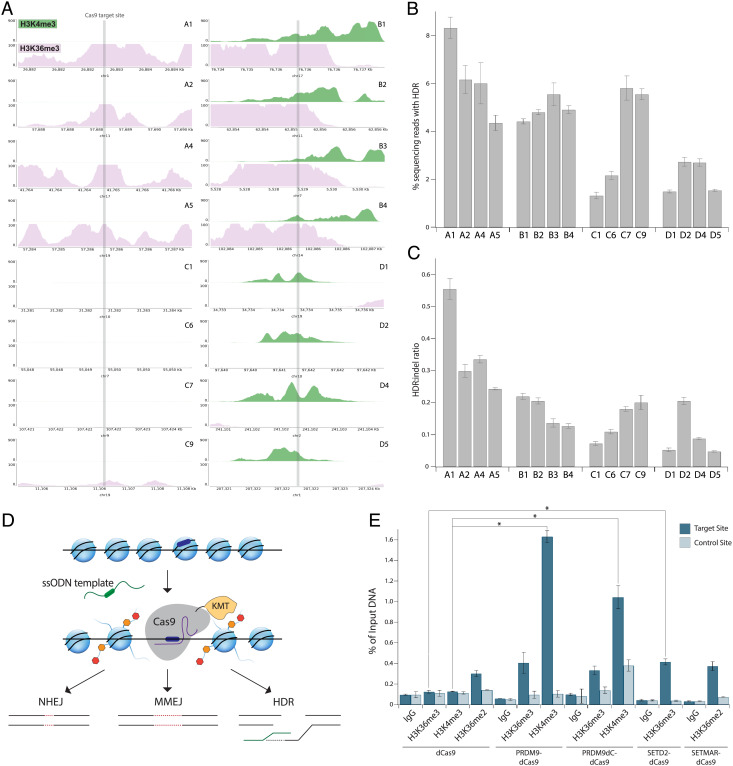
Fig. 1.
Fig. 1.
Endogenous histone modifications mediate DNA repair pathway choice. (A) University of California, Santa Cruz Genome Browser tracks showing normalized endogenous levels of H3K4me3 (green) and H3K36me3 (pink) at target site ± 1.5 kb based on ENCODE ChIP-seq datasets from HEK293 cells. Each plot spans 3 kb, and the Y-axis reports the negative log P value for peak enrichment. (B) HDR frequency measured by NGS at genomic sites with varying endogenous H3K4me3 and H3K36me3 enrichment in HEK293T cells transfected with plasmids expressing Cas9 and sgRNA along with an ssODN template with 50-nt homology arms. Data represent mean ± SD (n = 3). (C) HDR:indel ratio measured by NGS at genomic sites with varying endogenous H3K4me3 and H3K36me3 enrichment in HEK293T cells transfected with plasmids expressing Cas9 and sgRNA along with an ssODN template with 50-nt homology arms. Data represent mean ± SD (n = 3). (D) Schematic of Cas9-histone lysine methyltransferase (KMT) fusion protein activity. Cas9 fusion protein is guided by an sgRNA (purple) to the DNA target site (dark blue), which may be embedded within a heterochromatic region. Cas9 fusion protein deposits histone marks (orange and red) at the target site, which influence the choice of DNA repair pathway following Cas9-induced DSBs. (E) H3K36me3, H3K4me3, and H3K36me2 enrichment shown as a percentage of input DNA measured by ChIP-qPCR at site C7 in HEK293T cells 3 dpt. Cells were transfected with plasmids expressing the dCas9 fusion proteins and sgRNA. Data represent mean ± SD (n = 2). *P < 0.05, determined by Student’s two-tailed t test.
Fig. 2.
Fig. 2.
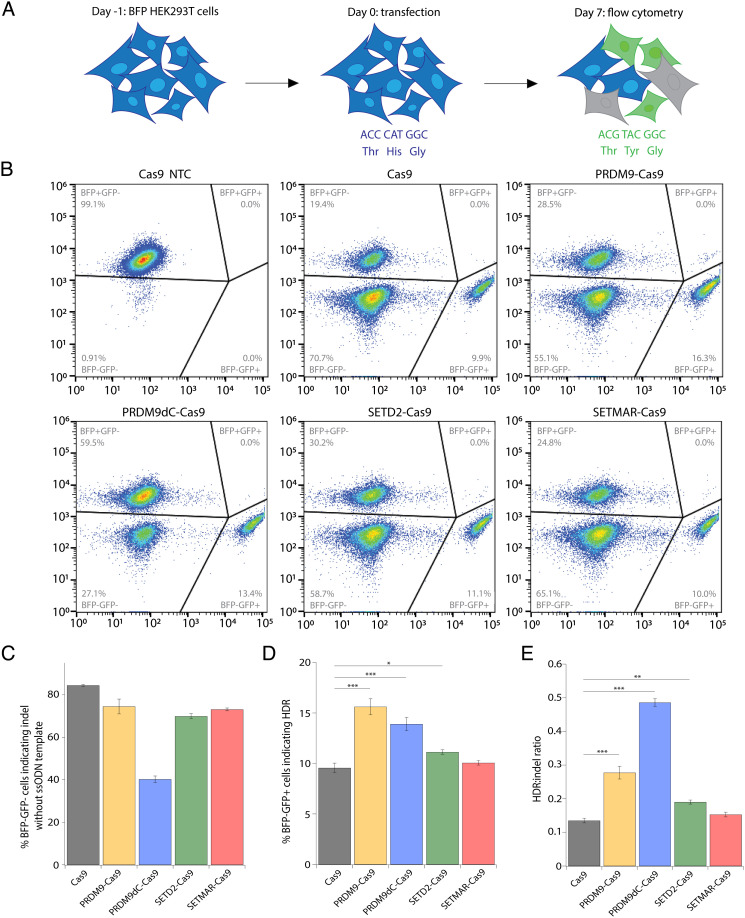
Engineered CRISPR-Cas9-methyltransferase fusion proteins produce higher HDR and HDR:indel ratios relative to Cas9. (A) Schematic of BFP-to-GFP reporter assay. In brief, BFP+/GFP HEK293T cells can be converted to BFP/GFP+ cells via HDR or to BFP/GFP via indel formation. Flow cytometry was performed 7 dpt. (B) Flow cytometry plots for BFP-to-GFP reporter cells showing frequency of HDR (BFP/GFP+) and indel (BFP/GFP). Cells were transfected with plasmids expressing the fusion proteins and sgRNA along with an ssODN template with a 91-nt homology arm on the PAM-proximal side of the DSB and a 36-nt homology arm on the PAM-distal side. A nontargeting negative control (NTC) sgRNA was included. Representative plots are shown for one biological replicate. (C) Editing activity of Cas9-methyltransferase fusion proteins measured by flow cytometry in BFP-to-GFP reporter cells transfected with plasmids encoding fusion protein and sgRNA without an ssODN template. (D) HDR frequency measured by flow cytometry in BFP-to-GFP reporter cells transfected with plasmids encoding fusion protein and sgRNA along with an ssODN template. (E) HDR:indel ratio measured by flow cytometry in BFP-to-GFP reporter cells transfected with plasmids encoding fusion protein and sgRNA along with an ssODN template. For CE, data represent mean ± SD (n = 4). *P < 0.05, **P < 0.01, and ***P < 0.001, determined by Student’s two-tailed t test.
Fig. 3.
Fig. 3.
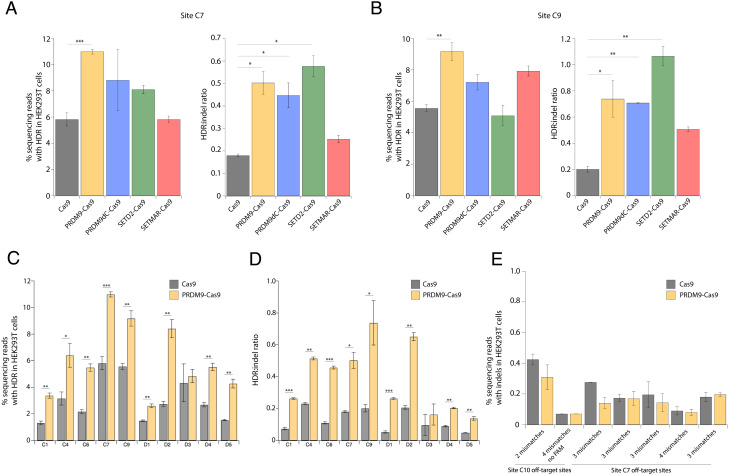
PRDM9-Cas9 fusion protein displays increased HDR efficiency and HDR:indel ratio across multiple genomic sites. (A) HDR frequency and HDR:indel ratio measured by NGS at site C7 (intergenic) in HEK293T cells transfected with plasmids expressing fusion protein and sgRNA along with an ssODN template with 50-nt homology arms. (B) HDR frequency and HDR:indel ratio measured by NGS at site C9 (exon 5 of LDLR) in HEK293T cells transfected with fusion protein and sgRNA along with an ssODN template with 50-nt homology arms. (C) HDR frequency measured by NGS at 10 genomic loci in HEK293T cells transfected with PRDM9-Cas9 and sgRNA with an ssODN template. (D) HDR:indel ratio measured by NGS at 10 genomic loci in HEK293T cells transfected with PRDM9-Cas9 and sgRNA with an ssODN template. (E) Off-target activity of PRDM9-Cas9 measured by NGS at seven potential off-target sites predicted from two sgRNAs. For AE, data represent mean ± SD (n = 3). *P < 0.05, **P < 0.01, and ***P < 0.001, determined by Student’s two-tailed t test.
Fig. 4.
Fig. 4.
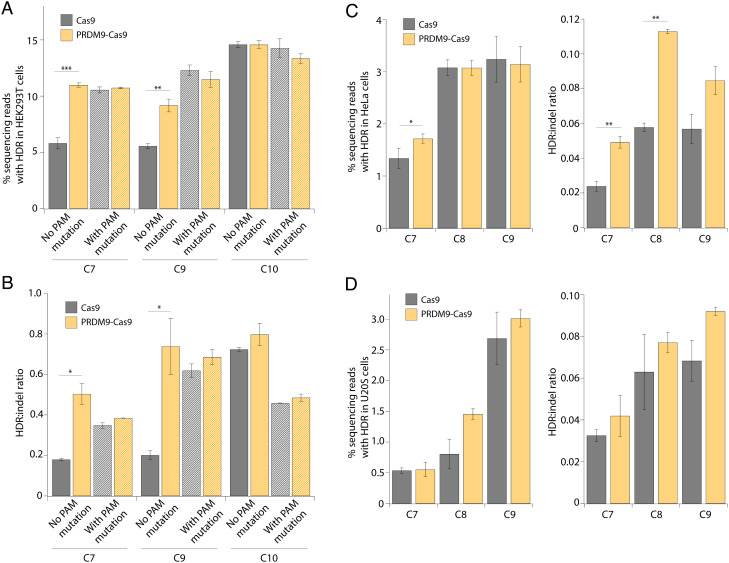
PRDM9-Cas9 fusion protein produces increased HDR:indel ratios in different cell types. (A) HDR frequency measured by NGS at multiple genomic loci (C7, C9, and C10) in HEK293T cells transfected with PRDM9-Cas9 and sgRNA with ssODN templates that either include (hash pattern) or lack (solid pattern) a mutation at the PAM site. (B) HDR:indel ratio measured by NGS at multiple genomic loci (C7, C9, and C10) in HEK293T cells transfected with PRDM9-Cas9 and sgRNA with ssODN templates that either include (hash pattern) or lack (solid pattern) a mutation at the PAM site. (C) HDR frequency and HDR:indel ratio measured by NGS at multiple genomic loci (C7–C9) in HeLa cells transfected with PRDM9-Cas9 and sgRNA with an ssODN template. (D) HDR frequency and HDR:indel ratio measured by NGS at multiple genomic loci (C7–C9) in U2OS cells transfected with PRDM9-Cas9 and sgRNA with an ssODN template. For AD, data represent mean ± SD (n = 3). *P < 0.05, **P < 0.01, and ***P < 0.001, determined by Student’s two-tailed t test.

References

    1. Jinek M., et al. , A programmable dual-RNA-guided DNA endonuclease in adaptive bacterial immunity. Science 337, 816–821 (2012). - PMC - PubMed
    1. Jinek M., et al. , RNA-programmed genome editing in human cells. elife 2, e00471 (2013). - PMC - PubMed
    1. Mali P., et al. , RNA-guided human genome engineering via Cas9. Science 339, 823–826 (2013). - PMC - PubMed
    1. Cong L., et al. , Multiplex genome engineering using CRISPR/Cas systems. Science 339, 819–823 (2013). - PMC - PubMed
    1. Chapman J. R., Taylor M. R. G., Boulton S. J., Playing the end game: DNA double-strand break repair pathway choice. Mol. Cell 47, 497–510 (2012). - PubMed

Publication types