


Vitamin K supplementation and bone mineral density in dialysis: results of the double-blind, randomized, placebo-controlled RenaKvit trial
- PMID: 36460034
- PMCID: PMC10539208
- DOI: 10.1093/ndt/gfac315
Vitamin K supplementation and bone mineral density in dialysis: results of the double-blind, randomized, placebo-controlled RenaKvit trial
Abstract
Background: Vitamin K deficiency is highly prevalent in patients on dialysis and may contribute to their low bone mineral density (BMD) and increased risk of fracture. This study investigated the effect of menaquinone-7 (MK-7) supplementation on BMD in patients on chronic dialysis.
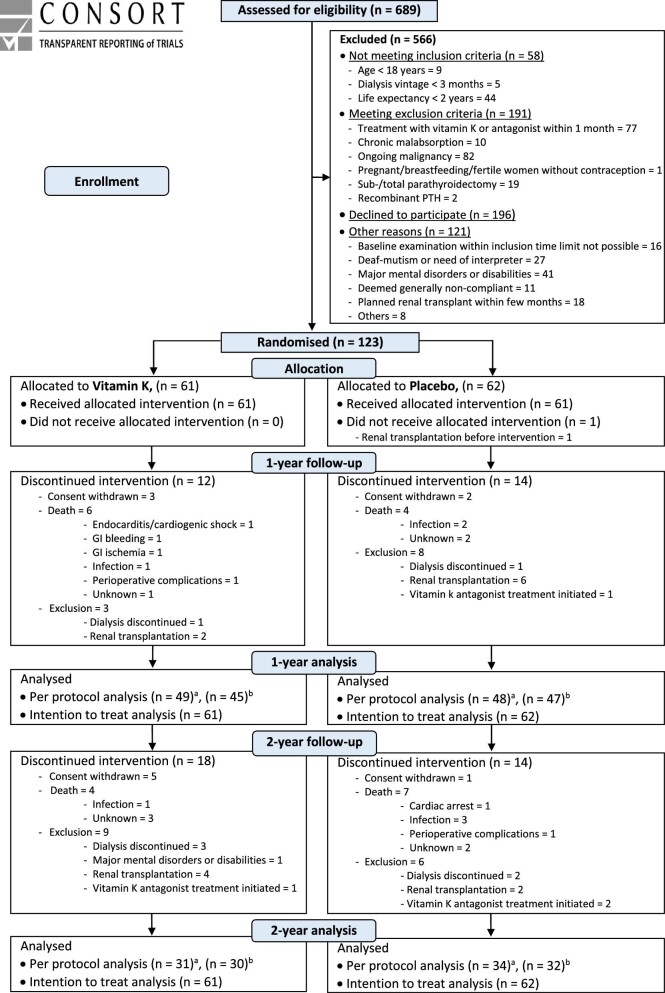
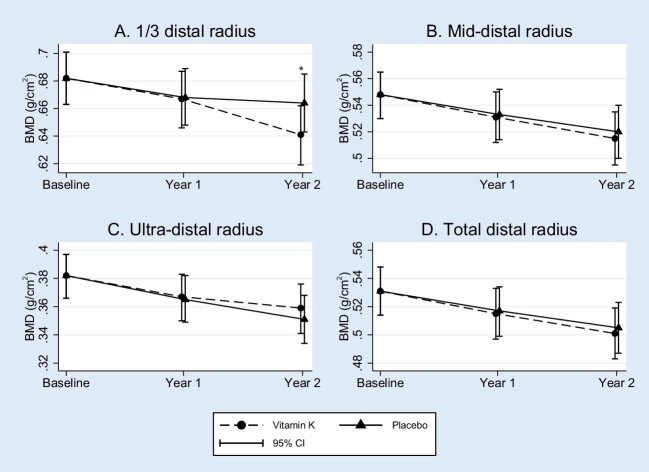
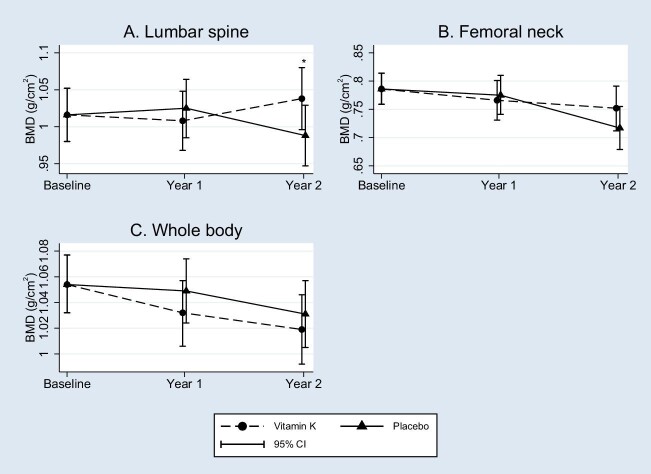
Methods: In a multicentre, double-blind, placebo-controlled intervention trial, 123 patients on chronic dialysis were randomised to a daily oral supplement of either MK-7 360 µg or placebo for 2 years. BMD of the distal radius (1/3, mid, ultradistal and total), femoral neck, lumbar spine (L1-L4) and whole body was assessed by dual-energy X-ray absorptiometry. Serum levels of vitamin K1 and MK-7 and plasma levels of total osteocalcin, dephosphorylated-uncarboxylated matrix Gla protein and protein induced by vitamin K absence II were measured to assess vitamin K status.
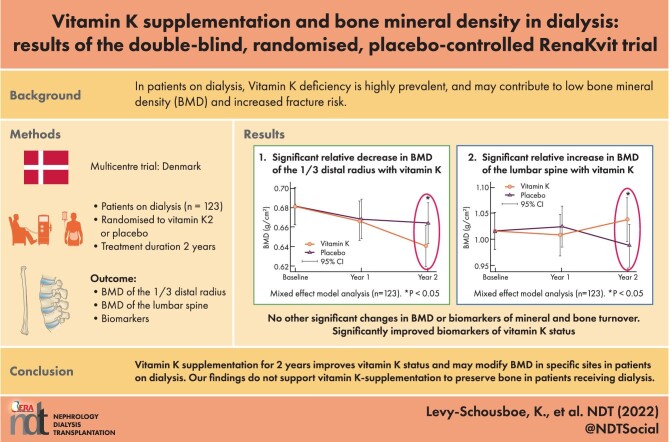
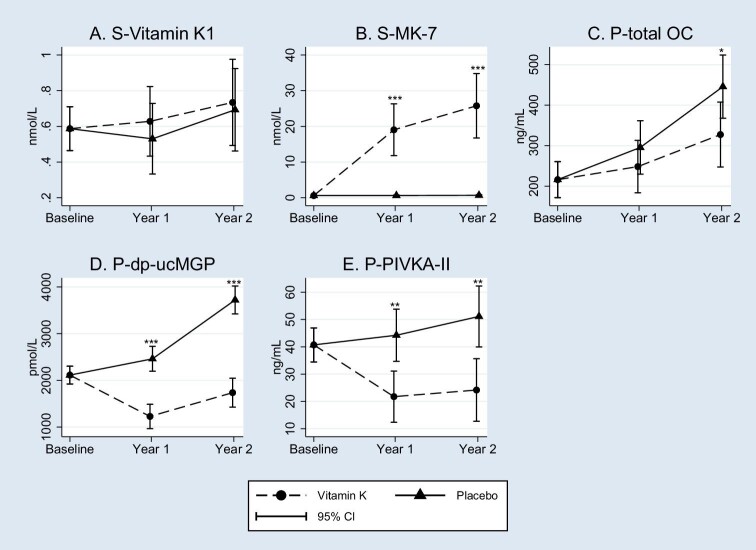
Results: After 2 years, an accelerated BMD loss of the 1/3 distal radius was found with MK-7 supplementation {mean difference of changes relative to placebo -0.023 g/cm2 [95% confidence interval (CI) -0.039 to -0.008]}, whereas the decrease in lumbar spine BMD seen in the placebo group was prevented [mean difference of changes between groups 0.050 g/cm2 (95% CI 0.015-0.085)]. No significant effects were observed at the remaining skeletal sites. Vitamin K status strongly improved in MK-7-supplemented participants.
Conclusion: Compared with placebo, an accelerated BMD loss of the 1/3 distal radius was found after 2 years of MK-7 supplementation, whereas a decline in lumbar spine BMD was prevented. As such, MK-7 supplementation might modify BMD site-specifically in patients on dialysis. In aggregate, our findings do not support MK-7 supplementation to preserve bone in patients on dialysis.
Keywords: bone mineral density; chronic kidney disease; end-stage kidney disease; menaquinone-7; mineral and bone disorder.
© The Author(s) 2022. Published by Oxford University Press on behalf of the ERA.
Conflict of interest statement
K.L.-S.’s salary was partially funded by Kappa Bioscience AS, the Danish Society of Nephrology and the Karen Elise Jensen Foundation during the RenaKvit trial. M.F.H. has received a research grant from Orkla Care AS. B.L. has received research grants from Amgen and honoraria for academic services from Amgen, UCB, Gilead, Astellas, AstraZeneca and Gedeon-Richter, unrelated to the RenaKvit trial. The remaining authors have nothing to declare.
Figures
Comment in
-
Efficacy of vitamin K on bone fragility: puzzling findings from which we should learn how to design a rigorous study.Nephrol Dial Transplant. 2023 Sep 29;38(10):2105-2108. doi: 10.1093/ndt/gfad117. Nephrol Dial Transplant. 2023. PMID: 37279891 Free PMC article. No abstract available.
References
-
- Moe S, Drüeke T, Cunningham Jet al. . Definition, evaluation, and classification of renal osteodystrophy: a position statement from Kidney Disease: Improving Global Outcomes (KDIGO). Kidney Int 2006;69:1945–53. - PubMed
-
- Hansen D, Olesen JB, Gislason GHet al. . Risk of fracture in adults on renal replacement therapy: a Danish national cohort study. Nephrol Dial Transplant 2016;31:1654–62. - PubMed
-
- Leonard MB, Wehrli FW, Ziolkowski SLet al. . A multi-imaging modality study of bone density, bone structure and the muscle - bone unit in end-stage renal disease. Bone 2019;127:271–9. - PubMed
-
- Iimori S, Mori Y, Akita Wet al. . Diagnostic usefulness of bone mineral density and biochemical markers of bone turnover in predicting fracture in CKD stage 5D patients—a single-center cohort study. Nephrol Dial Transplant 2012;27:345–51. - PubMed
Publication types
MeSH terms
Substances
LinkOut - more resources
Full Text Sources
Medical
Research Materials
