. 2023 Jan:222:173499.
doi: 10.1016/j.pbb.2022.173499. Epub 2022 Dec 1.

iTat transgenic mice exhibit hyper-locomotion in the behavioral pattern monitor after chronic exposure to methamphetamine but are unaffected by Tat expression

Affiliations

iTat transgenic mice exhibit hyper-locomotion in the behavioral pattern monitor after chronic exposure to methamphetamine but are unaffected by Tat expression

Samantha Ayoub et al. Pharmacol Biochem Behav. 2023 Jan.

Abstract

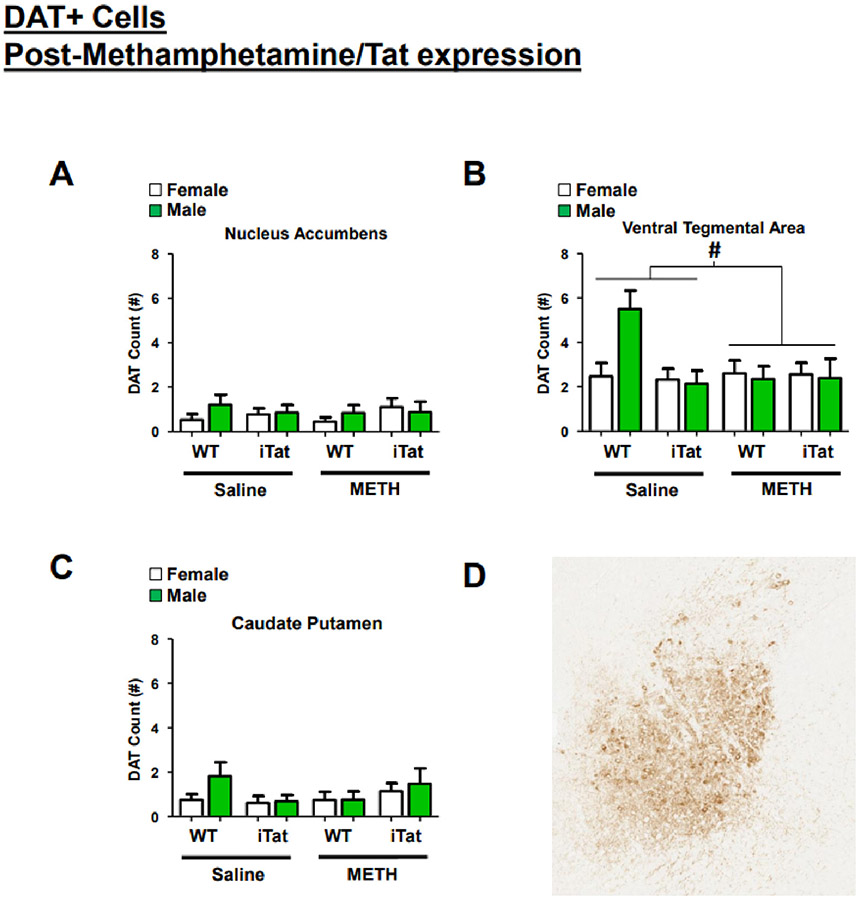
Although antiretroviral therapy (ART) has increased the quality of life and lifespan in people living with HIV (PWH), millions continue to suffer from the neurobehavioral effects of the virus. Additionally, the abuse of illicit drugs (methamphetamine in particular) is significantly higher in PWH compared to the general population, which may further impact their neurological functions. The HIV regulatory protein, Tat, has been implicated in the neurobehavioral impacts of HIV and is purported to inhibit dopamine transporter (DAT) function in a way similar to methamphetamine. Thus, we hypothesized that a combination of Tat expression and methamphetamine would exert synergistic deleterious effects on behavior and DAT expression. We examined the impact of chronic methamphetamine exposure on exploration in transgenic mice expressing human Tat (iTat) vs. their wildtype littermates using the behavioral pattern monitor (BPM). During baseline, mice exhibited sex-dependent differences in BPM behavior, which persisted through methamphetamine exposure, and Tat activation with doxycycline. We observed a main effect of methamphetamine, wherein exposure, irrespective of genotype, increased locomotor activity and decreased specific exploration. After doxycycline treatment, mice continued to exhibit drug-dependent alterations in locomotion, with no effect of Tat, or methamphetamine interactions. DAT levels were higher in wildtype, saline-exposed males compared to all other groups. These data support stimulant-induced changes of locomotor activity and exploration, and suggest that viral Tat and methamphetamine do not synergistically interact to alter these behaviors in mice. These findings are important for future studies attempting to disentangle the effect of substances that impact DAT on HAND-relevant behaviors using such transgenic animals.

Keywords: Behavioral pattern monitor; Dopamine; Exploration; Mouse; Movement; iTAT HIV model.


Figures

Fig. 1.
Fig. 1.
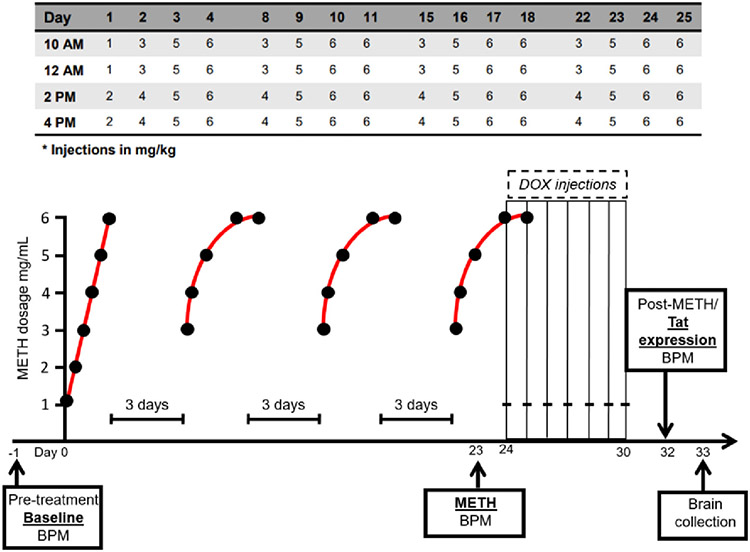
Experimental timeline. Mice were assessed on the behavior pattern monitor (BPM) prior to any exposure to either methamphetamine (METH) or doxycycline (DOX)-induced Tat expression to establish a behavioral baseline. When the METH exposure regimen began, mice were treated with a low dose (1 mg/ml) and slowly increased to a higher dose (6 mg/ml). After the first four-day block of injections, injections began with a mid-range dose (3 mg/mL) and ended with the highest dose (6 mg/ml). Mice were treated four days in a row at four different time points (1000, 1200, 1400, 1600 h) separated by a three-day period without injections. The four-day block of injection occurred four separate times and the entire regimen lasted 25 days. Mice were further assessed on the BPM near the end of the METH regimen (day 23) and on Day 32 (2 days after the end of DOX injections and 7 days following METH exposure).
Fig. 2.
Fig. 2.
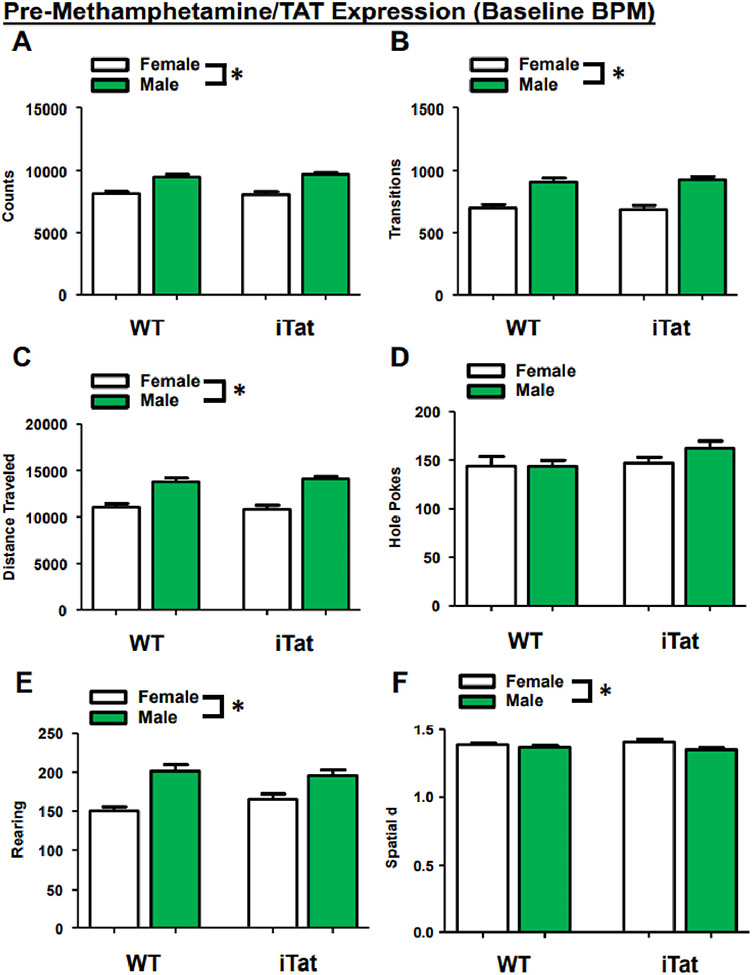
Sex determines baseline BPM activity, regardless of Tat promotor transgene expression. Compared to female mice, male mice exhibit higher total behavioral activity (A), transitions (B), and travel distance (C). Mice have similar holepoking behavior regardless of sex (D). While male mice exhibit higher rearing behavior (F), female mice have higher spatial d (F). Data presented as mean ± SEM. * = p < 0.05.
Fig. 3.
Fig. 3.
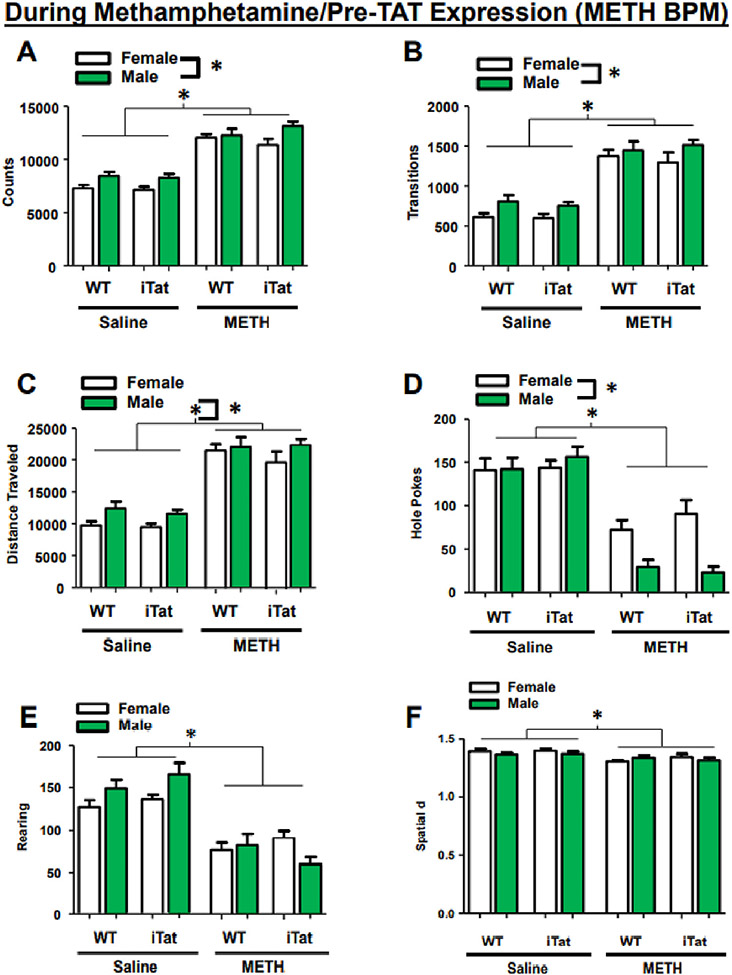
Previous exposure to METH alters activity in the BPM. Mice previously exposed to METH exhibited higher total behavioral activity (A), transitions (B), and travel distance (C), with all males showing higher scores compared to females across all groups. METH exposure also reduced holepoking behavior (D), rearing (E), and spatial d (F). Holepoking behavior showed a sex × drug interaction, with male mice performing significantly lower than female mice (D). Data presented as mean ± SEM. * = p < 0.05.
Fig. 4.
Fig. 4.
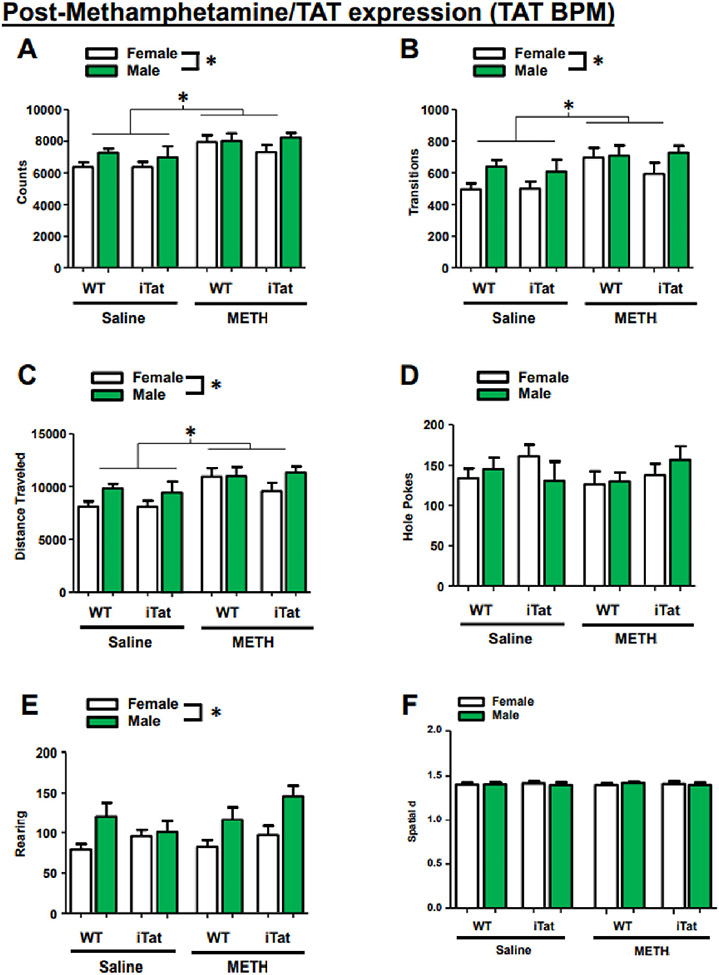
Movement in the BPM remains elevated long after METH exposure, but performance is unaltered by Tat expression. Five days after the end of the METH exposure regimen, METH-treated mice (and males across all groups) continue to display elevated total behavioral counts (A), transitions (B), and travel distance (C). METH treatment and Tat expression do not appear to affect holepokes (D), rearing (E), or spatial d (F). However, males across all groups exhibit higher rearing behavior than females (E). Data presented as mean ± SEM. * = p < 0.05.
Fig. 5.
Fig. 5.
DAT expression is slightly altered in the ventral tegmental area. After the third and final BPM assessment, mice were sacrificed and brain were taken for immunostaining to determine the effects of METH exposure and Tat expression on the dopamine transporter (DAT). No effects were seen on DAT expression in the nucleus accumbens (A). In the ventral tegmental area, saline-treated mice tended to have higher DAT expression, driven mainly by WT, male mice (B). Neither sex, METH exposure, nor Tat expression altered DAT expression in the caudate putamen (C). A representative image of immunohistochemistry for DAT (brown) on a paraffin embedded mouse brain, sagittal section, ventral tegmental area. Original magnification 5×; no counterstaining (D). Data presented as mean ± SEM. # = p < 0.1.

References

    1. Appadoo CN, Sambo D, Alonge T, Harvey B, Khoshbouei H, 2017. The dual effect of HIV-1 Tat and methamphetamine on dopamine transporter function. FASEB J 31 (S1), 610–662. 10.1096/fasebj.31.1_supplement.662.10. - DOI
    1. Baek EJ, Kim H, Basova LA, Rosander A, Kesby JP, Semenova S, Marcondes MCG, 2020. Sex differences and tat expression affect dopaminergic receptor expression and response to antioxidant treatment in methamphetamine-sensitized HIV tat transgenic mice. Neuropharmacology 178, 108245. 10.1016/j.neuropharm.2020.108245. - DOI - PMC - PubMed

    1. Berger JR, Kumar M, Kumar A, Fernandez JB, Levin B, 1994. Cerebrospinal fluid dopamine in HIV-1 infection. AIDS 8 (1), 67–71. 10.1097/00002030-199401000-00010. - DOI - PubMed
    1. Brown JM, Riddle EL, Sandoval V, Weston RK, Hanson JE, Crosby MJ, Ugarte YV, Gibb JW, Hanson GR, Fleckenstein AE, 2002. A single methamphetamine administration rapidly decreases vesicular dopamine uptake. J. Pharmacol. Exp. Ther 302 (2), 497–501. 10.1124/jpet.302.2.497. - DOI - PubMed
    1. Camp DM, Browman KE, Robinson TE, 1994. The effects of methamphetamine and cocaine on motor behavior and extracellular dopamine in the ventral striatum of Lewis versus fischer 344 rats. Brain Res. 668 (1–2), 180–193. 10.1016/0006-8993(94)90523-1. - DOI - PubMed

Publication types

Substances