


Viability of SARS-CoV-2 on lettuce, chicken, and salmon and its inactivation by peracetic acid, ethanol, and chlorine dioxide
- PMID: 36462820
- PMCID: PMC9560751
- DOI: 10.1016/j.fm.2022.104164
Viability of SARS-CoV-2 on lettuce, chicken, and salmon and its inactivation by peracetic acid, ethanol, and chlorine dioxide
Abstract
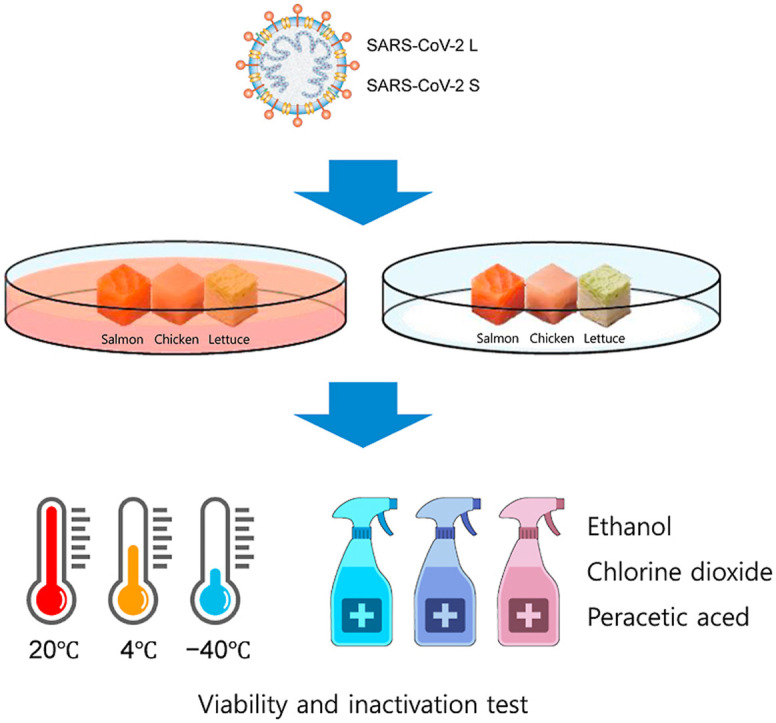
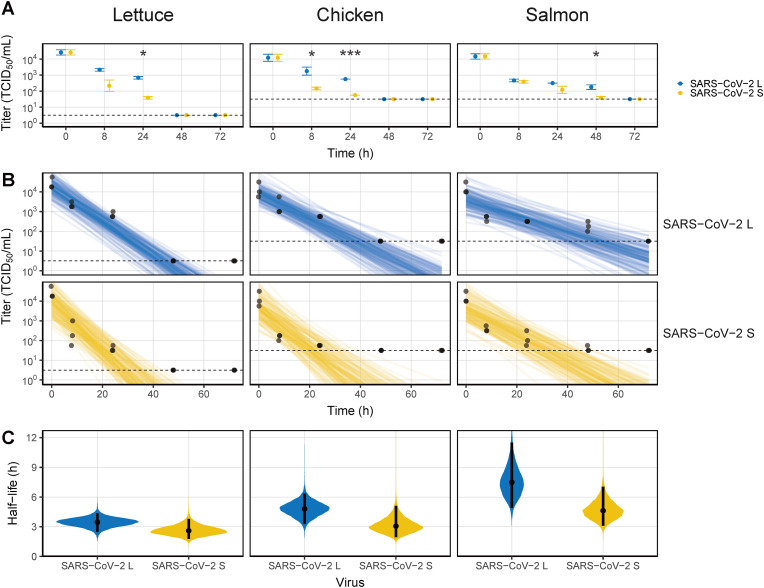
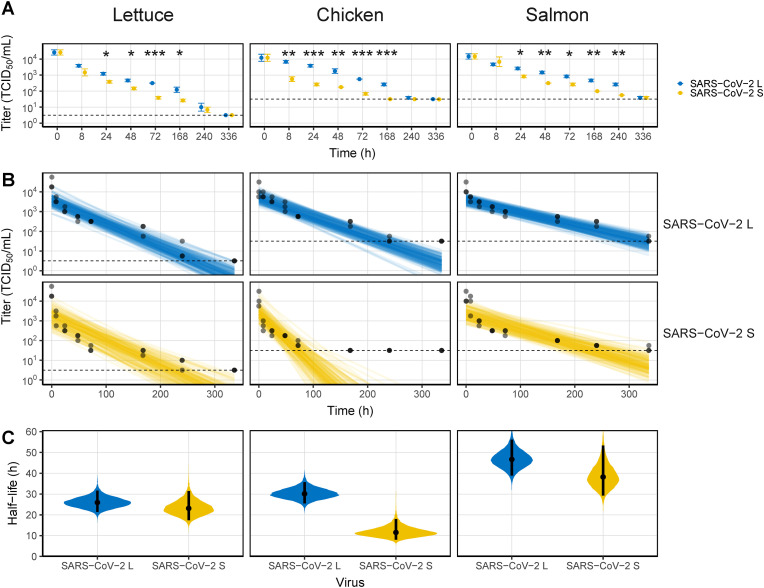
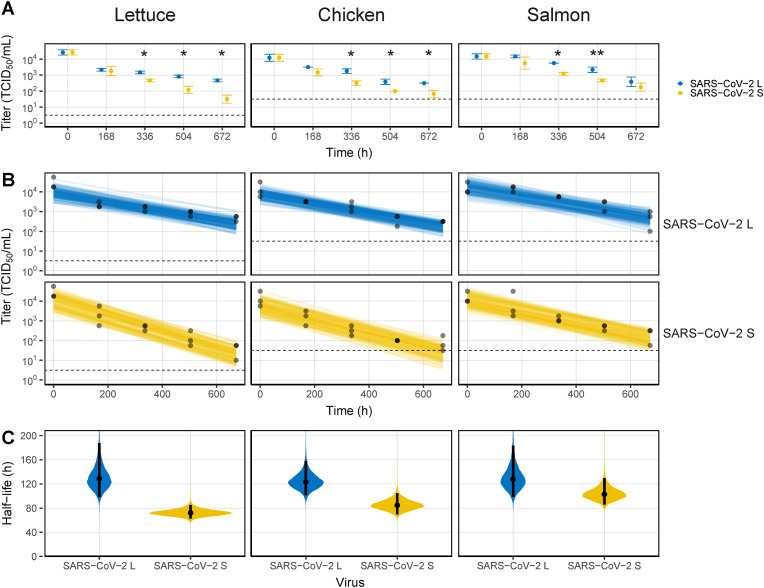
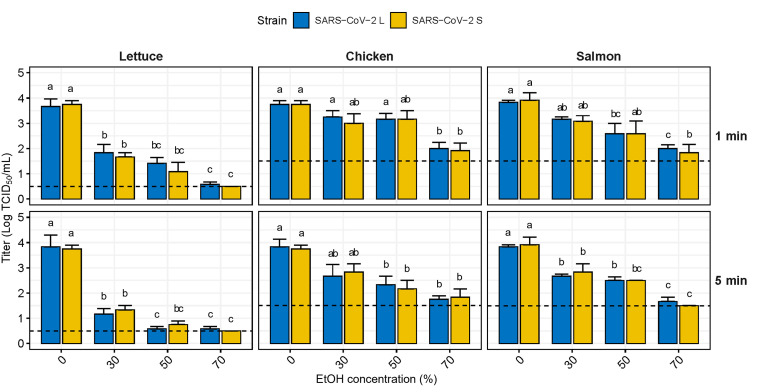
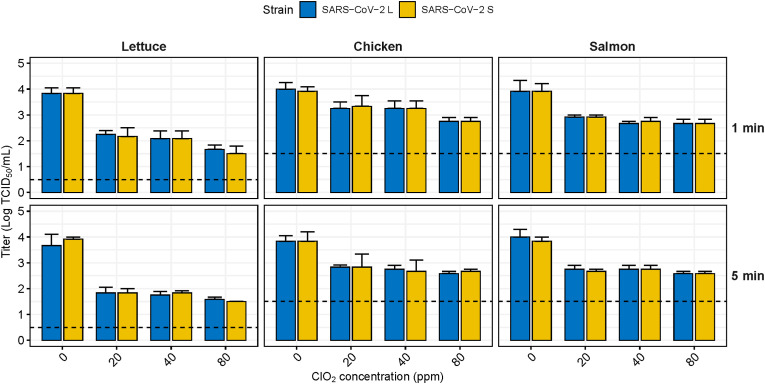
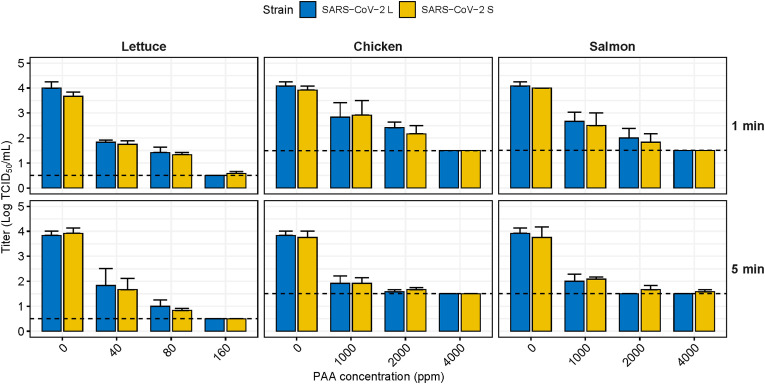
Since the first SARS-CoV-2 outbreak in Wuhan, China, there has been continued concern over the link between SARS-CoV-2 transmission and food. However, there are few studies on the viability and removal of SARS-CoV-2 contaminating food. This study aimed to evaluate the viability of SARS-CoV-2 on food matrices, depending on storage temperature, and inactivate the virus contaminating food using disinfectants. Two SARS-CoV-2 strains (L and S types) were used to contaminate lettuce, chicken, and salmon, which were then stored at 20,4 and -40 °C. The half-life of SARS-CoV-2 at 20 °C was 3-7 h but increased to 24-46 h at 4 °C and exceeded 100 h at -40 °C. SARS-CoV-2 persisted longer on chicken or salmon than on lettuce. Treatment with 70% ethanol for 1 min inactivated 3.25 log reduction of SARS-CoV-2 inoculated on lettuce but not on chicken and salmon. ClO2 inactivated up to 2 log reduction of SARS-CoV-2 on foods. Peracetic acid was able to eliminate SARS-CoV-2 from all foods. The virucidal effect of all disinfectants used in this study did not differ between the two SARS-CoV-2 strains; therefore, they could also be effective against other SARS-CoV-2 variants. This study demonstrated that the viability of SARS-CoV-2 can be extended at 4 and -40 °C and peracetic acid can inactivate SARS-CoV-2 on food matrices.
Keywords: Beef; Chlorine dioxide; Ethanol; Lettuce; Peracetic acid; SARS-CoV-2; Salmon; Viability.
Copyright © 2022 Elsevier Ltd. All rights reserved.
Conflict of interest statement
Declaration of competing interest The authors declare that they have no known competing financial interests or personal relationships that could have appeared to influence the work reported in this paper.
Figures
References
-
- Aieta E.M., Berg J.D. A review of chlorine dioxide in drinking water treatment. J. Am. WATER Work. Assoc. 1986;78:62–72.
-
- Assiri A., Al-Tawfiq J.A., Al-Rabeeah A.A., Al-Rabiah F.A., Al-Hajjar S., Al-Barrak A., Flemban H., Al-Nassir W.N., Balkhy H.H., Al-Hakeem R.F. Epidemiological, demographic, and clinical characteristics of 47 cases of Middle East respiratory syndrome coronavirus disease from Saudi Arabia: a descriptive study. Lancet Infect. Dis. 2013;13:752–761. - PMC - PubMed
-
- FDA . 2017. Environmental Assessment for Food Contact Notification FCN 1867.https://www.fda.gov/media/114385/download Accessed 16 March 2022.
MeSH terms
Substances
Supplementary concepts
LinkOut - more resources
Full Text Sources
Medical
Miscellaneous
