. 2023 Jan 17;122(2):433-441.
doi: 10.1016/j.bpj.2022.11.2947. Epub 2022 Dec 5.

Learning continuous potentials from smFRET

Affiliations

Learning continuous potentials from smFRET

J Shepard Bryan 4th et al. Biophys J. .

Abstract

Potential energy landscapes are useful models in describing events such as protein folding and binding. While single-molecule fluorescence resonance energy transfer (smFRET) experiments encode information on continuous potentials for the system probed, including rarely visited barriers between putative potential minima, this information is rarely decoded from the data. This is because existing analysis methods often model smFRET output assuming, from the onset, that the system probed evolves in a discretized state space to be analyzed within a hidden Markov model (HMM) paradigm. By contrast, here, we infer continuous potentials from smFRET data without discretely approximating the state space. We do so by operating within a Bayesian nonparametric paradigm by placing priors on the family of all possible potential curves. As our inference accounts for a number of required experimental features raising computational cost (such as incorporating discrete photon shot noise), the framework leverages a structured-kernel-interpolation Gaussian process prior to help curtail computational cost. We show that our structured-kernel-interpolation priors for potential energy reconstruction from smFRET analysis accurately infers the potential energy landscape from a smFRET binding experiment. We then illustrate advantages of structured-kernel-interpolation priors for potential energy reconstruction from smFRET over standard HMM approaches by providing information, such as barrier heights and friction coefficients, that is otherwise inaccessible to HMMs.


Conflict of interest statement

Declaration of interests The authors declare no competing interests.

Figures
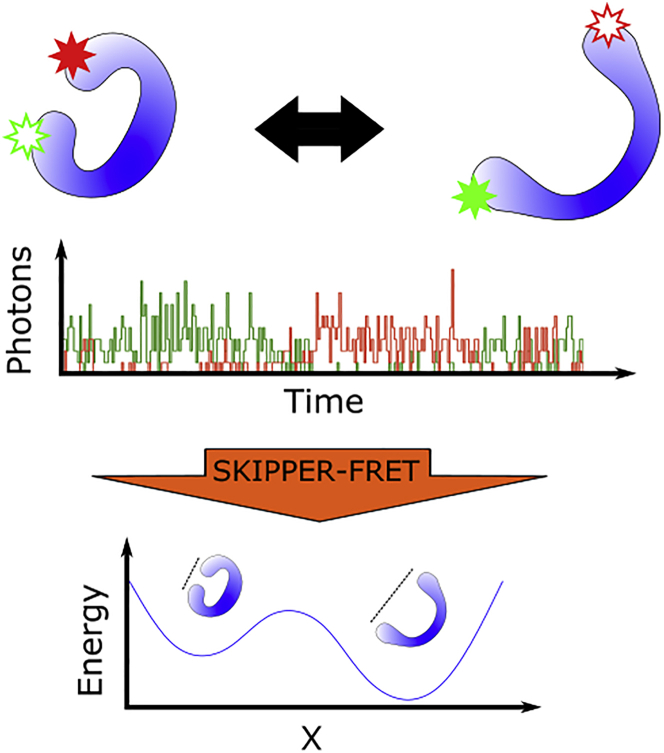
Figure 1
Figure 1
Cartoon description of SKIPPER-FRET. At the top, we see a protein switching between two conformations over time. The protein is labeled with donor and acceptor fluorophores. As the protein changes configuration, the FRET efficiency between the fluorophores also changes. In the middle panel, we illustrate a typical trace containing the number of red and green photons over time. In the bottom panel, we show the outcome of SKIPPER-FRET analysis used to infer the potential energy landscape along the reaction coordinate probed. To see this figure in color, go online.
Figure 2
Figure 2
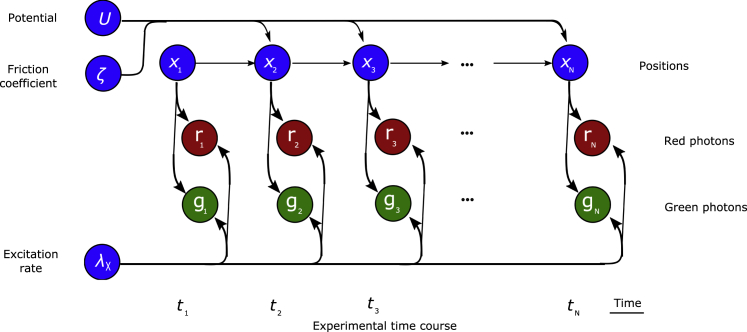
Graphical description of the model. Nodes (circles) represent random variables of our model, while arrows connecting the nodes highlight conditional dependency. Blue nodes represent variables we wish to learn in our inference scheme, and the red and green nodes represent the measured photon counts for each bin. To see this figure in color, go online.
Figure 3
Figure 3
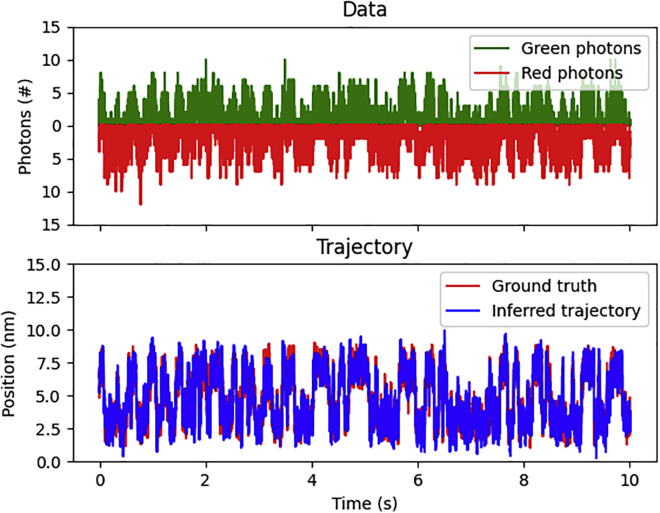
Demonstration on simulated data. Here, we demonstrate our method on simulated data. The top shows the raw data from the experiment including red and green photon counts binned every millisecond. The bottom shows the inferred pair distance trajectory (blue) with the ground-truth pair distance trajectory (red). To see this figure in color, go online.
Figure 4
Figure 4
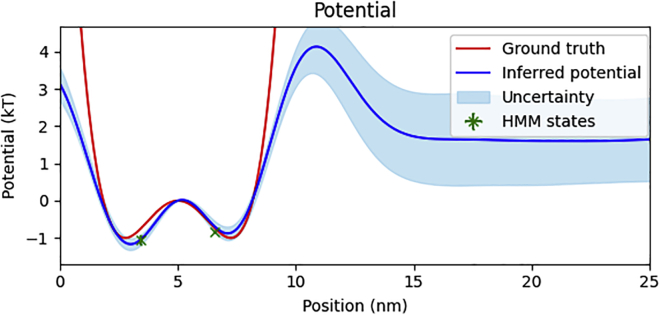
Simulated potential energy landscape. We show our inferred potential energy landscape (blue) with uncertainty (light blue) against the ground-truth potential energy landscape used in the simulation (red). We additionally plot markers, with uncertainty, indicating the inferred state energy and pair distance using the HMM method (green). The common point of zero potential energy was set at the top of the barrier at 5 nm. To see this figure in color, go online.
Figure 5
Figure 5
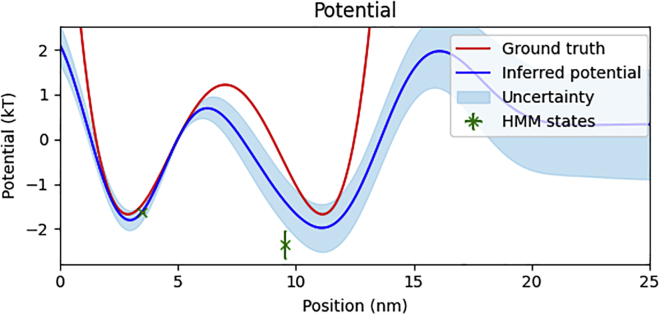
Simulated potential energy landscape when one barrier is far from the characteristic FRET distance. Here, we analyze data simulated using an energy landscape in which one of the wells is outside of the characteristic FRET range. We compare our inferred potential energy landscape with the potential energy landscape inferred using the Bayesian HMM as well as the ground truth. We show our inferred potential energy landscape (blue) with uncertainty (light blue) against the ground-truth potential energy landscape used in the simulation (red). We additionally plot markers, with uncertainty, indicating the inferred state energy and pair distance using the HMM method (green). The common point of zero potential energy was set at the bottom of the leftmost well at 2.87 nm. To see this figure in color, go online.
Figure 6
Figure 6
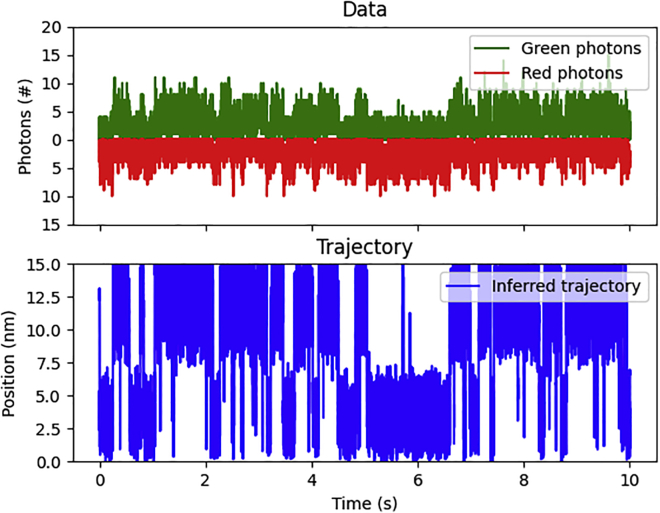
Demonstration on NCBD-ACTR. Here, we demonstrate our method on data probing the energy landscape of NCBD-ACTR binding. (Top) shows the raw data from the experiment including red and green photon counts. (Bottom) shows the inferred pair distance trajectory (blue). To see this figure in color, go online.
Figure 7
Figure 7
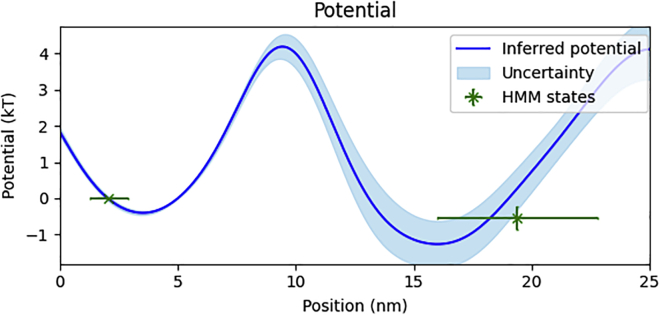
NCBD-ACTR potential energy landscape. Here, we compare our inferred potential energy landscape with the relative potential energy landscape inferred using standard HMM methods. We show our inferred potential energy landscape (blue) with uncertainty (light blue). We additionally plot markers, with uncertainty, indicating the inferred state energy and pair distance using the HMM method (green). To see this figure in color, go online.

References

    1. Phillips R., Kondev J., et al. Garcia H. Garland Science; 2012. Physical Biology of the Cell.
    1. Schuler B., Lipman E.A., Eaton W.A. Probing the free-energy surface for protein folding with single-molecule fluorescence spectroscopy. Nature. 2002;419:743–747. - PubMed
    1. Yan Z., Wang J. Funneled energy landscape unifies principles of protein binding and evolution. Proc. Natl. Acad. Sci. USA. 2020;117:27218–27223. - PMC - PubMed
    1. Weistuch C., Pressé S. Spatiotemporal organization of catalysts driven by enhanced diffusion. J. Phys. Chem. B. 2018;122:5286–5290. - PubMed
    1. Makarov D.E. Barrier crossing dynamics from single-molecule measurements. J. Phys. Chem. B. 2021;125:2467–2476. - PubMed

Publication types

MeSH terms