


Potential biomarkers of atopic dermatitis
- PMID: 36465933
- PMCID: PMC9712451
- DOI: 10.3389/fmed.2022.1028694
Potential biomarkers of atopic dermatitis
Abstract
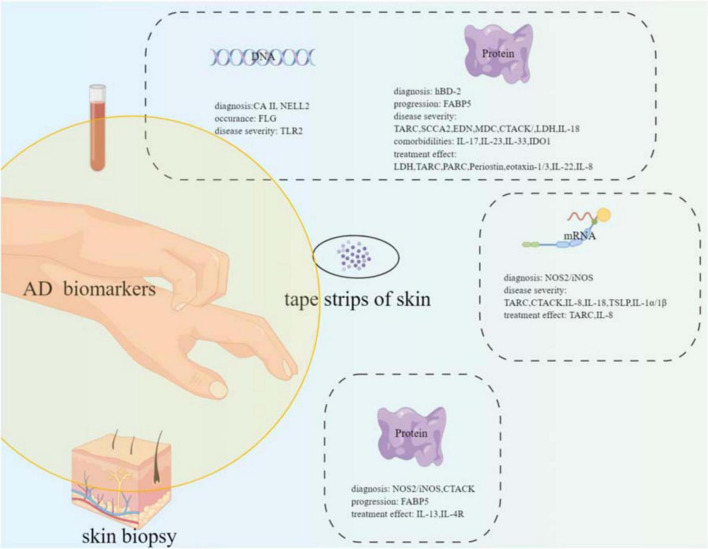
Atopic dermatitis (AD) is a chronic, recurrent inflammatory skin disease with a wide range of heterogeneity. Accurate biomarkers or predictors are the keys to instructing personalized tailored precise treatment. The development of technology such as transcriptomics, genomics, and proteomics provides novel insights into the possibility to find potential biomarkers. Meanwhile, emerging minimally invasive methods such as tape stripping were used to reveal different profiles of patients' skin without biopsy. Several potential biomarkers or predictors have been found. In this review, we summarized the current development of potential biomarkers of AD. Nitric oxide synthase 2/inducible nitric oxide synthase (NOS2/iNOS), human beta-defensin-2 (hBD-2), and matrix metalloproteinases 8/9 (MMP8/9) may be the candidate biomarkers for AD diagnosis. Filaggrin (FLG) gene mutation increased the occurrence risk of AD. Fatty-acid-binding protein 5 (FABP5) may serve as an effective biomarker for the atopic march (AM). Squamous cell carcinoma antigen 2 (SCCA2), serum thymus and activation-regulated chemokine (TARC), cutaneous T-cell-attracting chemokine (CTACK), eosinophil-derived neurotoxin (EDN), macrophage-derived chemokine (MDC), lactate dehydrogenase (LDH), and interleukin (IL)-18 can be the candidate biomarkers for disease severity monitoring. IL-17, IL-23, IL-33, and indoleamine 2,3-dioxygenase (IDO1) can be used as predictive biomarkers for AD comorbidities. LDH, TARC, pulmonary and activation-regulated chemokine (PARC), periostin, IL-22, eotaxin-1/3, and IL-8 may be the candidate biomarkers for monitoring treatment effects. There are still unmet needs and a long way to go for more convenient, non-invasive, and effective predictors and biomarkers to better guide personalized precise treatment.
Keywords: atopic dermatitis; biomarker; phenotype; precise treatment; predictor.
Copyright © 2022 Yu and Li.
Conflict of interest statement
The authors declare that the research was conducted in the absence of any commercial or financial relationships that could be construed as a potential conflict of interest.
Figures
References
Publication types
LinkOut - more resources
Full Text Sources
Research Materials
Miscellaneous
