


Educational contexts that nurture students' psychological needs predict low distress and healthy lifestyle through facilitated self-control
- PMID: 36468166
- PMCID: PMC9684939
- DOI: 10.1007/s12144-022-04019-5
Educational contexts that nurture students' psychological needs predict low distress and healthy lifestyle through facilitated self-control
Abstract
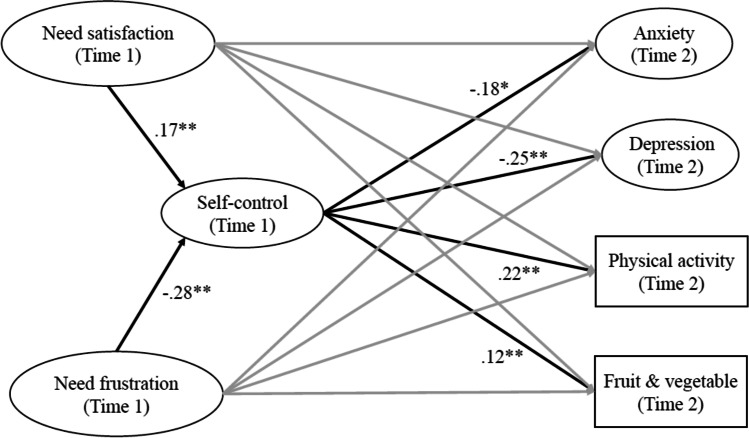
Psychological distress and unhealthy lifestyle behaviors are highly prevalent among undergraduate students. Importantly, numerous longitudinal studies show that these phenomena rise significantly during the first months of college and remain high thereafter. However, research identifying theory-driven mechanisms to explain these phenomena is lacking. Using two complementary statistical approaches (person- and variable-centered), this study assesses basic psychological needs (BPNs) and self-control as possible explanatory factors underlying the association between student's educational experience and multiple health-related outcomes. A total of 2450 Canadian undergraduates participated in this study study involving two time points (12 months apart; NTime1 = 1783; NTime2 = 1053), of which 386 participated at both measurement occasions. First, results from person-centered analyses (i.e., latent profile and transition analyses) revealed three profiles of need-satisfaction and frustration in students that were replicated at both time points. Need-supportive conditions within college generally predicted membership in the most adaptive profile. In turn, more adaptive profiles predicted higher self-control, lower levels of psychological distress (anxiety, depression), and healthier lifestyle behaviors (physical activity, fruit and vegetable consumption). Second, results from variable-centered analyses (i.e., structural equation modeling) showed that the association between students' BPNs and health-related outcomes was mediated by self-control. In other words, high need satisfaction and low need frustration were associated with higher self-regulatory performance at Time 1, which in turn predicted a more adaptive functioning at Time 2. Overall, these findings help clarify the mechanisms underlying the association between college educational climate and students' health-related functioning.
Supplementary information: The online version contains supplementary material available at 10.1007/s12144-022-04019-5.
Keywords: Basic psychological needs; Educational climate; Health behaviors; Latent transition analysis; Psychological distress; Self-control.
© The Author(s), under exclusive licence to Springer Science+Business Media, LLC, part of Springer Nature 2022, Springer Nature or its licensor (e.g. a society or other partner) holds exclusive rights to this article under a publishing agreement with the author(s) or other rightsholder(s); author self-archiving of the accepted manuscript version of this article is solely governed by the terms of such publishing agreement and applicable law.
Conflict of interest statement
Conflicts of interestThe authors have no conflicts of interest to declare that are relevant to the content of this article.
Figures


References
-
- Alsubaie MM, Stain HJ, Webster LAD, Wadman R. The role of sources of social support on depression and quality of life for university students. International Journal of Adolescence and Youth. 2019;24:484–496. doi: 10.1080/02673843.2019.1568887. - DOI
-
- Arango, C., Díaz-Caneja, C. M., McGorry, P. D., Rapoport, J., Sommer, I. E., Vorstman, J. A., … Carpenter, W. (2018). Preventive strategies for mental health. The Lancet Psychiatry, 5, 591–604. - PubMed
-
- Auerbach, R. P., Mortier, P., Bruffaerts, R., Alonso, J., Benjet, C., Cuijpers, P., … WHO WMH-ICS Collaborators. (2018). WHO World Mental Health Surveys International College Student Project: Prevalence and distribution of mental disorders. Journal of Abnormal Psychology, 127, 623–638. - PMC - PubMed
-
- Bai L, Liu Y, Xiang S. Associations between parental psychological control and externalizing problems: The roles of need frustration and self-control. Journal of Child and Family Studies. 2020;29:3071–3079. doi: 10.1007/s10826-020-01810-5. - DOI
-
- Basque J. L'approche-programme : Les multiples connaissances mobilisées dans un projet d'approche-programme en enseignement supérieur. In: Pelletier P, Huot A, editors. Construire l’expertise pédagogique et curriculaire en enseignement supérieur : Connaissances, compétences et expériences. Presses de l'Université du Québec; 2017. pp. 161–181.
LinkOut - more resources
Full Text Sources