


The impact of dementia, frailty and care home characteristics on SARS-CoV-2 incidence in a national cohort of Welsh care home residents during a period of high community prevalence
- PMID: 36469089
- PMCID: PMC9721242
- DOI: 10.1093/ageing/afac250
The impact of dementia, frailty and care home characteristics on SARS-CoV-2 incidence in a national cohort of Welsh care home residents during a period of high community prevalence
Abstract
Background: dementia may increase care home residents' risk of COVID-19, but there is a lack of evidence on this effect and on interactions with individual and care home-level factors.
Methods: we created a national cross-sectional retrospective cohort of care home residents in Wales for 1 September to 31 December 2020. Risk factors were analysed using multi-level logistic regression to model the likelihood of SARS-CoV-2 infection and mortality.
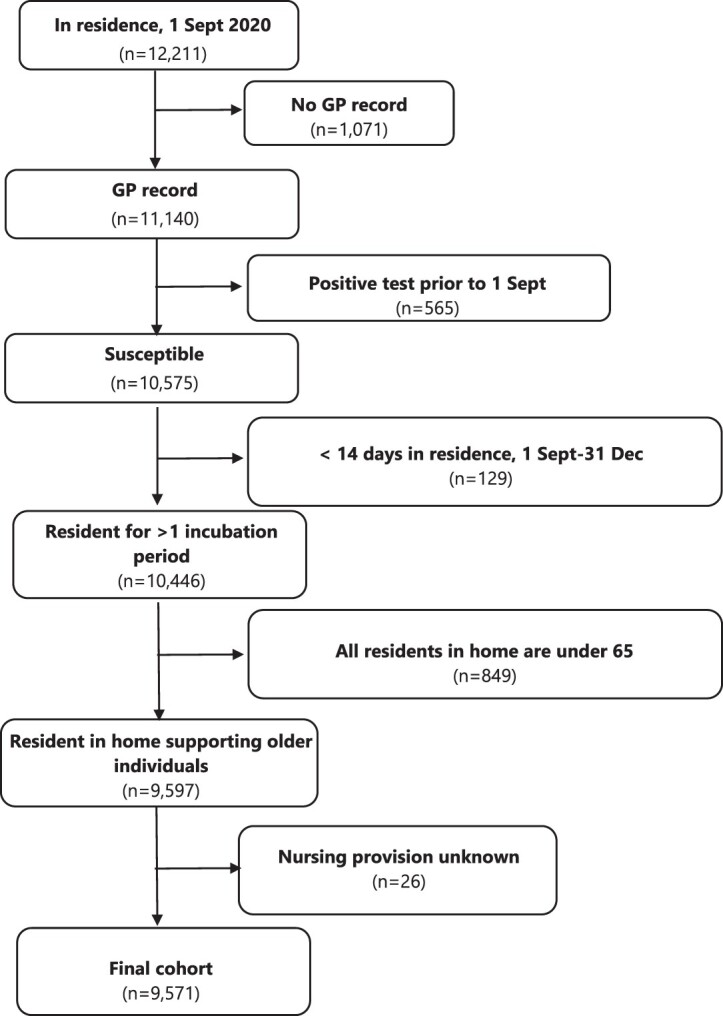
Results: the cohort included 9,571 individuals in 673 homes. Dementia was diagnosed in 5,647 individuals (59%); 1,488 (15.5%) individuals tested positive for SARS-CoV-2. We estimated the effects of age, dementia, frailty, care home size, proportion of residents with dementia, nursing and dementia services, communal space and region. The final model included the proportion of residents with dementia (OR for positive test 4.54 (95% CIs 1.55-13.27) where 75% of residents had dementia compared to no residents with dementia) and frailty (OR 1.29 (95% CIs 1.05-1.59) for severe frailty compared with no frailty). Analysis suggested 76% of the variation was due to setting rather than individual factors. Additional analysis suggested severe frailty and proportion of residents with dementia was associated with all-cause mortality, as was dementia diagnosis. Mortality analyses were challenging to interpret.
Discussion: whilst individual frailty increased the risk of COVID-19 infection, dementia was a risk factor at care home but not individual level. These findings suggest whole-setting interventions, particularly in homes with high proportions of residents with dementia and including those with low/no individual risk factors may reduce the impact of COVID-19.
Keywords: COVID-19; SARS-CoV-2; care homes; dementia; frailty; older people.
© The Author(s) 2022. Published by Oxford University Press on behalf of the British Geriatrics Society. All rights reserved. For permissions, please email: journals.permissions@oup.com.
Figures
References
-
- Scientific Advisory Group for Emergencies . Scientific Pandemic Influenza Group on Modelling (SPI-M) Consensus Statement, Government Office for Science, 2020. https://assets.publishing.service.gov.uk/government/uploads/system/uploa....
-
- Hollinghurst J, Hollinghurst R, North L et al. COVID-19 risk factors amongst 14,786 care home residents: an observational longitudinal analysis including daily community positive test rates of COVID-19, hospital stays and vaccination status in Wales (UK) between 1 September 2020 and 1 May 2021. Age Ageing 2022; 51: 1–9. - PMC - PubMed
Publication types
MeSH terms
Grants and funding
LinkOut - more resources
Full Text Sources
Medical
Miscellaneous
