Association Between Consumption of Ultraprocessed Foods and Cognitive Decline
- PMID: 36469335
- PMCID: PMC9857155
- DOI: 10.1001/jamaneurol.2022.4397
Association Between Consumption of Ultraprocessed Foods and Cognitive Decline
Abstract
Importance: Although consumption of ultraprocessed food has been linked to higher risk of cardiovascular disease, metabolic syndrome, and obesity, little is known about the association of consumption of ultraprocessed foods with cognitive decline.
Objective: To investigate the association between ultraprocessed food consumption and cognitive decline in the Brazilian Longitudinal Study of Adult Health.
Design, setting, and participants: This was a multicenter, prospective cohort study with 3 waves, approximately 4 years apart, from 2008 to 2017. Data were analyzed from December 2021 to May 2022. Participants were public servants aged 35 to 74 years old recruited in 6 Brazilian cities. Participants who, at baseline, had incomplete food frequency questionnaire, cognitive, or covariate data were excluded. Participants who reported extreme calorie intake (<600 kcal/day or >6000 kcal/day) and those taking medication that could negatively interfere with cognitive performance were also excluded.
Exposures: Daily ultraprocessed food consumption as a percentage of total energy divided into quartiles.
Main outcomes and measures: Changes in cognitive performance over time evaluated by the immediate and delayed word recall, word recognition, phonemic and semantic verbal fluency tests, and Trail-Making Test B version.
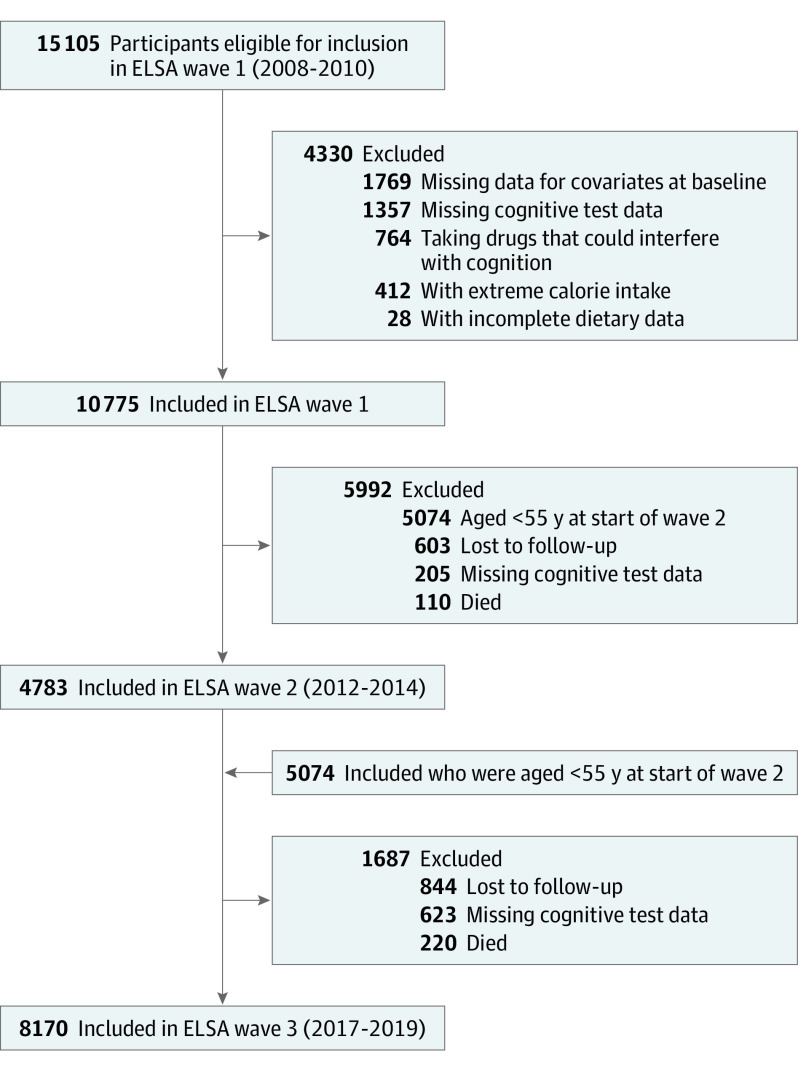
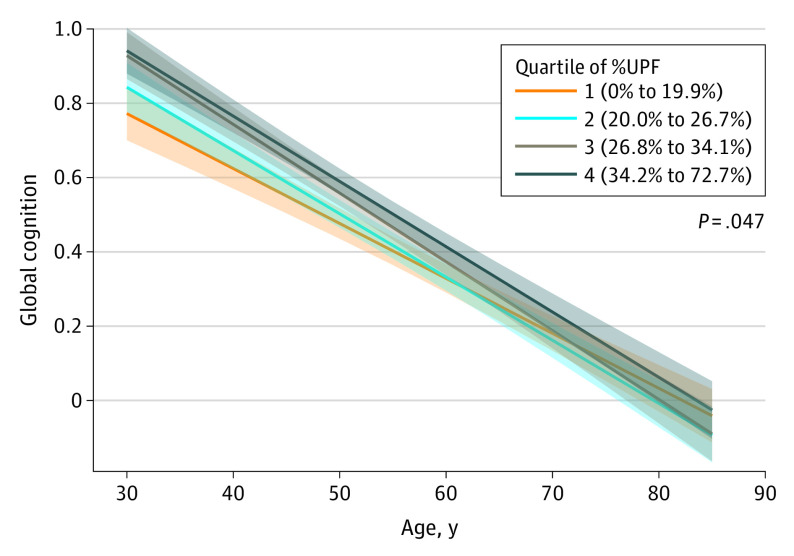
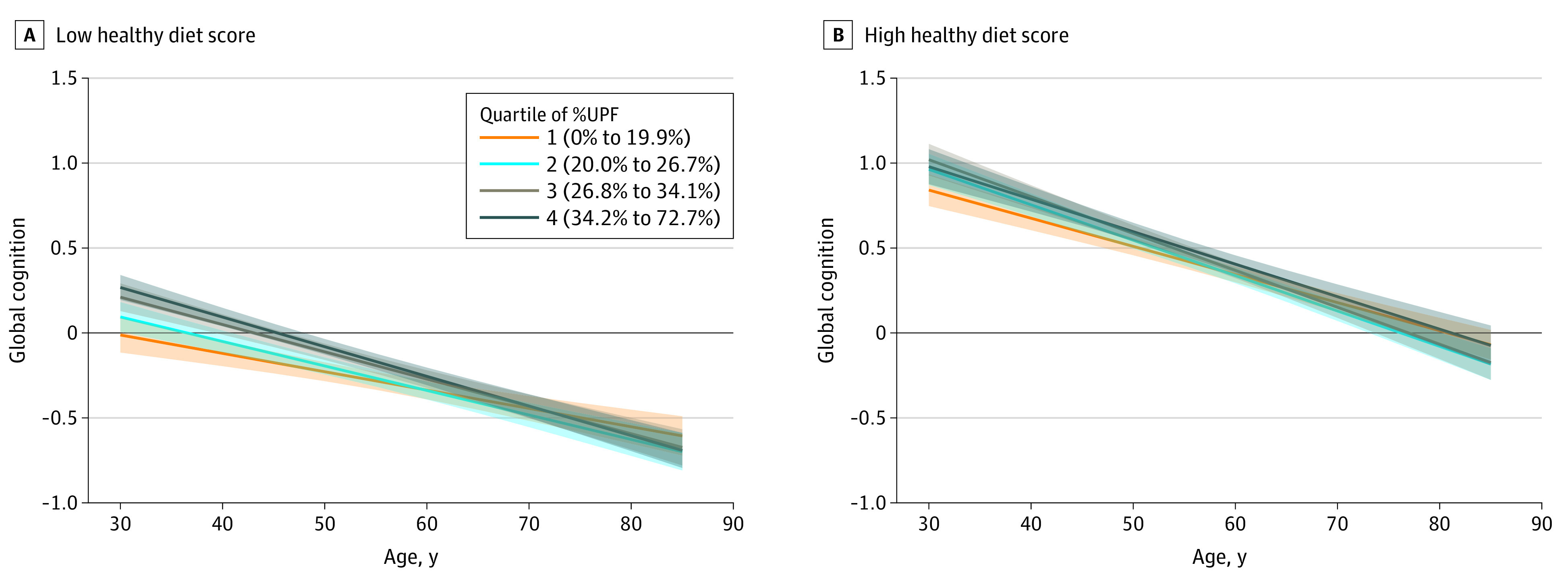
Results: A total of 15 105 individuals were recruited and 4330 were excluded, leaving 10 775 participants whose data were analyzed. The mean (SD) age at the baseline was 51.6 (8.9) years, 5880 participants (54.6%) were women, 5723 (53.1%) were White, and 6106 (56.6%) had at least a college degree. During a median (range) follow-up of 8 (6-10) years, individuals with ultraprocessed food consumption above the first quartile showed a 28% faster rate of global cognitive decline (β = -0.004; 95% CI, -0.006 to -0.001; P = .003) and a 25% faster rate of executive function decline (β = -0.003, 95% CI, -0.005 to 0.000; P = .01) compared with those in the first quartile.
Conclusions and relevance: A higher percentage of daily energy consumption of ultraprocessed foods was associated with cognitive decline among adults from an ethnically diverse sample. These findings support current public health recommendations on limiting ultraprocessed food consumption because of their potential harm to cognitive function.
Conflict of interest statement
Figures
References
-
- Nichols E, Steinmetz JD, Vollset SE, et al. ; GBD 2019 Dementia Forecasting Collaborators . Estimation of the global prevalence of dementia in 2019 and forecasted prevalence in 2050: an analysis for the Global Burden of Disease Study 2019. Lancet Public Health. 2022;7(2):e105-e125. doi:10.1016/S2468-2667(21)00249-8 - DOI - PMC - PubMed
-
- World Health Organization . Risk reduction of cognitive decline and dementia: WHO guidelines. Accessed October 28, 2022. https://apps.who.int/iris/bitstream/handle/10665/312180/9789241550543-en... - PubMed
-
- World Health Organization . World Report on Ageing and Health 2015. World Health Organization; 2015.
Publication types
MeSH terms
LinkOut - more resources
Full Text Sources
Other Literature Sources
Medical