


Changes in the characteristics and outcomes of COVID-19 patients from the early pandemic to the delta variant epidemic: a nationwide population-based study
- PMID: 36469641
- PMCID: PMC9788709
- DOI: 10.1080/22221751.2022.2155250
Changes in the characteristics and outcomes of COVID-19 patients from the early pandemic to the delta variant epidemic: a nationwide population-based study
Abstract
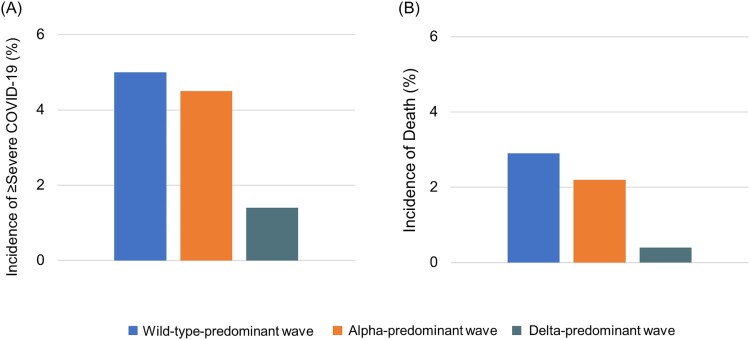
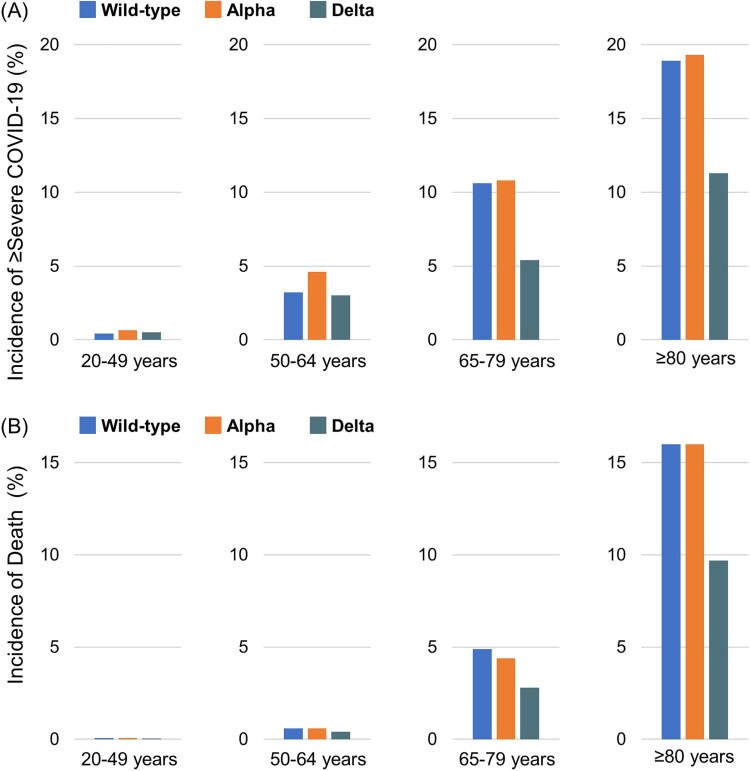
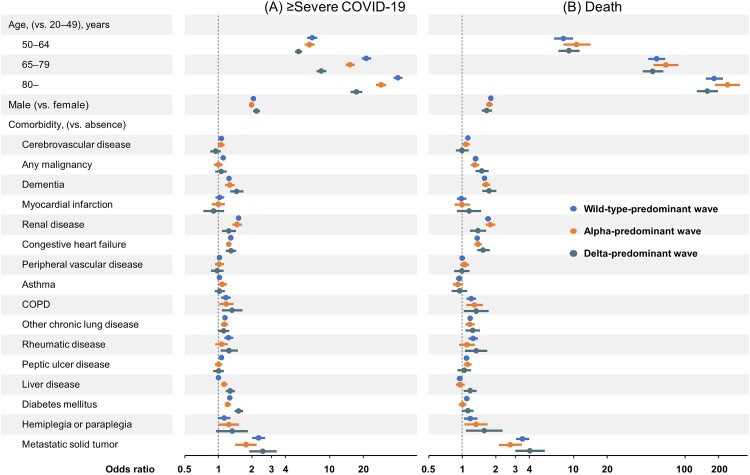
The coronavirus disease 2019 (COVID-19) pandemic has dramatically changed because of virus mutations, vaccine dissemination, treatment development and policies, among other factors. These factors have a dynamic and complex effect on the characteristics and outcomes of patients. Therefore, there is an urgent need to understand those changes and update the evidence. We used a large-scale real-world data set of 937,758 patients with COVID-19 from a nationwide claims database that included outpatients and inpatients in Japan to investigate the changes in their characteristics, outcomes and risk factors for severity/mortality from the early pandemic to the delta variant-predominant waves. The severity of COVID-19 was defined according to the modified World Health Organization clinical-progression ordinal scale. With changing waves, mean patient age decreased, and proportion of patients with comorbidities decreased. The incidences of "severe COVID-19 or death (i.e. ≥severe COVID-19)" and "death" markedly declined (5.0% and 2.9%, wild-type-predominant; 4.6% and 2.2%, alpha variant-predominant and 1.4% and 0.4%, delta variant-predominant waves, respectively). Across the wave shift, risk factors for ≥ severe COVID-19 and death, including older age, male, malignancy, congestive heart failure and chronic obstructive pulmonary disease, were largely consistent. The significance of some factors, such as liver disease, varied as per the wave. This study, one of the largest population-based studies on COVID-19, showed that patient characteristics and outcomes changed during the waves. Risk factors for severity/mortality were similar across all waves, but some factors were inconsistent. These data suggest that the clinical status of COVID-19 will change further with the coming epidemic wave.
Keywords: COVID-19; NDB; epidemiology; national database of health insurance claims and specific health checkups of Japan; risk factors.
Conflict of interest statement
No potential conflict of interest was reported by the author(s).
Figures
References
-
- World Health Organization: WHO Coronavirus (COVID-19) Dashboard . [cited 2022 May 2]. Available from: https://covid19.who.int/.
-
- World Health Organization: Tracking SARS-CoV-2 variants . [cited 2022 July 16]. Available from: https://www.who.int/en/activities/tracking-SARS-CoV-2-variants. - PubMed
-
- Centers for Disease Control and Prevention: Underlying Medical Conditions Associated with Higher Risk for Severe COVID-19: Information for Healthcare Professionals . [cited 2022 May 2]. Available from: https://www.cdc.gov/coronavirus/2019-ncov/hcp/clinical-care/underlyingco.... - PubMed
MeSH terms
Supplementary concepts
Grants and funding
LinkOut - more resources
Full Text Sources
Other Literature Sources
Medical
