. 2023 Feb 25:861:160609.
doi: 10.1016/j.scitotenv.2022.160609. Epub 2022 Dec 2.

Prolonged smoldering Douglas fir smoke inhalation augments respiratory resistances, stiffens the aorta, and curbs ejection fraction in hypercholesterolemic mice

Affiliations

Prolonged smoldering Douglas fir smoke inhalation augments respiratory resistances, stiffens the aorta, and curbs ejection fraction in hypercholesterolemic mice

Matthew J Eden et al. Sci Total Environ. .

Abstract

While mounting evidence suggests that wildland fire smoke (WFS) inhalation may increase the burden of cardiopulmonary disease, the occupational risk of repeated exposure during wildland firefighting remains unknown. To address this concern, we evaluated the cardiopulmonary function in mice following a cumulative exposure to lab-scale WFS equivalent to a mid-length wildland firefighter (WLFF) career. Dosimetry analysis indicated that 80 exposure hours at a particulate concentration of 22 mg/m3 yield in mice the same cumulative deposited mass per unit of lung surface area as 3600 h of wildland firefighting. To satisfy this condition, male Apoe-/- mice were whole-body exposed to either air or smoldering Douglas fir smoke (DFS) for 2 h/day, 5 days/week, over 8 consecutive weeks. Particulate size in DFS fell within the respirable range for both mice and humans, with a count median diameter of 110 ± 20 nm. Expiratory breath hold in mice exposed to DFS significantly reduced their minute volume (DFS: 27 ± 4; Air: 122 ± 8 mL/min). By the end of the exposure time frame, mice in the DFS group exhibited a thicker (DFS: 109 ± 3; Air: 98 ± 3 μm) and less distensible (DFS: 23 ± 1; Air: 28 ± 1 MPa-1) aorta with reduced diastolic blood augmentation capacity (DFS: 53 ± 2; Air: 63 ± 2 kPa). Cardiac magnetic resonance imaging further revealed larger end-systolic volume (DFS: 14.6 ± 1.1; Air: 9.9 ± 0.9 μL) and reduced ejection-fraction (DFS: 64.7 ± 1.0; Air: 75.3 ± 0.9 %) in mice exposed to DFS. Consistent with increased airway epithelium thickness (DFS: 10.4 ± 0.8; Air: 7.6 ± 0.3 μm), airway Newtonian resistance was larger following DFS exposure (DFS: 0.23 ± 0.03; Air: 0.20 ± 0.03 cmH2O-s/mL). Furthermore, parenchyma mean linear intercept (DFS: 36.3 ± 0.8; Air: 33.3 ± 0.8 μm) and tissue thickness (DFS: 10.1 ± 0.5; Air: 7.4 ± 0.7 μm) were larger in DFS mice. Collectively, mice exposed to DFS manifested early signs of cardiopulmonary dysfunction aligned with self-reported events in mid-career WLFFs.

Keywords: Airway morphometry; Aortic distensibility; Carboxyhemoglobin; Dosimetry; Particulate matter; Wildland fire smoke.


Conflict of interest statement

Declaration of competing interest The authors declare that they have no known competing financial interests or personal relationships that could have appeared to influence the work reported in this paper.

Figures
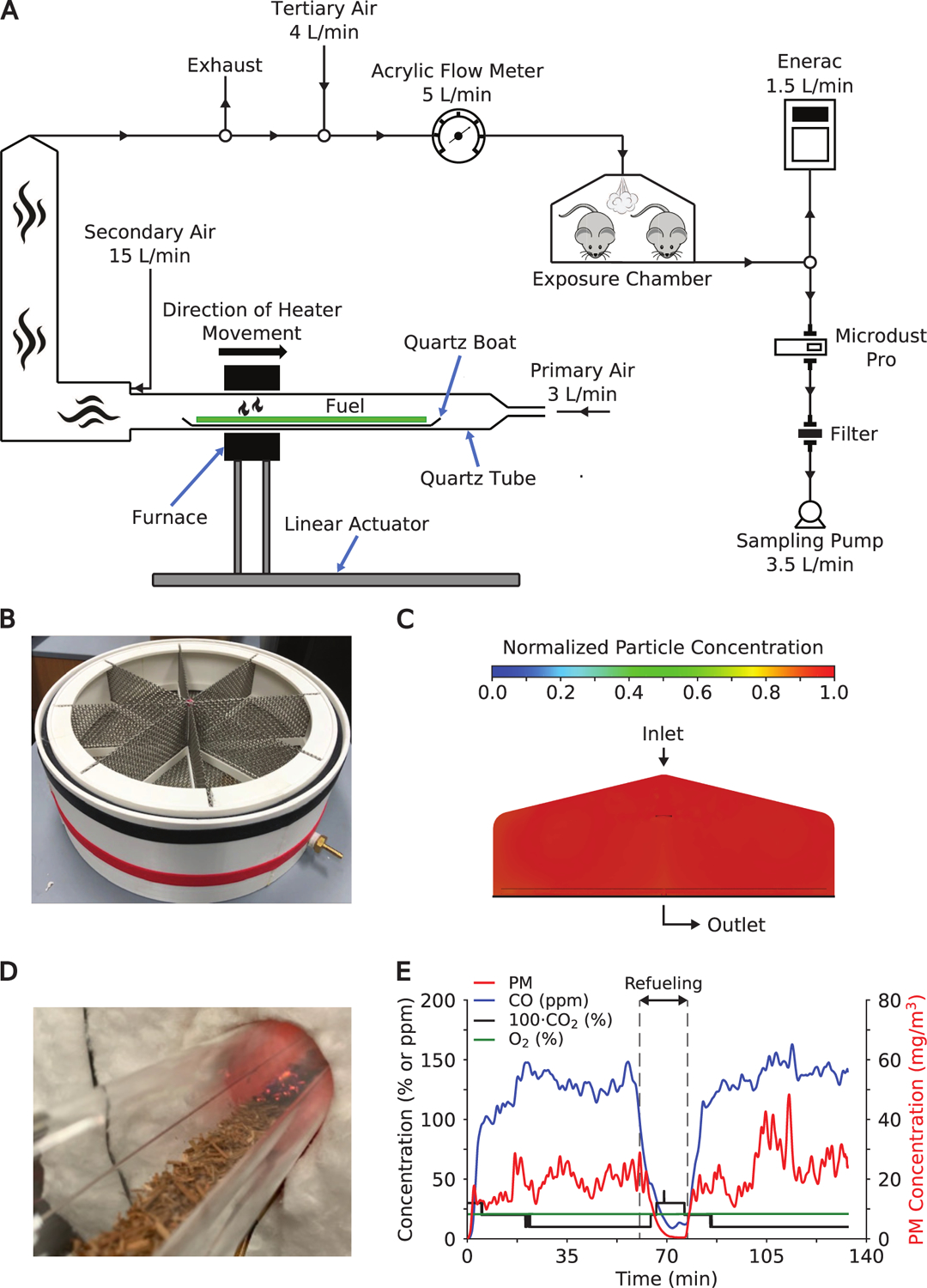
Figure 1:
Figure 1:
Custom apparatus for consistent generation and homogeneous delivery of smoldering DFS to a mouse whole-body exposure chamber. A ring furnace produces DFS that is diluted (A) and propelled to the exposure chamber (B). The design of the exposure chamber was iteratively refined until physics-based simulations predicted a homogeneous distribution of the smoke within each compartment (C). The ring furnace is mounted onto a linear actuator and generates smoldering combustion as it travels over the dried Douglas fir needles at 450 °C (D). Daily exposure consists of two, 1 hour-long sessions separated by a brief refueling period, after which PM and CO concentrations in DFS quickly stabilize (E).
Figure 2:
Figure 2:
Mice tolerate inhalation of respirable PM in DFS but consistently exhibit expiratory flow interruption. Concentrations of PM (A) and CO (B) in DFS and COHb levels in the blood of exposed mice (C) increase linearly with the mass of combusted fuel. Aerosol analysis and health assessments presented hereafter leverage a fuel load of 3.75g to maximize emissions without exceeding the threshold for CO-mediated toxicity (C). Under these conditions, the count distribution of particle sizes in DFS is unimodal and follows a lognormal probability function (red shaded area) (D). Processing of TEM images confirms that individual particles and agglomerates in DFS (E) are mostly circular in shape (F). Traces of pressure signals in a wholebody plethysmograph reveal expiratory braking in mice exposed to DFS (I) and corroborate normal breathing in air controls (G). Note, a rise in pressure (i.e., positive slope) is indicative of inhalation, whereas a drop in pressure (i.e., negative slope) corresponds to exhalation. As a result, the representative volume curve under DFS exposure conditions comprises inspiration, primary expiration, breath hold, and secondary expiration phases (J), while inspiration and expiration alone appear in the case of air exposure (H). Black solid lines delineate average values while grey shaded areas reflect 95% confidence intervals. Note, the scale on the x-axis for panels (H) and (J) matches the RR of mice exposed to HEPA-filtered air or DFS, respectively (Table 3).
Figure 3:
Figure 3:
Daily inhalation of DFS over 8 weeks promotes structural stiffening of the abdominal aorta and triggers cardiovascular dysfunction. Peripheral blood pressure increases linearly over time in mice exposed to DFS but remains at baseline in air controls (A). When subjected to the same stress, tissues from the aorta of DFS-exposed mice experience higher circumferential (B) and lower axial (C) deformations compared to air controls. Solid line predictions in panels (B) and (C) are based upon best-fit values for the coefficients of the strain energy potential pertaining to group average data (Equation S.14, Supplementary Material). Fitting of individual data sets facilitated additional calculation of geometrical and mechanical metrics under physiological loads. Amongst those, prolonged inhalation of DFS reduces axial extensibility (D) and limits the amount of elastic energy for diastolic blood flow augmentation (E). Wall thickening (F) contributes to decreasing the distensibility of the DFS aorta within the range of in vivo pressures (G). Consistently, segmentation of left ventricular volumes from cardiac MR images (H) reveals increased end-systolic volume (J) with preserved end-diastolic volume (I), supporting a significant decline in ejection fraction (K). Movat’s pentachrome stained cross-sections confirm thickening of the aortic wall with DFS exposure (L). Picrosirius red stained cross-sections imaged under polarized light further suggest preserved medial collagen (M) and adventitial collagen deposition (N) in the DFS group. Statistically significant difference between groups denoted as * overbar for p<0.05.
Figure 4:
Figure 4:
Remodeling of the airways following 8 weeks of daily DFS inhalation increases the Newtonian resistance. Mice exposed to DFS exhibit larger respiratory system resistance (Rrs) than air controls when ventilated at or above 9.5 Hz and 1 cmH2O Ppeep (A). No difference in reactance (Xrs) emerges between the two groups at any frequency and 1 cmH2O Ppeep (B). Solid lines superimposed to real (A) and imaginary (B) components of impedance rely on best-fit parameters for the constant phase model in Equation 6, as estimated from group average data. Fitting the constant phase model to individual impedance data at 1 cmH2O Ppeep further provided within-group variability for parameters RN, H, and G, alongside the derived metric η. Exposure to DFS augments airway resistance (C) but preserves the coefficient of tissue elastance (D), the coefficient of tissue resistance (E), and therefore lung tissue hysteresivity (F). Morphological analysis of Movat’s pentachorme stained airway (G–H) and parenchyma (I–J) tissues reveals airspace enlargement (K) as well as thickening of epithelial cell-laden airways (L) and alveolar septa (M) following DFS exposure. Statistically significant difference between groups denoted as * overbar for p<0.05.

References

    1. Westerling AL, Hidalgo HG, Cayan DR, Swetnam TW, Warming and earlier spring increase western US forest wildfire activity, Science 313 (5789) (2006) 940–943. doi:10.1126/science.1128834. - DOI - PubMed
    1. Caton SE, Hakes RS, Gorham DJ, Zhou A, Gollner MJ, Review of pathways for building fire spread in the wildland urban interface part I: exposure conditions, Fire technology 53 (2) (2017) 429–473. doi:10.1007/s10694-016-0601-7. - DOI
    1. Intergovernmental Panel On Climate Change, Climate change: Impact, adaptation, vulnerability, Available at https://www.ipcc.ch/report/ar5/wg2/ [Online; accessed 12-Nov-2021] (2014).
    1. Rice MB, Henderson SB, Lambert AA, Cromar KR, Hall JA, Cascio WE, Smith PG, Marsh BJ, Coefield S, Balmes JR, et al., Respiratory impacts of wildland fire smoke: Future challenges and policy opportunities. an official american thoracic society workshop report, Annals of the American Thoracic Society 18 (6) (2021) 921–930. doi:10.1513/AnnalsATS.202102-148ST. - DOI - PMC - PubMed
    1. US Environmental Protection Agency, Air emissions inventories. criteria pollutants national tier 1 for 1970 – 2020. Available at https://www.epa.gov/air-emissions-inventories [Online; accessed 12-Nov-2021].
