. 2023 Jan;22(1):100476.
doi: 10.1016/j.mcpro.2022.100476. Epub 2022 Dec 5.

Proteins in Tumor-Derived Plasma Extracellular Vesicles Indicate Tumor Origin

Affiliations

Proteins in Tumor-Derived Plasma Extracellular Vesicles Indicate Tumor Origin

Meltem Barlin et al. Mol Cell Proteomics. 2023 Jan.

Abstract

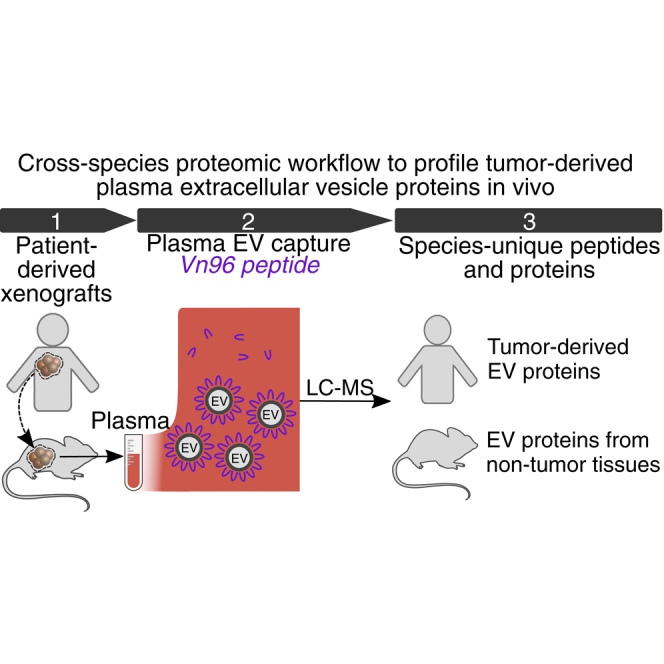
Cancer-derived extracellular vesicles (EVs) promote tumorigenesis, premetastatic niche formation, and metastasis via their protein cargo. However, the proteins packaged by patient tumors into EVs cannot be determined in vivo because of the presence of EVs derived from other tissues. We therefore developed a cross-species proteomic method to quantify the human tumor-derived proteome of plasma EVs produced by patient-derived xenografts of four cancer types. Proteomic profiling revealed individualized packaging of novel protein cargo, and machine learning accurately classified the type of the underlying tumor.

Keywords: ProteoClade; cancer; exosomes; extracellular vesicles; machine learning; patient-derived xenografts; proteomics.


Conflict of interest statement

Conflict of interest Dr. Li has received license fee from Envigo and research funding from Pfizer, Takeda Oncology, and Zenopharm not associated with this article.

Figures
None
Graphical abstract
Fig. 1
Fig. 1
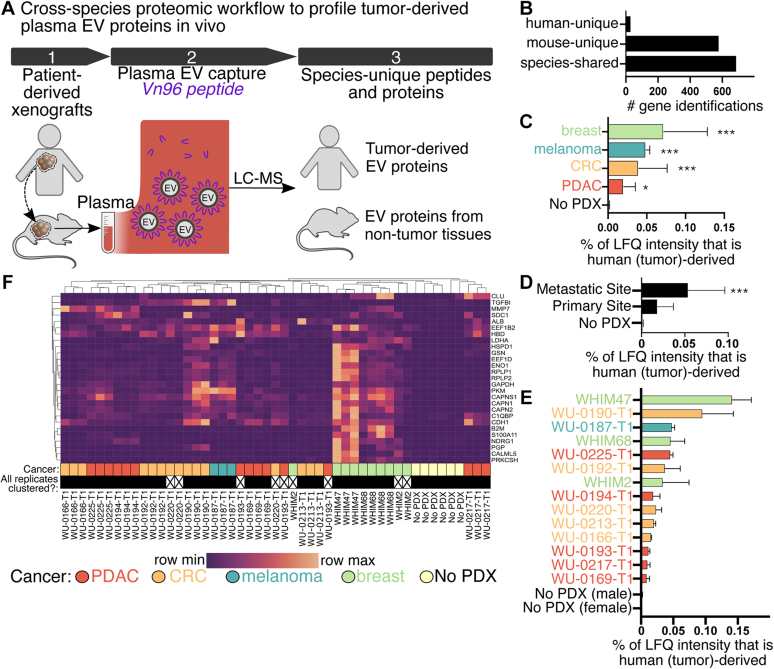
Patient tumor–derived EV proteins are an intrinsic property of the individual patient tumor and indicative of the tumor type and metastatic origin.A, overview schematic of cross-species proteomic profiling of tumor-derived plasma EV proteins. B, number of species-specific assignments. C, total human-unique (tumor-derived) protein intensity by tumor type, (D) tumor site, and (E) individual PDX lines. F, heatmap of tumor-derived proteins across PDX lines and biological replicates. Filled black squares indicate each biological replicates clustered together. ∗p < 0.05, ∗∗∗p <0.005, based on Kruskal–Wallis one-way ANOVA, and N is detailed in supplemental Table S1. EV, extracellular vesicle; PDX, patient-derived xenograft.
Fig. 2
Fig. 2
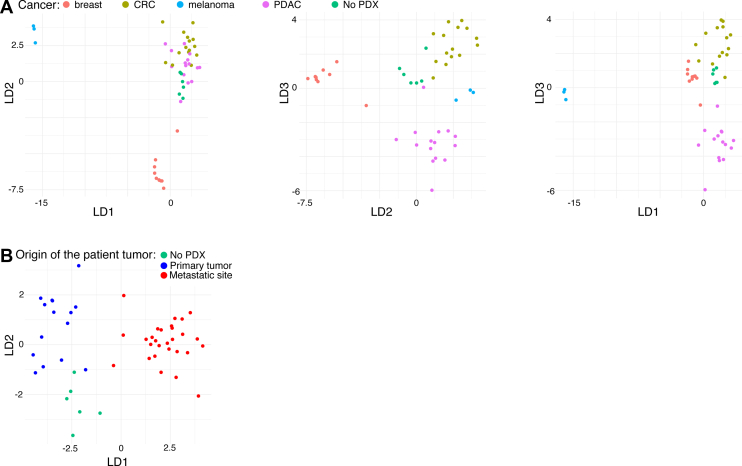
Tumor classification via the tumor-derived EV proteome using machine learning.A, LDA classification of PDXs based on tumor type or (B) origin of the patient tumor. EV, extracellular vesicle; LDA, linear discriminant analysis; PDX, patient-derived xenograft.
Fig. 3
Fig. 3
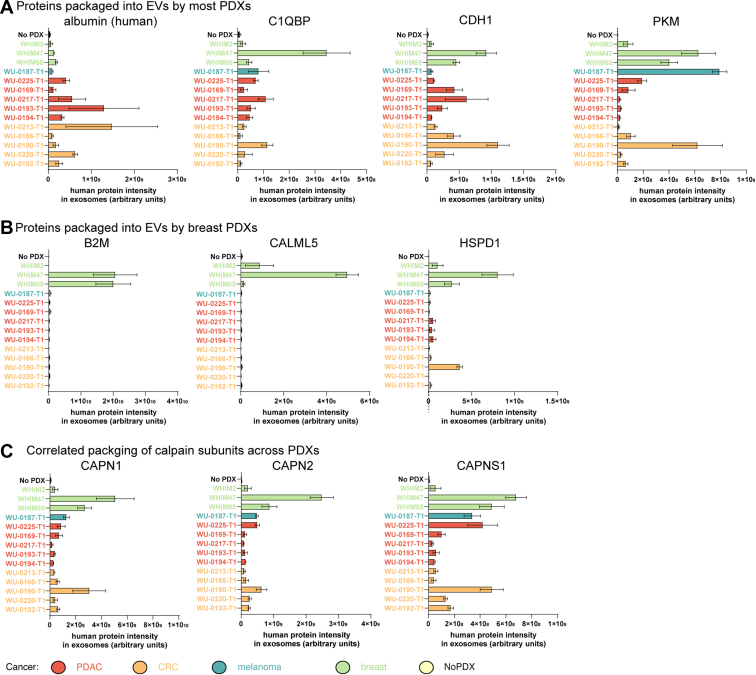
Abundance of tumor-derived proteins in EVs reveals pan-cancer markers and cancer-unique indicators.A, relative human protein abundance of newly identified and known components of cancer EVs that pan-cancer markers present in most tumor-derived EVs. B, human proteins detected from EVs specific for breast cancer. C, relative human protein abundance of members of the calpain protein complex in EVs. N is detailed in supplemental Table S1. EV, extracellular vesicle.

References

    1. Das A., Mohan V., Krishnaswamy V.R., Solomonov I., Sagi I. Exosomes as a storehouse of tissue remodeling proteases and mediators of cancer progression. Cancer Metastasis Rev. 2019;38:455–468. - PubMed
    1. Hoshino A., Costa-Silva B., Shen T.-L.L., Rodrigues G., Hashimoto A., Mark M.T., et al. Tumour exosome integrins determine organotropic metastasis. Nature. 2015;527:329–335. - PMC - PubMed
    1. Xu R., Rai A., Chen M., Suwakulsiri W., Greening D.W., Simpson R.J. Extracellular vesicles in cancer — implications for future improvements in cancer care. Nat. Rev. Clin. Oncol. 2018;15:617–638. - PubMed
    1. Kugeratski F.G., Hodge K., Lilla S., McAndrews K.M., Zhou X., Hwang R.F., et al. Springer; US: 2021. Quantitative Proteomics Identifies the Core Proteome of Exosomes with Syntenin-1 as the Highest Abundant Protein and a Putative Universal Biomarker. - PMC - PubMed
    1. Jeppesen D.K., Fenix A.M., Franklin J.L., Higginbotham J.N., Zhang Q., Zimmerman L.J., et al. Reassessment of exosome composition. Cell. 2019;177:428–445.e18. - PMC - PubMed