


Coexisting Frailty and Cognitive Impairment as a Predictor of Adverse Outcomes in Older Inpatients After Discharge: Results from a One-Year Follow-Up Study
- PMID: 36471807
- PMCID: PMC9719277
- DOI: 10.2147/CIA.S376691
Coexisting Frailty and Cognitive Impairment as a Predictor of Adverse Outcomes in Older Inpatients After Discharge: Results from a One-Year Follow-Up Study
Abstract
Purpose: This study aimed to investigate the combined effects of frailty and cognitive impairment on adverse outcomes, including new falls and new activities of daily living (ADL) dependency over a 1-year follow-up.
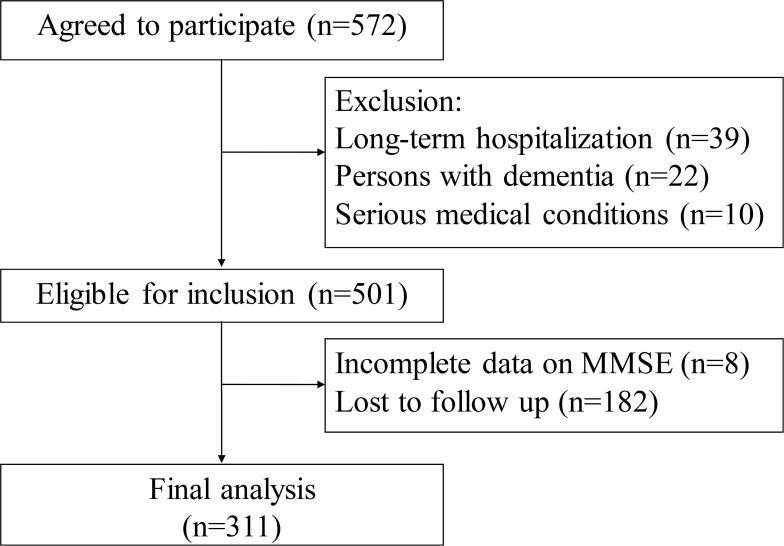
Patients and methods: A total of 311 older hospitalized patients participated in this retrospective observational study and completed a 1-year follow-up. Frailty was assessed by the Clinical Frailty Scale (CFS). Cognitive function was evaluated by the Mini-Mental State Examination (MMSE). All participants were classified into four groups: 1) the healthy group (n=180); 2) the cognitive impairment group only (n=38); 3) the frailty group only (n=44); and 4) coexisting frailty and cognitive impairment group (n=49). The follow-up data of adverse outcomes include the incidences of new falls and new ADL dependence. Binary logistic regression analysis was used to explore the associations of frailty and/or cognitive impairment with adverse outcomes.
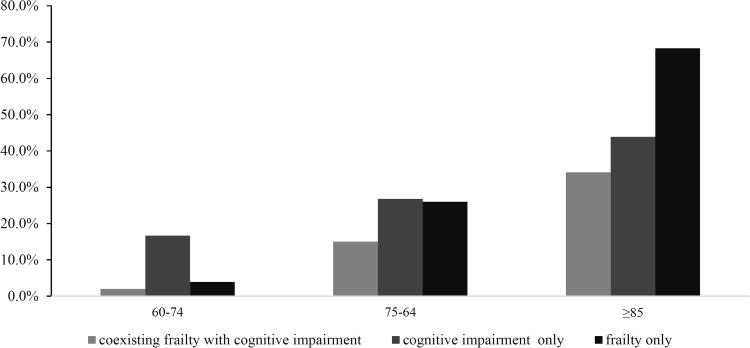
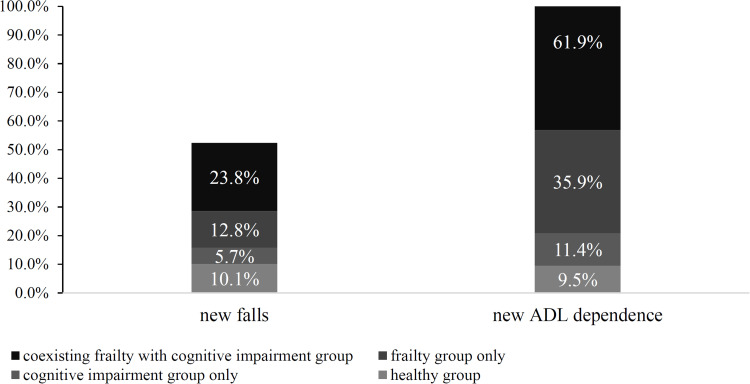
Results: The prevalence rates of frailty, cognitive impairment, and co-occurring frailty with cognitive impairment were 29.9%, 28%, and 15.8%, respectively. Among these four groups, there was a statistical difference in the incidence of new ADL dependence during the follow-up period (9.5% vs 11.4% vs 35.9% vs 61.9%, P < 0.001). After adjusting the confounding variables, older hospitalized patients with frailty and cognitive impairment had a higher risk of new ADL dependence when compared with the healthy group (OR: 4.786, 95% CI: 1.492-15.355), but frailty only or cognitive impairment only was not associated with new ADL dependency.
Conclusion: Elderly inpatients with comorbid frailty and cognitive impairment on admission were significantly associated with an increased risk of new ADL dependency 1 year after discharge. Therefore, it is necessary for the early identification of frailty and cognitive impairment, and effective interventions should be implemented.
Keywords: ADL dependency; cognitive impairment; fall; frailty; older adults.
© 2022 Zeng et al.
Conflict of interest statement
The authors report no conflicts of interest in this work.
Figures
References
-
- Hanlon P, Nicholl BI, Jani BD, et al. Frailty and pre-frailty in middle-aged and older adults and its association with multimorbidity and mortality: a prospective analysis of 493 737 UK biobank participants. Lancet Public Health. 2018;3(7):e323–e332. doi: 10.1016/S2468-2667(18)30091-4 - DOI - PMC - PubMed
-
- Martin Prince MG, Ali G-C, Wimo A. World Alzheimer Report 2015. London: Alzheimer’s Disease International (ADI); 2015.
-
- Lu C, Zhang H, Fu X, et al. Clinical investigation and analysis of chronic diseases and geriatric syndromes in elderly inpatients. Chin J Geriatr. 2019;38(8):913–916. doi: 10.3760/cma.j.issn.0254-9026.2019.08.021 - DOI
Publication types
MeSH terms
LinkOut - more resources
Full Text Sources
Medical
