Comparison between obese and non-obese nonalcoholic fatty liver disease
- PMID: 36472052
- PMCID: PMC10029940
- DOI: 10.3350/cmh.2022.0350
Comparison between obese and non-obese nonalcoholic fatty liver disease
Abstract
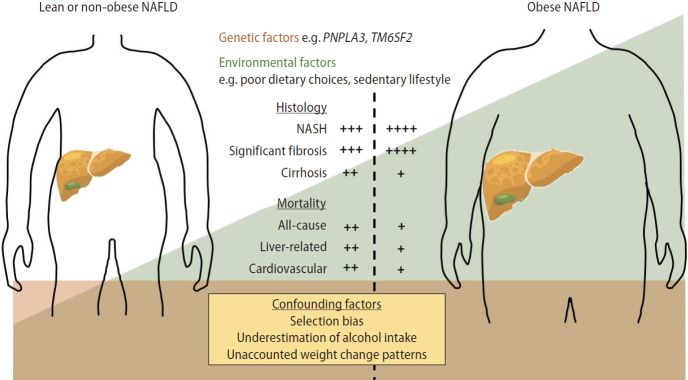
Nonalcoholic fatty liver disease (NAFLD) encompasses a spectrum of liver conditions that are characterized by excess accumulation of fat in the liver, and is diagnosed after exclusion of significant alcohol intake and other causes of chronic liver disease. In the majority of cases, NAFLD is associated with overnutrition and obesity, although it may be also found in lean or non-obese individuals. It has been estimated that 19.2% of NAFLD patients are lean and 40.8% are non-obese. The proportion of patients with more severe liver disease and the incidence of all-cause mortality, liver-related mortality, and cardiovascular mortality among non-obese and obese NAFLD patients varies across studies and may be confounded by selection bias, underestimation of alcohol intake, and unaccounted weight changes over time. Genetic factors may have a greater effect towards the development of NAFLD in lean or non-obese individuals, but the effect may be less pronounced in the presence of strong environmental factors, such as poor dietary choices and a sedentary lifestyle, as body mass index increases in the obese state. Overall, non-invasive tests, such as the Fibrosis-4 index, NAFLD fibrosis score, and liver stiffness measurement, perform better in lean or non-obese patients compared to obese patients. Lifestyle intervention works in non-obese patients, and less amount of weight loss may be required to achieve similar results compared to obese patients. Pharmacological therapy in non-obese NAFLD patients may require special consideration and a different approach compared to obese patients.
Keywords: Lean; Non-obese; Nonalcoholic fatty liver disease.
Conflict of interest statement
Wah-Kheong Chan has served as a consultant or advisory board member for Roche, Abbvie, Boehringer Ingelheim and Novo Nordisk; and a speaker for Viatris and Hisky Medical.
Figures
Comment in
-
Lean vs. obese phenotypes of nonalcoholic fatty liver disease: similar or different?Clin Mol Hepatol. 2023 Apr;29(2):377-380. doi: 10.3350/cmh.2023.0061. Epub 2023 Mar 9. Clin Mol Hepatol. 2023. PMID: 36907573 Free PMC article. No abstract available.
References
-
- Wong VW, Chan WK, Chitturi S, Chawla Y, Dan YY, Duseja A, et al. Asia-Pacific Working Party on Non-alcoholic Fatty Liver Disease guidelines 2017-part 1: definition, risk factors and assessment. J Gastroenterol Hepatol. 2018;33:70–85. - PubMed
-
- Alberti KG, Eckel RH, Grundy SM, Zimmet PZ, Cleeman JI, Donato KA, et al. Harmonizing the metabolic syndrome: a joint interim statement of the International Diabetes Federation Task Force on Epidemiology and Prevention; National Heart, Lung, and Blood Institute; American Heart Association; World Heart Federation; International Atherosclerosis Society; and International Association for the Study of Obesity. Circulation. 2009;120:1640–1645. - PubMed
-
- Le MH, Yeo YH, Li X, Li J, Zou B, Wu Y, et al. 2019 Global NAFLD prevalence: a systematic review and meta-analysis. Clin Gastroenterol Hepatol. 2022;20:2809–2817. e28. - PubMed
Publication types
MeSH terms
LinkOut - more resources
Full Text Sources
Medical