. 2023 Apr 1;118(4):727-737.
doi: 10.14309/ajg.0000000000002081. Epub 2022 Dec 20.

Acute Pancreatitis Recurrences Augment Long-Term Pancreatic Cancer Risk

Affiliations

Acute Pancreatitis Recurrences Augment Long-Term Pancreatic Cancer Risk

Satish Munigala et al. Am J Gastroenterol. .

Abstract

Introduction: In animal models, inflammation caused by experimental acute pancreatitis (AP) promotes pancreatic carcinogenesis that is preventable by suppressing inflammation. Recent studies noted higher long-term risk of pancreatic ductal adenocarcinoma (PDAC) after AP. In this study, we evaluated whether the long-term PDAC risk after AP was influenced by the etiology of AP, number of recurrences, and if it was because of progression to chronic pancreatitis (CP).

Methods: This retrospective study used nationwide Veterans Administration database spanning 1999-2015. A 2-year washout period was applied to exclude patients with preexisting AP and PDAC. PDAC risk was estimated in patients with AP without (AP group) and with underlying CP (APCP group) and those with CP alone (CP group) and compared with PDAC risk in patients in a control group, respectively, using cause-specific hazards model.

Results: The final cohort comprised 7,147,859 subjects (AP-35,550 and PDAC-16,475). The cumulative PDAC risk 3-10 years after AP was higher than in controls (0.61% vs 0.18%), adjusted hazard ratio (1.7 [1.4-2.0], P < 0.001). Adjusted hazard ratio was 1.5 in AP group, 2.4 in the CP group, and 3.3 in APCP group. PDAC risk increased with the number of AP episodes. Elevated PDAC risk after AP was not influenced by the etiology of AP (gallstones, smoking, or alcohol).

Discussion: There is a higher PDAC risk 3-10 years after AP irrespective of the etiology of AP, increases with the number of episodes of AP and is additive to higher PDAC risk because of CP.


Conflict of interest statement

Guarantor of the article: Satish Munigala, MBBS, MPH.

Specific author contributions: S.M.: study concept and design, statistical analysis, and interpretation of data, drafting of the manuscript, critical revision of the manuscript for important intellectual content, and approved the final draft of the manuscript. S.A.: critical revision of the manuscript for important intellectual content and approved the final draft of the manuscript. D.S.S.: study design, critical revision of the manuscript for important intellectual content, and approved the final draft of the manuscript. B.B.: critical revision of the manuscript for important intellectual content and approved the final draft of the manuscript. S.B.: data analysis, critical revision of the manuscript for important intellectual content, and approved the final draft of the manuscript. H.X.: study design, interpretation of data, drafting of the manuscript, critical revision of the manuscript for important intellectual content, and approved the final draft of the manuscript. S.G.S.: critical revision of the manuscript for important intellectual content and approved the final draft of the manuscript. T.E.B.: study design, interpretation of data, drafting of the manuscript, critical revision of the manuscript for important intellectual content, and approved the final draft of the manuscript. B.A.: study concept and design, interpretation of data, drafting of the manuscript, critical revision of the manuscript for important intellectual content, and approved the final draft of the manuscript.

Financial support: S.M. was supported in parts by funds from the Cancer Epidemiology Education in Special Populations (CEESP) Program; Grant R25 CA112383 from the National Cancer Institute.

Potential competing interests: None to report.

Figures

Figure 1.
Figure 1.
Flow diagram illustrating the selection of our study cohort. AP group, patients with AP without preexisting CP; CP group, patients with CP without AP; APCP group, patients with AP and preexisting CP; controls, remaining patients in the database without AP or CP. AP, acute pancreatitis; CP, chronic pancreatitis, PDAC, pancreatic ductal adenocarcinoma; VA, Veteran's Administration.
Figure 2.
Figure 2.
Cumulative incidence of pancreatic cancer in controls, AP group, CP group, and the APCP group. Hazard ratios presented on the figures are unadjusted hazard ratios from Cox-proportional model. Adjusted HRs with 95% CI from Cox-proportional model and the corresponding P values are listed in the appropriate sections of the manuscript. Gray K-sample test P value is for comparing the cumulative incidence between the groups. P < 0.001 AP group vs controls. P < 0.001 APCP group vs CP group. AP, acute pancreatitis; APCP, AP with preexisting CP; CI, confidence interval; CP, chronic pancreatitis; HRs, hazard ratios.
Figure 3.
Figure 3.
Cumulative incidence of pancreatic cancer based on the number of AP episodes. The trend of higher PDAC risk with increasing number of AP episodes was statistically significant as determined by Gray K-sample test P value for comparing the cumulative incidence between the groups. AP, acute pancreatitis; CI, confidence interval; PDAC, pancreatic ductal adenocarcinoma.
Figure 4.
Figure 4.
Cumulative incidence of pancreatic cancer after AP in patients with gallstone(s) vs those without nongallstone(s). (a) All patients with AP in cohort (b). Patients with AP with only one episode of AP. Note: There was no significant difference in PDAC risk in patients with and without gallstones. Because a difference in the number of AP episodes in the 2 groups could be a potential confounder, we evaluated and noted a similar pattern in the subset of patients with a single episode of AP. AP, acute pancreatitis; CI, confidence interval; PDAC, pancreatic ductal adenocarcinoma.
Figure 5.
Figure 5.
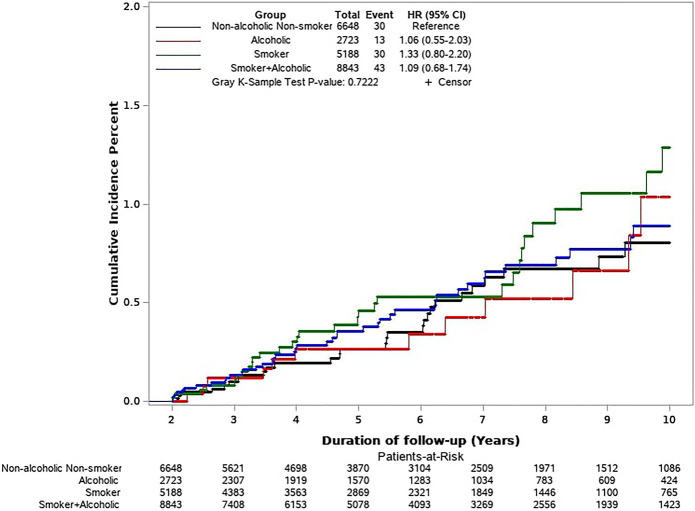
Cumulative incidence of pancreatic cancer after AP is uninfluenced by the etiology of AP. Note: None of the 4 groups were significantly different from each other. There was also no additive effect on PDAC risk after AP in patients who are smokers and heavy alcohol drinkers. AP, acute pancreatitis; CI, confidence interval; PDAC, pancreatic ductal adenocarcinoma.

References

    1. How Common Is Pancreatic Cancer? The American Cancer Society; (https://www.cancer.org/cancer/pancreatic-cancer/about/key-statistics.html) (2022). (Accessed January 7, 2022).
    1. Cho J, Petrov MS. Pancreatitis, pancreatic cancer, and their metabolic sequelae: Projected burden to 2050. Clin Transl Gastroenterol 2020;11:e00251. - PMC - PubMed
    1. Lippi G, Mattiuzzi C. The global burden of pancreatic cancer. Arch Med Sci 2020;16:820–4. - PMC - PubMed
    1. Petrov MS, Yadav D. Global epidemiology and holistic prevention of pancreatitis. Nat Rev Gastroenterol Hepatol 2019;16(3):175–84. - PMC - PubMed
    1. Agarwal B, Correa AM, Ho L. Survival in pancreatic carcinoma based on tumor size. Pancreas 2008;36(1):e15–20. - PubMed

Publication types

MeSH terms