Review
. 2023 Jun;21(6):396-407.
doi: 10.1038/s41579-022-00825-7. Epub 2022 Dec 6.

A molecular understanding of alphavirus entry and antibody protection

Affiliations
Review

A molecular understanding of alphavirus entry and antibody protection

Arthur S Kim et al. Nat Rev Microbiol. 2023 Jun.

Abstract

Alphaviruses are arthropod-transmitted RNA viruses that cause epidemics of human infection and disease on a global scale. These viruses are classified as either arthritogenic or encephalitic based on their genetic relatedness and the clinical syndromes they cause. Although there are currently no approved therapeutics or vaccines against alphaviruses, passive transfer of monoclonal antibodies confers protection in animal models. This Review highlights recent advances in our understanding of the host factors required for alphavirus entry, the mechanisms of action by which protective antibodies inhibit different steps in the alphavirus infection cycle and candidate alphavirus vaccines currently under clinical evaluation that focus on humoral immunity. A comprehensive understanding of alphavirus entry and antibody-mediated protection may inform the development of new classes of countermeasures for these emerging viruses.


Conflict of interest statement

M.S.D. is a consultant for Inbios, Vir Biotechnology, Senda Biosciences, Moderna, and Immunome. The Diamond laboratory has received unrelated funding support in sponsored research agreements from Vir Biotechnology, Moderna, Immunome and Emergent BioSolutions. A.S.K. declares no competing interests.

Figures

Fig. 1
Fig. 1. Alphavirus structure and entry mechanisms.
The alphavirus virion (Protein Data Bank (PDB) ID: 6NK6) is composed of 80 trimeric E2–E1 heterodimer spikes (blue) arranged in T = 4 icosahedral symmetry. The fivefold (i5, pentagon), threefold (q3 and i3, triangle) and twofold (i2, circle) axes of symmetry are indicated on one icosahedral asymmetric unit (white triangle outline). An E2–E1 heterotrimer is shown in the zoomed left inset with E2 proteins depicted in light cyan, medium cyan and dark cyan, and E1 proteins depicted in light grey, medium grey and dark grey. Alphavirus entry is mediated by the E2 and E1 structural proteins through several attachment factors — namely, heparan sulfate, C-type lectin receptors (DC-SIGN and L-SIGN) and phosphatidylserine receptors (TIM1 (ref.), TIM4 and AXL) — and receptors (NRAMP2 (ref.), MXRA8 (refs.,), LDLRAD3 (refs.,), VLDLR and ApoER2 (ref.)). Upon attachment, the alphavirus virion undergoes clathrin-mediated internalization (endocytosis) and subsequent membrane fusion in the endosome. The nucleocapsid is disassembled in the cytoplasm and releases viral RNA, which encodes four nonstructural proteins (nsP1, nsP2, nsP3 and nsP4) and five structural proteins (capsid, E3, E2, 6K/TF and E1). The viral nonstructural proteins are synthesized after translation of the input viral RNA to generate a replication complex for synthesis of additional genomic (blue) and subgenomic (green) viral RNA. The subgenomic viral RNA encodes the viral structural proteins, which are processed in the endoplasmic reticulum (ER) and Golgi complex and are subsequently transported to the plasma membrane for assembly and budding of virions. CHIKV, chikungunya virus; EEEV, Eastern equine encephalitis virus; MAYV, Mayaro virus; NA, not applicable; ONNV, O’nyong’nyong virus; RRV, Ross River virus; SFV, Semliki Forest virus; SINV, Sindbis virus; VEEV, Venezuelan equine encephalitis virus; WEEV, Western equine encephalitis virus. Virion diagram adapted with permission from ref., Elsevier.
Fig. 2
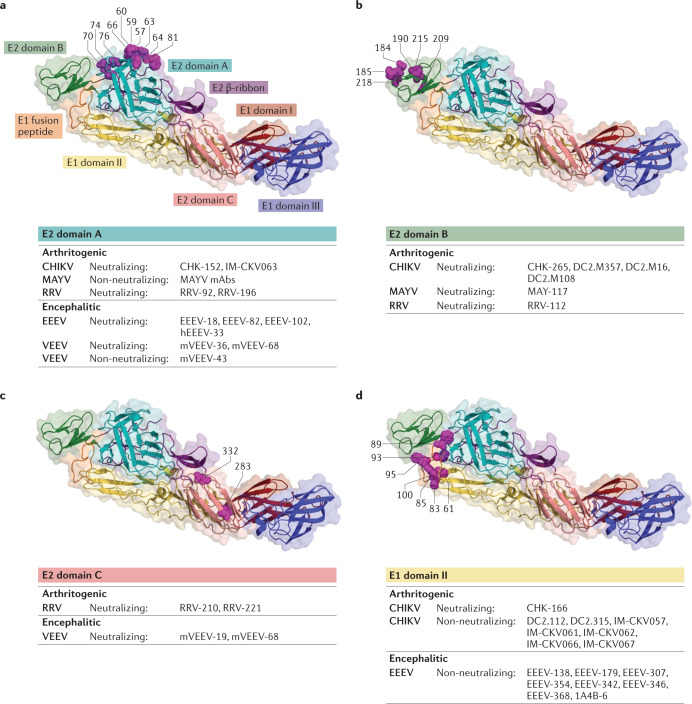
Fig. 2. Neutralizing and non-neutralizing monoclonal antibody epitopes on the alphavirus p62–E1 heterotrimer.
The key amino acids of alphavirus monoclonal antibodies (mAbs) described in this Review are highlighted on the chikungunya virus (CHIKV) E2–E1 heterodimer (Protein Data Bank ID: 6NK5). Each E2–E1 panel highlights the amino acids of protective epitopes (magenta spheres) from each mAb class (E2 domain A (part a), E2 domain B (part b), E2 domain C (part c) and E1 domain II (part d)) that are shared by two or more mAbs. CHIKV amino acid numbering is used. EEEV, Eastern equine encephalitis virus; hEEEV, human EEEV; MAYV, Mayaro virus; mVEEV, mouse VEEV; RRV, Ross River virus; VEEV, Venezuelan equine encephalitis virus.

References

    1. Suhrbier A, Jaffar-Bandjee MC, Gasque P. Arthritogenic alphaviruses — an overview. Nat. Rev. Rheumatol. 2012;8:420–429. doi: 10.1038/nrrheum.2012.64. - DOI - PubMed
    1. Carrera JP, et al. Eastern equine encephalitis in Latin America. N. Engl. J. Med. 2013;369:732–744. doi: 10.1056/NEJMoa1212628. - DOI - PMC - PubMed
    1. Morens DM, Folkers GK, Fauci AS. Eastern equine encephalitis virus — another emergent arbovirus in the United States. N. Engl. J. Med. 2019;381:1989–1992. doi: 10.1056/NEJMp1914328. - DOI - PubMed
    1. Baker RE, et al. Infectious disease in an era of global change. Nat. Rev. Microbiol. 2022;20:193–205. doi: 10.1038/s41579-021-00639-z. - DOI - PMC - PubMed
    1. Weaver SC, Reisen WK. Present and future arboviral threats. Antivir. Res. 2010;85:328–345. doi: 10.1016/j.antiviral.2009.10.008. - DOI - PMC - PubMed

Publication types

Substances