


Trends in hepatitis B notification rates in Guangzhou, China, between 2009 and 2020: an epidemiological study
- PMID: 36476118
- PMCID: PMC9727992
- DOI: 10.1186/s12879-022-07690-y
Trends in hepatitis B notification rates in Guangzhou, China, between 2009 and 2020: an epidemiological study
Abstract
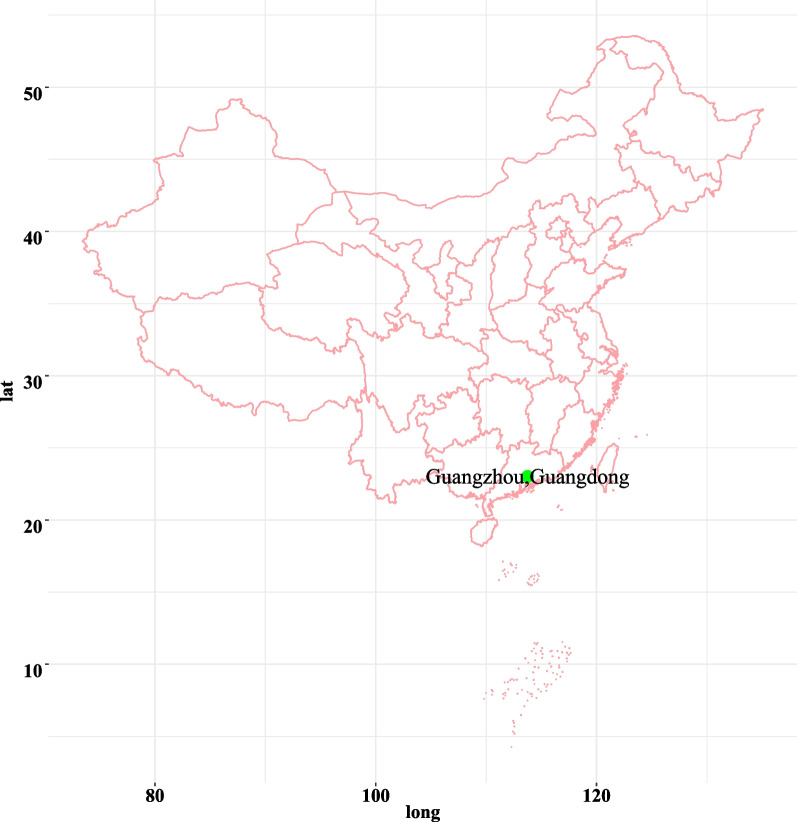
Background: Although the prevalence of hepatitis B in Guangzhou, China, is high, the epidemiological trends are not well-documented. We aimed to analyse newly reported hepatitis B cases in Guangzhou between 2009 and 2020 to explore the epidemiological trends and provide insights for the development of control measures.
Methods: Information on the population and new cases of hepatitis B in Guangzhou between 2009 and 2020 was obtained from the China Information System for Disease Control and Prevention, which was used to calculate the annual notification rates of hepatitis B by sex, age group (0-9; 10-19; 20-29; 30-39; 40-49; 50-59; ≥ 60 years), and location (urban or rural). Joinpoint regression analysis was used to analyse the temporal trends and calculate the average annual percentage change (AAPC) and annual percentage change (APC) for each identified trend line segment.
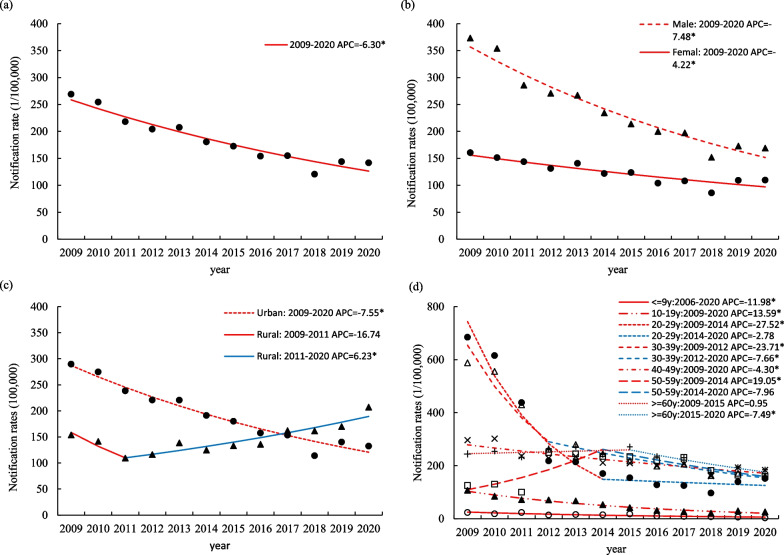
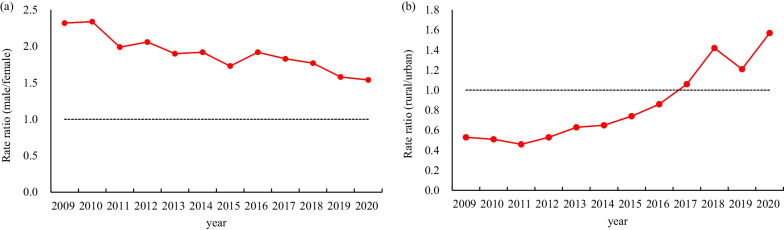
Results: Between 2009 and 2020, 287,034 new cases of hepatitis B were cumulatively reported. The average annual notification rate was 181.13/100,000, and the notification rate showed a long-term downward trend during the period 2009-2020, with an annual decrease of 6.30% (APC - 6.30%; 95% CI - 7.56 to - 5.02%). Men had a significantly higher notification rate than women; however, the sex ratio decreased from a maximum of 2.34 in 2010 to a minimum of 1.54 in 2020. A downward trend in the notification rate was observed in urban areas and an upward trend was observed in rural areas, with an increase in the rural/urban ratio from 0.46 in 2012 to 1.57 in 2020. The notification rate for all age groups showed a decreasing trend from 2009, with the exception of the 50-59 years and ≥ 60 years groups, whose notification rates began to decrease from 2014 and 2015, respectively.
Conclusions: Although the overall notification rate of hepatitis B in Guangzhou decreased annually, it remained high. Further, in rural areas, the notification rate has been increasing, and effective measures should be taken to control hepatitis B infection in Guangzhou.
Keywords: Epidemiology; Hepatitis B; Joinpoint regression; Temporal trends.
© 2022. The Author(s).
Conflict of interest statement
The authors declare that they have no competing interests.
Figures
Similar articles
-
Epidemic Trends and Spatial Distribution Characteristics of Hepatitis B in China: Surveillance Study.JMIR Public Health Surveill. 2025 May 12;11:e70888. doi: 10.2196/70888. JMIR Public Health Surveill. 2025. PMID: 40354628 Free PMC article.
-
Analysis of the epidemiological trends of Tuberculosis in China from 2000 to 2021 based on the joinpoint regression model.BMC Infect Dis. 2024 Oct 30;24(1):1223. doi: 10.1186/s12879-024-10126-4. BMC Infect Dis. 2024. PMID: 39478490 Free PMC article.
-
Trends and age-period-cohort effect on incidence of hepatitis B from 2008 to 2022 in Guangzhou, China.Sci Rep. 2024 Jun 11;14(1):13370. doi: 10.1038/s41598-024-63796-0. Sci Rep. 2024. PMID: 38862511 Free PMC article.
-
New patterns emerge after a sustained increase in the incidence of hepatitis C virus infection from 2004 to 2017: a joinpoint regression analysis.Public Health. 2019 May;170:49-56. doi: 10.1016/j.puhe.2019.01.014. Epub 2019 Mar 28. Public Health. 2019. PMID: 30928613
-
Epidemiology of Hepatitis B in Iran from 2000 to 2016: A Systematic Review and Meta-Regression Analysis.Arch Iran Med. 2020 Mar 1;23(3):189-196. Arch Iran Med. 2020. PMID: 32126788
Cited by
-
Spatial-temporal analysis of hepatitis B in Fujian Province, China in 2012-2021.Infect Med (Beijing). 2024 Apr 19;3(2):100110. doi: 10.1016/j.imj.2024.100110. eCollection 2024 Jun. Infect Med (Beijing). 2024. PMID: 38974348 Free PMC article.
-
Trends in sexually transmitted and blood-borne infections in China from 2005 to 2021: a joinpoint regression model.BMC Infect Dis. 2023 Oct 30;23(1):741. doi: 10.1186/s12879-023-08733-8. BMC Infect Dis. 2023. PMID: 37904156 Free PMC article.
-
Temporal trend analysis of acute hepatitis B virus infection in China, 1990-2019.Epidemiol Infect. 2024 Mar 12;152:e48. doi: 10.1017/S095026882400044X. Epidemiol Infect. 2024. PMID: 38468382 Free PMC article.
References
-
- Zhang Q, Qi W, Wang X, Zhang Y, Xu Y, Qin S, Zhao P, Guo H, Jiao J, Zhou C, et al. Epidemiology of hepatitis B and hepatitis C infections and benefits of programs for hepatitis prevention in Northeastern China: a cross-sectional study. Clin Infect Dis. 2016;62(3):305–312. doi: 10.1093/cid/civ859. - DOI - PubMed
-
- WHO: Hepatitis B. vol. 2022; 2021.
MeSH terms
Grants and funding
- 202102100001/Basic Research Project of Key Laboratory of Guangzhou
- 202102100001/Basic Research Project of Key Laboratory of Guangzhou
- 202201010800/Guangzhou Municipal Science and Technology Project
- 202201010800/Guangzhou Municipal Science and Technology Project
- 20215010/Scientific Research Project of Guangdong Provincial Bureau of Traditional Chinese Medicine
LinkOut - more resources
Full Text Sources
Medical
