


Prostatic artery embolization using reflux-control microcatheter: prospective experience addressing feasibility
- PMID: 36477441
- PMCID: PMC9729574
- DOI: 10.1186/s42155-022-00337-8
Prostatic artery embolization using reflux-control microcatheter: prospective experience addressing feasibility
Abstract
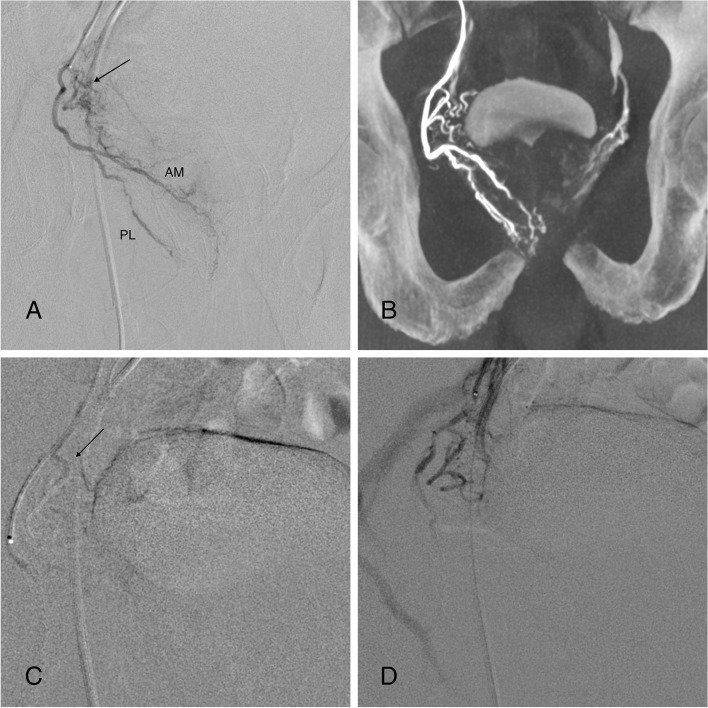
Purpose: To evaluate the efficacy and safety of Prostatic Artery Embolization (PAE) using a reflux control microcatheter.
Materials and methods: This is a prospective, single-center investigation that included 10 patients undergoing PAE for treatment of lower urinary tract symptoms (LUTS) attributed to benign prostate hyperplasia (BPH). Baseline, 3-month, and 12-month efficacy endpoints were obtained for all patients and included prostate-specific antigen (PSA), uroflowmetry, pelvic magnetic resonance imaging (MRI), and clinical assessment using the International Prostate Symptom Score (IPSS) questionnaire and the IPSS-Quality of life (QoL) item. Complications were assessed using the Cirse classification system.
Results: Ten patients entered statistical analysis and presented with significant LUTS improvement 12 months after PAE, as follows: mean IPSS reduction of 86.6% (2.8 vs. 20.7, - 17.9, P < 0.001), mean QoL reduction of 79.4% (1.1 vs. 5.4, - 4.3, P < 0.001), mean prostatic volume reduction of 38.4% (69.3 cm3 vs. 112.5 cm3, - 43.2 cm3, P < 0.001), mean peak urinary flow (Qmax) increase of 199.4% (19.9 mL/s vs. 6.6 mL/s, + 13.3 mL/s, P = 0.006) and mean PSA reduction of 50.1% (3.0 ng/mL vs. 6.1 ng/mL, - 3.0 ng/mL, P < 0.001). One patient (10%) needed transurethral resection of the prostate (TURP) after PAE due to a ball-valve effect. One microcatheter (10%) needed to be replaced during PAE due to occlusion. Non-target embolization was not observed in the cohort.
Conclusion: This initial experience suggests that PAE using a reflux control microcatheter is effective and safe for the treatment of LUTS attributed to BPH.
Keywords: Benign prostatic hyperplasia; Lower urinary tract symptoms; Non-target embolization; Prostate artery embolization.
© 2022. The Author(s).
Conflict of interest statement
The authors declare that they have no competing interests.
Figures

References
-
- Abt D, Hechelhammer L, Mullhaupt G, Markart S, Gusewell S, Kessler TM, et al. Comparison of prostatic artery embolisation (PAE) versus transurethral resection of the prostate (TURP) for benign prostatic hyperplasia: randomised, open label, noninferiority trial. Br Med J. 2018;361:k2338. doi: 10.1136/bmj.k2338. - DOI - PMC - PubMed
-
- Ayyagari R, Powell T, Staib L, Chapiro J, Schoenberger S, Devito R, et al. Case-control comparison of conventional end-hole versus balloon-occlusion microcatheter prostatic artery embolization for treatment of symptomatic benign prostatic hyperplasia. J Vasc Interv Radiol. 2019;30(9):1459–1470. doi: 10.1016/j.jvir.2019.05.033. - DOI - PubMed
LinkOut - more resources
Full Text Sources
Research Materials
Miscellaneous