


Motor skills and cognitive benefits in children and adolescents: Relationship, mechanism and perspectives
- PMID: 36478944
- PMCID: PMC9721199
- DOI: 10.3389/fpsyg.2022.1017825
Motor skills and cognitive benefits in children and adolescents: Relationship, mechanism and perspectives
Abstract
Objective: There is a strong interaction between motor skills and cognitive benefits for children and young people. The aim of this paper is to explore the relationship between motor skill types and their development and the cognitive benefits of children and adolescents. In turn, on this basis, it proposes pathways and mechanisms by which motor skills improve cognition, and provide a basis for subsequent teaching of skills that follow the laws of brain cognitive development.
Methods: This paper summarizes the research on the relationship between different types of motor skills and their development and cognitive benefits of children and adolescents. Based on these relationships, pathways, and mechanisms for motor skills to improve cognition are tentatively proposed.
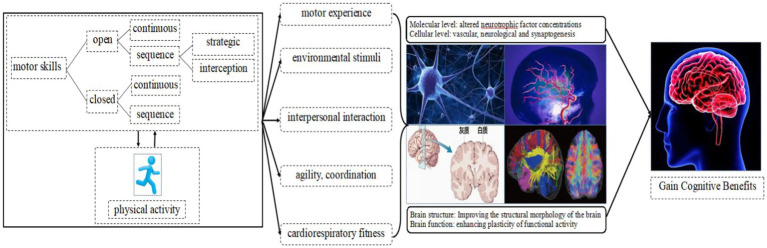
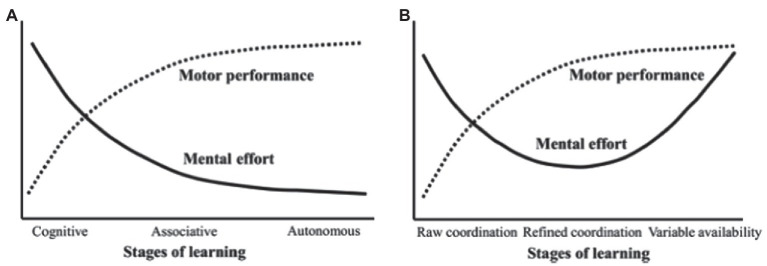
Results: There is an overall pattern of "open > closed, strategy > interception, sequence > continuous" between motor skill types and the cognitive benefits of children and adolescents. Long-term motor skill learning practice is accompanied by increased cognitive benefits as skill proficiency increases. The dynamic interaction between motor skills and physical activity exposes children and adolescents to environmental stimuli and interpersonal interactions of varying complexity, promoting the development of agility, coordination and cardiorespiratory fitness, enhancing their motor experience, which in turn improves brain structure and functional activity.
Conclusion: Motor skills training promote cognitive efficiency in children and adolescents. Motor skill interventions that are open-ended, strategic and sequential in nature are more effective. Environmental stimuli, interpersonal interaction, agility, coordination, and cardiorespiratory fitness can be considered as skill attribute moderators of motor skills to improve cognition.
Keywords: brain science; children and adolescents; cognition; executive function; motor skills.
Copyright © 2022 Shi and Feng.
Conflict of interest statement
The authors declare that the research was conducted in the absence of any commercial or financial relationships that could be construed as a potential conflict of interest.
Figures
References
-
- Ahmed A., Kramer M. S., Bernard J. Y., Perez Trejo M. E., Martin R. M., Oken E., et al. . (2020). Early childhood growth trajectory and later cognitive ability: evidence from a large prospective birth cohort of healthy term-born children. Int. J. Epidemiol. 49, 1998–2009. doi: 10.1093/ije/dyaa105, PMID: - DOI - PMC - PubMed
-
- Bi Y., Li J., Qin Z., Sun X. P., Shi J. L., Lang J. (2020). Differences in response inhibition in female college students of different soccer levels: correlation with brain anatomy. J. Beijing Normal Univ. (Nat. Sci.) 58, 310–317. doi: 10.12202/j.0476-0301.2021273 - DOI
Publication types
LinkOut - more resources
Full Text Sources
