


The impact of stigmatization of psoriasis, atopic dermatitis and mastocytosis in different areas of life-A qualitative interview study
- PMID: 36479263
- PMCID: PMC9720196
- DOI: 10.1002/ski2.62
The impact of stigmatization of psoriasis, atopic dermatitis and mastocytosis in different areas of life-A qualitative interview study
Abstract
Background: Stereotypes and false assumptions about chronic and visible skin diseases can determine the behaviour towards affected individuals and result in stigmatization or discrimination.
Objective: The aim of this study was to analyze the perceived disease-related stigmatization of individuals with psoriasis, atopic dermatitis (AD) or mastocytosis. The study also aims to broaden people-centred knowledge of the effects of stigmatization in different areas of life, namely in everyday life, at work, in sports and in relationships.
Methods: Qualitative in-depth semi-structured interviews were conducted among individuals with either psoriasis, AD or mastocytosis. Participants were recruited via self-help networks and were asked to express their experience of stigmatization in different areas of life. All interviews were audio recorded, transcribed verbatim and evaluated based on Mayring's content analysis.
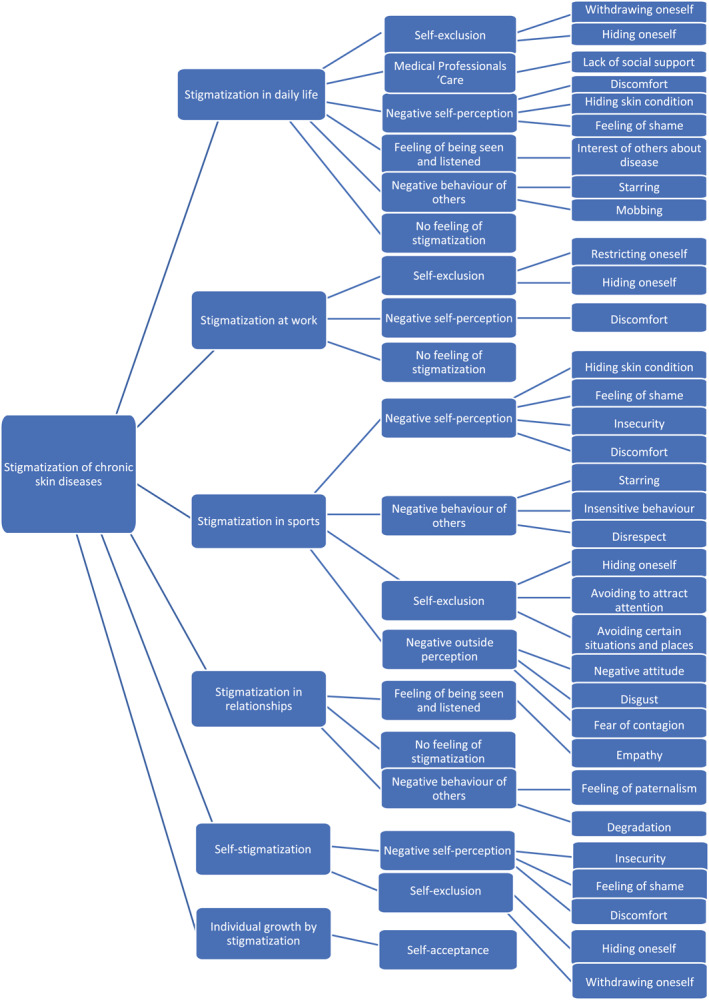
Results: In total, 24 individuals aged 19-79 years and living in Germany were included in the study-eight for each disease. Stigmatization was experienced in all three diseases in all mentioned areas of life as well as in interaction with medical professionals. Self-exclusion, negative self-perception and negative behaviour of others were the most frequent experiences with stigmatization.
Conclusion: Stigmatization, both internal and external, is an important factor contributing to the mental burden of people with chronic skin diseases. More research is needed to gain deeper insight into stigmatization and its psychological burden in various contexts to enhance people-centred care in chronic skin diseases.
© 2021 The Authors. Skin Health and Disease published by John Wiley & Sons Ltd on behalf of British Association of Dermatologists.
Conflict of interest statement
S. Ziehfreund has received speaker honoraria and travel fees from Novartis. M. C. Schielein has been an advisor and/or received speaker's honoraria of the following companies: Beiersdorf, Janssen‐Cilag, Leo Pharma, Novartis. A. Zink has been an advisor and/or received speaker's honoraria and/or received grants and/or participated in clinical trials of the following companies: AbbVie, Almirall, Amgen, Beiersdorf Dermo Medical, Celgene, Eli Lilly, GSK, Janssen Cilag, Leo Pharma, Miltenyi Biotec, Novartis, Sanofi‐Aventis, Takeda Pharma, UCB Pharma.
Figures
References
-
- Svensson A, Ofenloch RF, Bruze M, Naldi L, Cazzaniga S, Elsner P, et al. Prevalence of skin disease in a population‐based sample of adults from five European countries. Br J Dermatol. 2018;178(5):1111–8. - PubMed
-
- Tizek L, Schielein MC, Seifert F, Biedermann T, Böhner A, Zink A. Skin diseases are more common than we think: screening results of an unreferred population at the Munich Oktoberfest. J Eur Acad Dermatol Venereol. 2019;33(7):1421–8. - PubMed
-
- Mrowietz U, Schmid‐Ott G. Schuppenflechte – was sie schon immer über Psoriasis wissen wollten. Freiburg: Karger; 2012.
-
- Sabin BR, Peters N, Peters AT. Chapter 20: atopic dermatitis. Allergy Asthma Proc. 2012;33(Suppl 1):67–9. - PubMed
-
- Matito A, Azaña JM, Torrelo A, Alvarez‐Twose I. Cutaneous mastocytosis in adults and children: new classification and prognostic factors. Immunol Allergy Clin North Am. 2018;38(3):351–63. - PubMed
LinkOut - more resources
Full Text Sources