. 2022 Dec 8;12(1):21198.
doi: 10.1038/s41598-022-25628-x.

Influence of naps on sedentary time and physical activity in early childhood

Affiliations

Influence of naps on sedentary time and physical activity in early childhood

Christine W St Laurent et al. Sci Rep. .

Abstract

The objective was to determine if, in preschool-aged children, (1) nap habituality is associated with sedentary time and physical activity (movement behaviors), (2) nap physiology is associated with movement behaviors, and (3) if missing a nap, compared to taking a nap, affects movement behaviors on the same day and subsequent day. A within-subjects (44 children; 4.2 ± 0.6 years; 55.6% female), at-home study examined two experimental conditions (one afternoon each of nap- and wake-promotion with order counterbalanced) one week apart. Movement behaviors were derived from wrist-worn actigraphy (12.1 ± 3.1 days). Average movement behaviors were calculated from the overall study period with experimental days excluded. Movement behaviors were also extracted for the same day and the subsequent day of the two experimental conditions. Polysomnography was recorded during the nap-promoted condition. Children were classified as non-, intermediate-, or habitual-nappers. Although average movement behaviors were different between nap habituality groups, differences were not significant. There were no associations between movement behaviors and nap sleep stages, and no effects for nap condition or condition by nap habituality on same or next day movement behaviors. Findings do not suggest that naps and movement behaviors are related in children. Although a single missed nap was not detrimental to same or next day movement behaviors, future studies should explore effects of multiple days of subsequent nap restriction to examine potential cumulative effects.


Conflict of interest statement

The authors declare no competing interests.

Figures
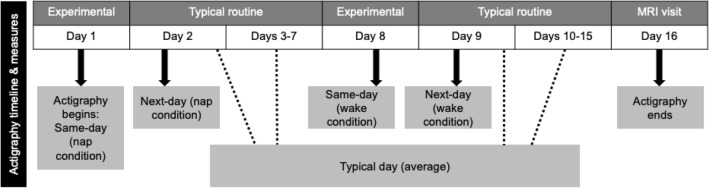
Figure 1
Figure 1
Study overview. Actigraphy was measured throughout the full period. Children followed their normal routines on non-experimental days and ‘typical’ behavior was determined from these days. On days shaded noted as experimental, children were either nap- or wake-promoted in the afternoon (order counter-balanced). Polysomnography was measured during the nap on the nap condition day. Actigraphy for each of the two conditions was determined separately for the same day of the condition (‘same’ day) and for the day immediately following the condition (‘next’ day).
Figure 2
Figure 2
Adjusted means and standard errors of habitual wake behaviors by nap habituality group. (MVPA moderate- to vigorous-intensity physical activity).
Figure 3
Figure 3
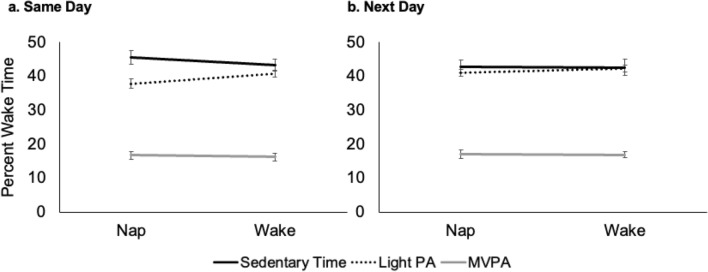
Predicted means and standard errors of wake behaviors by nap group on a) experimental condition days and b) the next day following each experimental day. (Light PA light intensity physical activity, MVPA moderate- to vigorous-intensity physical activity).
Figure 4
Figure 4
Participant flow diagram. (Note Data were pooled from the 6-month, 12-month, and then baseline time points, respectively, T time point).

References

    1. Carson V, et al. Systematic review of the relationships between physical activity and health indicators in the early years (0–4 years) BMC Public Health. 2017;17(5):33–63. - PMC - PubMed
    1. Poitras VJ, et al. Systematic review of the relationships between sedentary behaviour and health indicators in the early years (0–4 years) BMC Public Health. 2017;17(5):65–89. - PMC - PubMed
    1. St. Laurent CW, Burkart S, Andre C, Spencer RMC. Physical activity, fitness, school readiness, and cognition in early childhood: A systematic review. J. Phys. Act Health. 2021;18:1004–1013. doi: 10.1123/jpah.2020-0844. - DOI - PMC - PubMed
    1. Kuzik N, et al. Systematic review of the relationships between combinations of movement behaviours and health indicators in the early years (0–4 years) BMC Public Health. 2017;17:849–861. doi: 10.1186/s12889-017-4851-1. - DOI - PMC - PubMed
    1. Hnatiuk JA, Salmon J, Hinkley T, Okely AD, Trost S. A review of preschool children’s physical activity and sedentary time using objective measures. Am. J. Prev. Med. 2014;47:487–497. doi: 10.1016/j.amepre.2014.05.042. - DOI - PubMed

Publication types