. 2022 Dec 9;2022(1):1-8.
doi: 10.1182/hematology.2022000395.

Leukemogenesis in infants and young children with trisomy 21

Affiliations

Leukemogenesis in infants and young children with trisomy 21

Irene Roberts. Hematology Am Soc Hematol Educ Program. .

Abstract

Children with Down syndrome (DS) have a greater than 100-fold increased risk of developing acute myeloid leukemia (ML) and an approximately 30-fold increased risk of acute lymphoblastic leukemia (ALL) before their fifth birthday. ML-DS originates in utero and typically presents with a self-limiting, neonatal leukemic syndrome known as transient abnormal myelopoiesis (TAM) that is caused by cooperation between trisomy 21-associated abnormalities of fetal hematopoiesis and somatic N-terminal mutations in the transcription factor GATA1. Around 10% of neonates with DS have clinical signs of TAM, although the frequency of hematologically silent GATA1 mutations in DS neonates is much higher (~25%). While most cases of TAM/silent TAM resolve without treatment within 3 to 4 months, in 10% to 20% of cases transformation to full-blown leukemia occurs within the first 4 years of life when cells harboring GATA1 mutations persist and acquire secondary mutations, most often in cohesin genes. By contrast, DS-ALL, which is almost always B-lineage, presents after the first few months of life and is characterized by a high frequency of rearrangement of the CRLF2 gene (60%), often co-occurring with activating mutations in JAK2 or RAS genes. While treatment of ML-DS achieves long-term survival in approximately 90% of children, the outcome of DS-ALL is inferior to ALL in children without DS. Ongoing studies in primary cells and model systems indicate that the role of trisomy 21 in DS leukemogenesis is complex and cell context dependent but show promise in improving management and the treatment of relapse, in which the outcome of both ML-DS and DS-ALL remains poor.


Conflict of interest statement

Irene Roberts: no competing financial interests to declare.

Figures
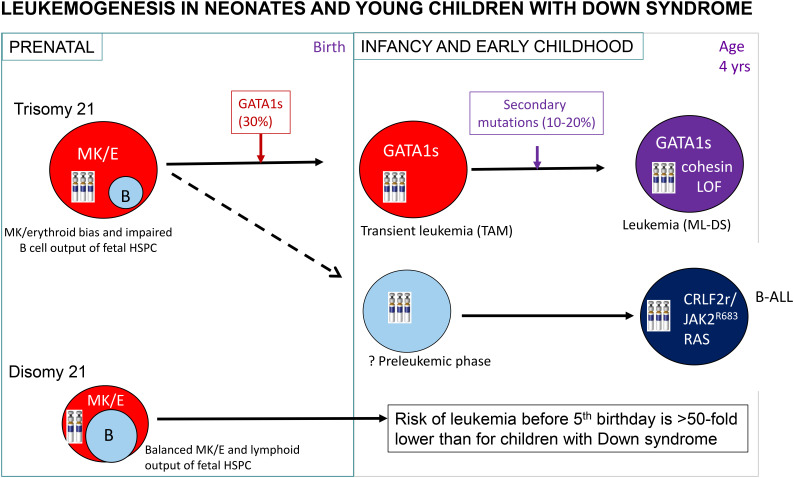
None
Graphical abstract
Figure 1.
Figure 1.
TAM and ML-DS, a multistep model of myeloid leukemogenesis in DS. Trisomy 21 causes an increase in the frequency of fetal MK-erythroid stem and progenitor cells in tandem with a severe reduction of B-cell progenitors. On this cellular background, somatic N-terminal truncating mutations in the GATA1 transcription factor gene that encode a shorter than normal GATA1 protein (GATA1s) are acquired at a high frequency during fetal life. The expression of GATA1s causes a fetal/neonatal leukemic syndrome known as TAM that is virtually unique to DS. Although TAM may be a severe disease, in 80% to 90% of cases it resolves spontaneously over the first 4 months of life. Where GATA1s-producing blast cells persist, the acquisition of mutations in additional genes, particularly those encoding cohesin complex proteins, leads to the development of ML-DS within the first 4 years of life.
Figure 2.
Figure 2.
Peripheral blood smear from a neonate with TAM. Blood smear of a 3-day-old neonate with DS and an exon 2 mutation in the GATA1 gene showing pleomorphic blast cells with features of immature and partially differentiated megakaryoblasts and a giant dysplastic platelet. May Grunwald Giemsa stain,  × 100 magnification.
Figure 3.
Figure 3.
Impact of T21 on hematopoiesis and leukemia in DS. Cartoon summarizing the putative mechanisms that link T21 with altered hematopoiesis and leukemia in early childhood in children with DS. A trisomy 21–mediated genome-wide perturbation of gene expression from early in embryonic/fetal development causes the expansion of a rapidly proliferating hematopoietic stem and myeloid progenitor pool with erythroid/MK bias in fetal liver and BM (bone marrow). These effects are hematopoietic cell-intrinsic but supported by T21-driven alterations in the microenvironment. The acquisition of somatic GATA1 mutations that encode a short GATA1 protein (GATA1s), possibly as a mutagenic effect of T21, cause further expansion of erythro-megakaryocytic cells and selective expansion of GATA1s clones, leading to the fetal/neonatal leukemia TAM. In 10% to 20% of cases of clinical TAM, ML-DS develops when GATA1s clones persist and acquire secondary mutations, most often in cohesin genes. The expansion of fetal megakaryopoiesis in DS occurs at the expense of B-progenitor development due to a T21-driven failure to properly activate the B-lineage molecular programs. This may lead to postnatal expansion of a depleted abnormally programmed B-progenitor pool, perhaps secondary to infections in early childhood, susceptible to transformation by aberrations in CRLF2, JAK2, and or RAS pathway signaling. HSC, hematopoietic stem cell; HSPC, hematopoietic stem/progenitor cell.

References

    1. Hasle H, Clemmensen IH, Mikkelsen M. Risks of leukaemia and solid tumours in individuals with Down's syndrome. Lancet. 2000;355(9199):165-169. doi:10.1016/S0140-6736(99)05264-2. - DOI - PubMed
    1. Marlow EC, Ducore J, Kwan ML, et al.. Leukemia risk in a cohort of 3.9 million children with and without Down syndrome. J Pediatr. 2021;234(July):172-180.e3180e3. doi:10.1016/j.jpeds.2021.03.001. - DOI - PMC - PubMed
    1. Antonarakis SE, Skotko BG, Rafii MS, et al.. Down syndrome. Nat Rev Dis Primers. 2020;6(1):9. doi:10.1038/s41572-019-0143-7. - DOI - PMC - PubMed
    1. Zipursky A. Transient leukaemia—a benign form of leukaemia in newborn infants with trisomy 21. Br J Haematol. 2003;120(6):930-938. doi:10.1046/j.1365-2141.2003.04229.x. - DOI - PubMed
    1. Hasle H, Friedman JM, Olsen JH, Rasmussen SA. Low risk of solid tumors in persons with Down syndrome. Genet Med. 2016;18(11):1151-1157. doi:10.1038/gim.2016.23. - DOI - PubMed

Substances

Supplementary concepts