. 2022 Dec 9;12(1):21307.
doi: 10.1038/s41598-022-25298-9.

Urinary neopterin reflects immunological variation associated with age, helminth parasitism, and the microbiome in a wild primate

Affiliations

Urinary neopterin reflects immunological variation associated with age, helminth parasitism, and the microbiome in a wild primate

India A Schneider-Crease et al. Sci Rep. .

Abstract

Neopterin, a product of activated white blood cells, is a marker of nonspecific inflammation that can capture variation in immune investment or disease-related immune activity and can be collected noninvasively in urine. Mounting studies in wildlife point to lifetime patterns in neopterin related to immune development, aging, and certain diseases, but rarely are studies able to assess whether neopterin can capture multiple concurrent dimensions of health and disease in a single system. We assessed the relationship between urinary neopterin stored on filter paper and multiple metrics of health and disease in wild geladas (Theropithecus gelada), primates endemic to the Ethiopian highlands. We tested whether neopterin captures age-related variation in inflammation arising from developing immunity in infancy and chronic inflammation in old age, inflammation related to intramuscular tapeworm infection, helminth-induced anti-inflammatory immunomodulation, and perturbations in the gastrointestinal microbiome. We found that neopterin had a U-shaped relationship with age, no association with larval tapeworm infection, a negative relationship with metrics related to gastrointestinal helminth infection, and a negative relationship with microbial diversity. Together with growing research on neopterin and specific diseases, our results demonstrate that urinary neopterin can be a powerful tool for assessing multiple dimensions of health and disease in wildlife.


Conflict of interest statement

The authors declare no competing interests.

Figures
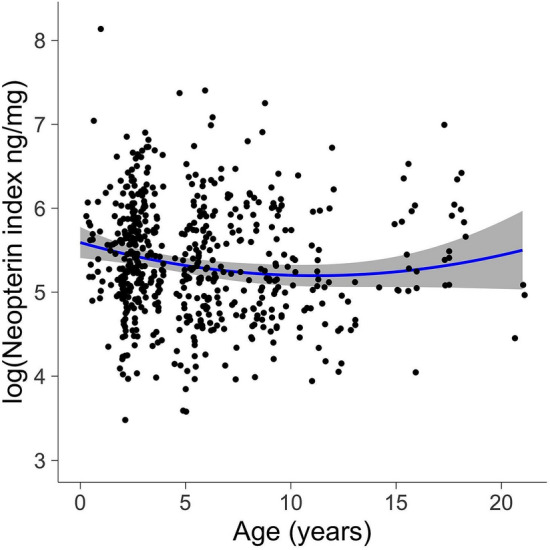
Figure 1
Figure 1
Log-transformed creatinine-corrected neopterin concentrations (neopterin:creatinine ng/mg) peak at early and older ages. The regression line and 95% confidence interval were generated with the R package ‘ggplot2’ for visualization; see Table 2 for estimates accounting for covariates and random effects. The marginal R2 (proportion of variance explained by the fixed effects) was 0.092, the conditional R2 (proportion of variance explained by the whole model) was 0.413, and the proportions of random effects variance explained by individual ID and batches were 0.086 and 0.267, respectively.
Figure 2
Figure 2
No association between log-transformed and creatinine-corrected Taenia antigen values and log-transformed neopterin index (neopterin:creatinine ng/mL). A small constant (4) was added to Taenia antigen concentrations to scale all concentrations to zero. The regression line and 95% confidence interval were generated with the R package ‘ggplot2’ for visualization; see Table 3 for estimates accounting for covariates and random effects. The marginal R2 (proportion of variance explained by the fixed effects) was 0.045, the conditional R2 (proportion of variance explained by the whole model) was 0.552, and the proportions of random effects variance explained by individual ID and batches were 0.411 and 0.130, respectively.
Figure 3
Figure 3
Higher richness of Oesophagostomum spp. helminth parasite amplicon sequence variants (ASVs) is associated with lower urinary neopterin index in geladas (neopterin:creatinine ng/mL). Neopterin samples were matched to all fecal parasite samples from the year prior to urine sample collection. Points are jittered for visualization. The regression line and 95% confidence interval were generated with the R package ‘ggplot2’ for visualization; see Table 4 for estimates accounting for covariates and random effects. The marginal R2 was 0.074, the conditional R2 was 0.392, and the proportions of random effects variance explained by individual ID and batches were 0.061 and 0.282, respectively.
Figure 4
Figure 4
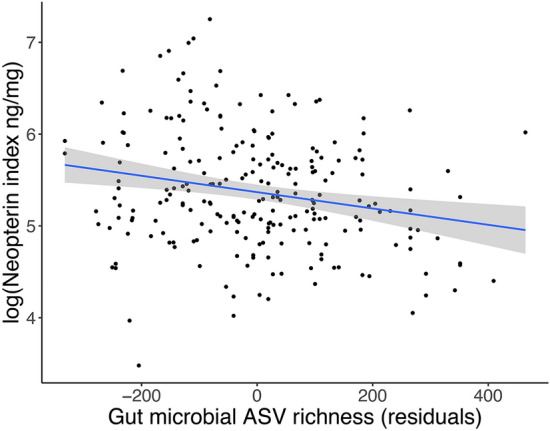
Higher microbial diversity (ASV richness) is associated with lower urinary neopterin index (neopterin:creatinine ng/mL) in geladas. Neopterin samples were matched to all gut microbiome samples from the month prior to urine sample collection. The regression line and 95% confidence interval were generated with the R package ‘ggplot2’ for visualization; see Table 5 for estimates accounting for covariates and random effects. The marginal R2 (proportion of variance explained by the fixed effects) was 0.146, the conditional R2 (proportion of variance explained by the whole model) was 0.368, and the proportions of random effects variance explained by individual ID and batches were 0.033 and 0.065, respectively.

References

    1. Schneider-Crease I, Griffin RH, Gomery MA, Dorny P, Noh JJC, Handali S, et al. Identifying wildlife reservoirs of neglected taeniid tapeworms: Non-invasive diagnosis of endemic Taenia serialis infection in a wild primate population. PLoS Negl Trop Dis. 2017;11:e0005709. doi: 10.1371/journal.pntd.0005709. - DOI - PMC - PubMed
    1. Schneider-Crease I, Beehner JC, Bergman TJ, Gomery MA, Koklic L, Lu A, et al. Ecology eclipses phylogeny as a major driver of nematode parasite community structure in a graminivorous primate. Funct. Ecol. 2020;34:1898–1906. doi: 10.1111/1365-2435.13603. - DOI - PMC - PubMed
    1. Gillespie TR. Noninvasive assessment of gastrointestinal parasite infections in free-ranging primates. Int. J. Primatol. 2006;27:1129. doi: 10.1007/s10764-006-9064-x. - DOI
    1. Budischak SA, Hoberg EP, Abrams A, Jolles AE, Ezenwa VO. A combined parasitological molecular approach for noninvasive characterization of parasitic nematode communities in wild hosts. Mol. Ecol. Resour. 2015;15:1112–1119. doi: 10.1111/1755-0998.12382. - DOI - PubMed
    1. Ghalehnoei H, Bagheri A, Fakhar M, Mishan MA. Circulatory microRNAs: promising non-invasive prognostic and diagnostic biomarkers for parasitic infections. Eur. J. Clin. Microbiol. Infect. Dis. 2020;39:395–402. doi: 10.1007/s10096-019-03715-8. - DOI - PubMed

Publication types