


The Follow-Up of Eating Disorders from Adolescence to Early Adulthood: A Systematic Review
- PMID: 36498309
- PMCID: PMC9736479
- DOI: 10.3390/ijerph192316237
The Follow-Up of Eating Disorders from Adolescence to Early Adulthood: A Systematic Review
Abstract
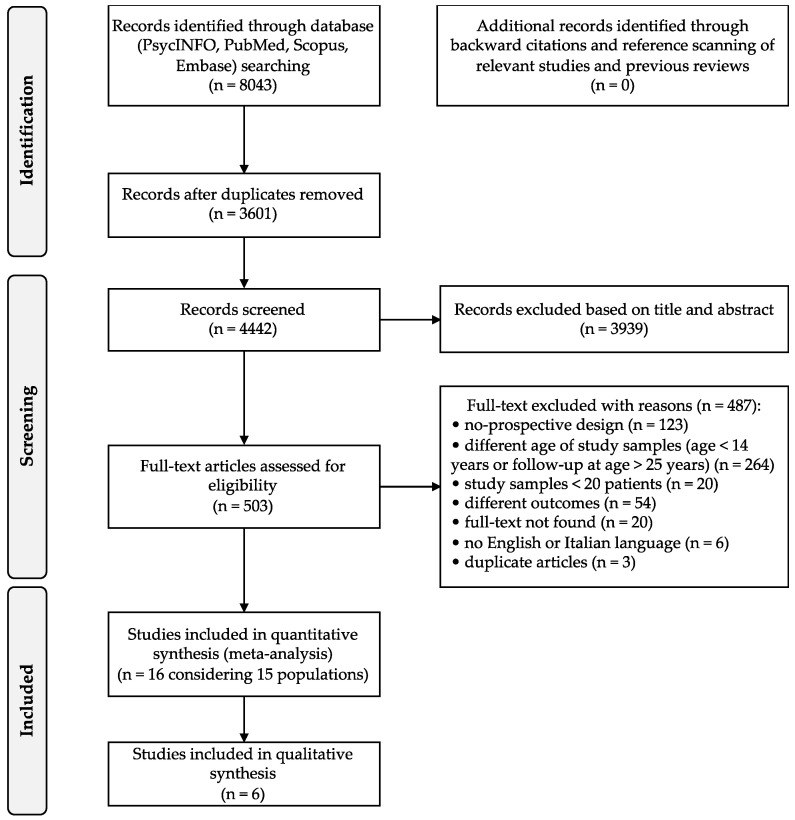
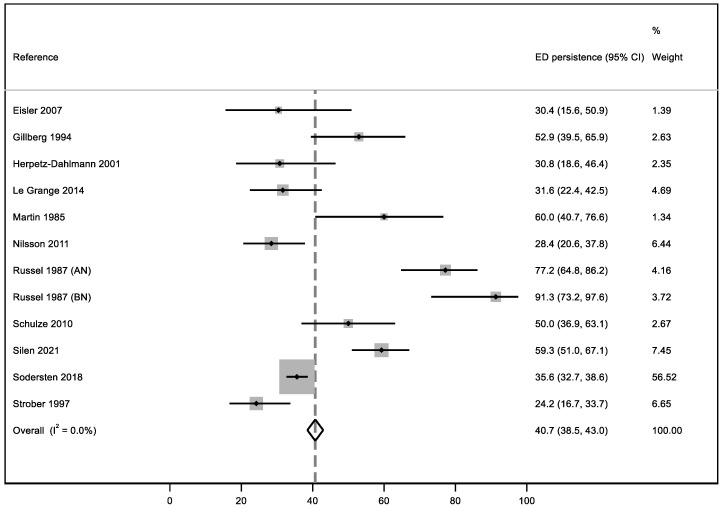
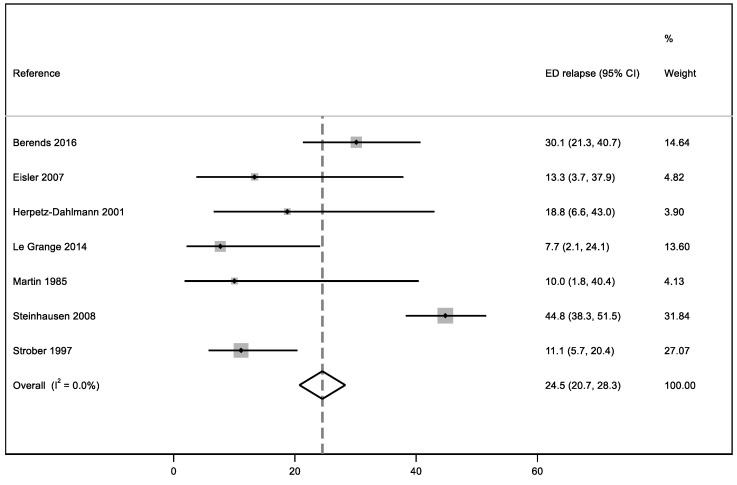
Eating disorders (EDs) are common among children and adolescents and are characterized by excessive concerns for physical appearance, distorted body image, and fear of gaining weight. The purpose of this review is to evaluate the follow-up of EDs from adolescence to adulthood, analyzing persistence, relapses, and associated comorbidities. We searched scientific articles in PubMed, PsycInfo, Scopus, and Embase through two research strings, one for quantitative outcomes (recovery/persistence, relapse, and remission) and one for the other outcomes (psychiatric and medical comorbidities, substance use, and social-relational complications). From a total of 8043 retrieved articles, we selected 503 papers after exclusion of duplicates and title/abstract screening. After a full-text evaluation, we included 16 studies eligible for this review. We performed a meta-analysis describing the quantitative results, and we created a narrative synthesis for the qualitative outcomes. Results: Our results confirm that EDs can persist in early adulthood in 40.7% of cases with a relapse percentage of 24.5%. Individuals with an ED more frequently present with an empathy deficit and comorbid anxiety and depressive disorders. EDs are chronic and complex disorders, more frequent in females. In most cases, EDs reduce the autonomy of individuals who present many difficulties in affirming their independence from parental family.
Keywords: adolescence; anorexia nervosa; bulimia nervosa; eating disorders; medical and psychiatric comorbidity; social–relational complications; substance use.
Conflict of interest statement
The authors declare no conflict of interest.
Figures
References
-
- Ferguson C.P., Pigott T.A. Anorexia and bulimia nervosa: Neurobiology and pharmacotherapy. Behav. Ther. 2000;31:237–263. doi: 10.1016/S0005-7894(00)80014-3. - DOI
-
- Gull W. Anorexia nervosa. Lancet. 1888;131:516–517. doi: 10.1016/S0140-6736(00)48519-3. - DOI
-
- World Health Organization . ICD-10: International Statistical Classification of Diseases and Related Health Problems: Tenth Revision. 2nd ed. World Health Organization; Geneva, Switzerland: 2004. [(accessed on 19 October 2022)]. Available online: https://apps.who.int/iris/handle/10665/42980.
-
- American Psychiatric Association . Diagnostic and Statistical Manual of Mental Disorders: DSM-III. American Psychiatric Association; Washington, DC, USA: 1980.
Publication types
MeSH terms
LinkOut - more resources
Full Text Sources
Medical
