


Pharmacokinetics, Pharmacodynamics, and Dosing Considerations of Novel β-Lactams and β-Lactam/β-Lactamase Inhibitors in Critically Ill Adult Patients: Focus on Obesity, Augmented Renal Clearance, Renal Replacement Therapies, and Extracorporeal Membrane Oxygenation
- PMID: 36498473
- PMCID: PMC9738279
- DOI: 10.3390/jcm11236898
Pharmacokinetics, Pharmacodynamics, and Dosing Considerations of Novel β-Lactams and β-Lactam/β-Lactamase Inhibitors in Critically Ill Adult Patients: Focus on Obesity, Augmented Renal Clearance, Renal Replacement Therapies, and Extracorporeal Membrane Oxygenation
Abstract
Objective: Dose optimization of novel β-lactam antibiotics (NBLA) has become necessary given the increased prevalence of multidrug-resistant infections in intensive care units coupled with the limited number of available treatment options. Unfortunately, recommended dose regimens of NBLA based on PK/PD indices are not well-defined for critically ill patients presenting with special situations (i.e., obesity, extracorporeal membrane oxygenation (ECMO), augmented renal clearance (ARC), and renal replacement therapies (RRT)). This review aimed to discuss and summarize the available literature on the PK/PD attained indices of NBLA among critically ill patients with special circumstances.
Data sources: PubMed, MEDLINE, Scopus, Google Scholar, and Embase databases were searched for studies published between January 2011 and May 2022.
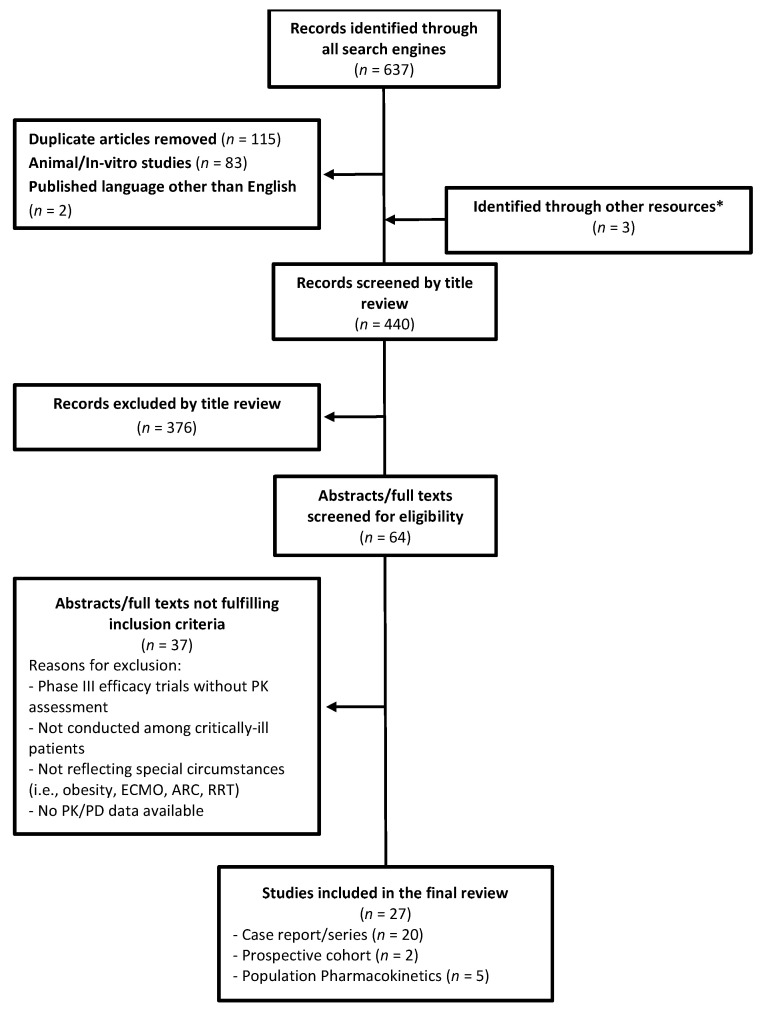
Study selection and data extraction: Articles relevant to NBLA (i.e., ceftolozane/tazobactam, ceftazidime/avibactam, cefiderocol, ceftobiprole, imipenem/relebactam, and meropenem/vaborbactam) were selected. The MeSH terms of "obesity", "augmented renal clearance", "renal replacement therapy", "extracorporeal membrane oxygenation", "pharmacokinetic", "pharmacodynamic" "critically ill", and "intensive care" were used for identification of articles. The search was limited to adult humans' studies that were published in English. A narrative synthesis of included studies was then conducted accordingly.
Data synthesis: Available evidence surrounding the use of NBLA among critically ill patients presenting with special situations was limited by the small sample size of the included studies coupled with high heterogeneity. The PK/PD target attainments of NBLA were reported to be minimally affected by obesity and/or ECMO, whereas the effect of renal functionality (in the form of either ARC or RRT) was more substantial.
Conclusion: Critically ill patients presenting with special circumstances might be at risk of altered NBLA pharmacokinetics, particularly in the settings of ARC and RRT. More robust, well-designed trials are still required to define effective dose regimens able to attain therapeutic PK/PD indices of NBLA when utilized in those special scenarios, and thus aid in improving the patients' outcomes.
Keywords: augmented renal clearance; critical care; extracorporeal membrane oxygenation; novel beta-lactam antibiotics; obesity; pharmacodynamics; pharmacokinetics; renal replacement.
Conflict of interest statement
The authors declare no conflict of interest.
Figures
References
-
- Rudd K.E., Johnson S.C., Agesa K.M., Shackelford K.A., Tsoi D., Kievlan D.R., Colombara D.V., Ikuta K.S., Kissoon N., Finfer S., et al. Global, regional, and national sepsis incidence and mortality, 1990–2017: Analysis for the Global Burden of Disease Study. Lancet. 2020;395:200–211. doi: 10.1016/S0140-6736(19)32989-7. - DOI - PMC - PubMed
-
- Sunenshine R.H., Wright M.O., Maragakis L.L., Harris A.D., Song X., Hebden J., Cosgrove S.E., Anderso A., Carnell J., Jernigan D.B., et al. Multidrug-resistant Acinetobacter infection mortality rate and length of hospitalization. Emerg. Infect. Dis. 2007;13:97–103. doi: 10.3201/eid1301.060716. - DOI - PMC - PubMed
Publication types
LinkOut - more resources
Full Text Sources
