


Global Transcriptional Profiling of Granulosa Cells from Polycystic Ovary Syndrome Patients: Comparative Analyses of Patients with or without History of Ovarian Hyperstimulation Syndrome Reveals Distinct Biomarkers and Pathways
- PMID: 36498516
- PMCID: PMC9740016
- DOI: 10.3390/jcm11236941
Global Transcriptional Profiling of Granulosa Cells from Polycystic Ovary Syndrome Patients: Comparative Analyses of Patients with or without History of Ovarian Hyperstimulation Syndrome Reveals Distinct Biomarkers and Pathways
Abstract
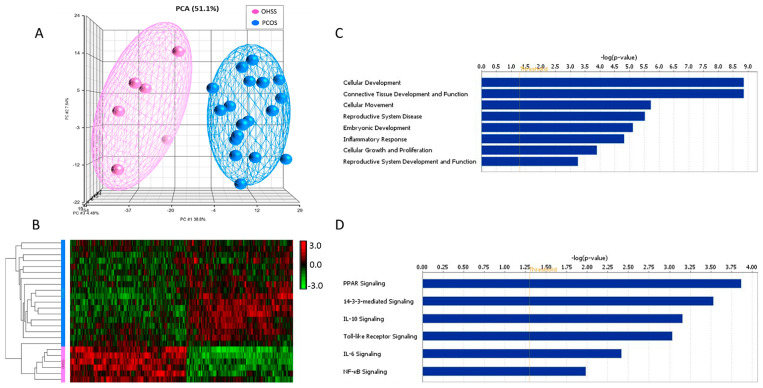
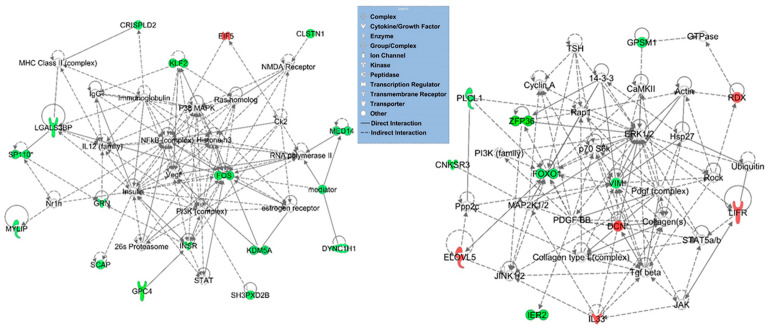
Ovarian hyperstimulation syndrome (OHSS) is often a complication of polycystic ovarian syndrome (PCOS), the most frequent disorder of the endocrine system, which affects women in their reproductive years. The etiology of OHSS is multifactorial, though the factors involved are not apparent. In an attempt to unveil the molecular basis of OHSS, we conducted transcriptome analysis of total RNA extracted from granulosa cells from PCOS patients with a history of OHSS (n = 6) and compared them to those with no history of OHSS (n = 18). We identified 59 significantly dysregulated genes (48 down-regulated, 11 up-regulated) in the PCOS with OHSS group compared to the PCOS without OHSS group (p-value < 0.01, fold change >1.5). Functional, pathway and network analyses revealed genes involved in cellular development, inflammatory and immune response, cellular growth and proliferation (including DCN, VIM, LIFR, GRN, IL33, INSR, KLF2, FOXO1, VEGF, RDX, PLCL1, PAPPA, and ZFP36), and significant alterations in the PPAR, IL6, IL10, JAK/STAT and NF-κB signaling pathways. Array findings were validated using quantitative RT-PCR. To the best of our knowledge, this is the largest cohort of Saudi PCOS cases (with or without OHSS) to date that was analyzed using a transcriptomic approach. Our data demonstrate alterations in various gene networks and pathways that may be involved in the pathophysiology of OHSS. Further studies are warranted to confirm the findings.
Keywords: biomarker; functional pathway; gene ontology; genome-wide gene expression; network analyses; ovarian hyperstimulation syndrome (OHSS); polycystic ovarian syndrome (PCOS); transcriptome.
Conflict of interest statement
The authors declare no conflict of interest. The funders had no role in the design of the study; in the collection, analyses, or interpretation of data; in the writing of the manuscript; or in the decision to publish the results.
Figures
References
-
- Namavar Jahromi B.M., Parsanezhad M.M., Shomali Z.M., Bakhshai P.M., Alborzi M.M., Moin Vaziri N.M.D.P., Anvar Z.P. Ovarian Hyperstimulation Syndrome: A Narrative Review of Its Pathophysiology, Risk Factors, Prevention, Classification, and Management. Iran. J. Med. Sci. 2018;43:248–260. - PMC - PubMed
-
- Soave I., Marci R. Ovarian stimulation in patients in risk of OHSS. Minerva Ginecol. 2014;66:165–178. - PubMed
Grants and funding
LinkOut - more resources
Full Text Sources
Research Materials
Miscellaneous
