


Fractional Flow Reserve versus Angiography-Guided Management of Coronary Artery Disease: A Meta-Analysis of Contemporary Randomised Controlled Trials
- PMID: 36498667
- PMCID: PMC9735801
- DOI: 10.3390/jcm11237092
Fractional Flow Reserve versus Angiography-Guided Management of Coronary Artery Disease: A Meta-Analysis of Contemporary Randomised Controlled Trials
Abstract
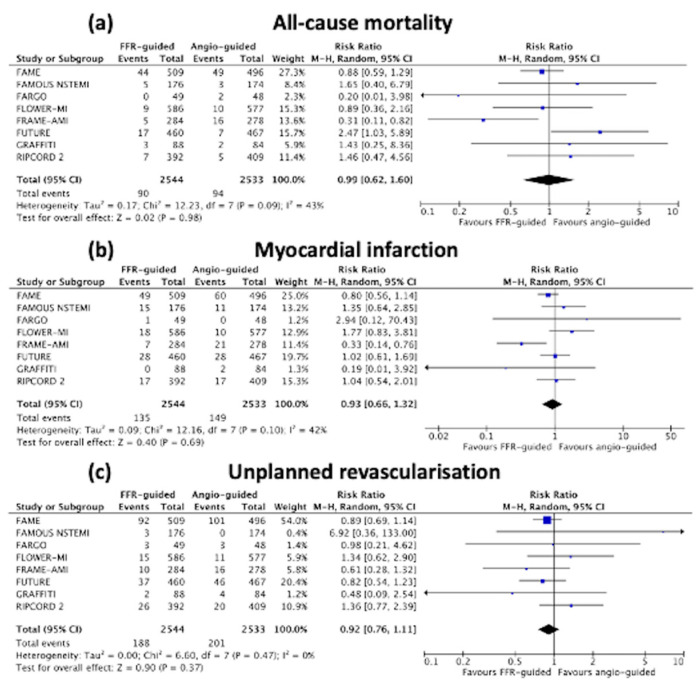
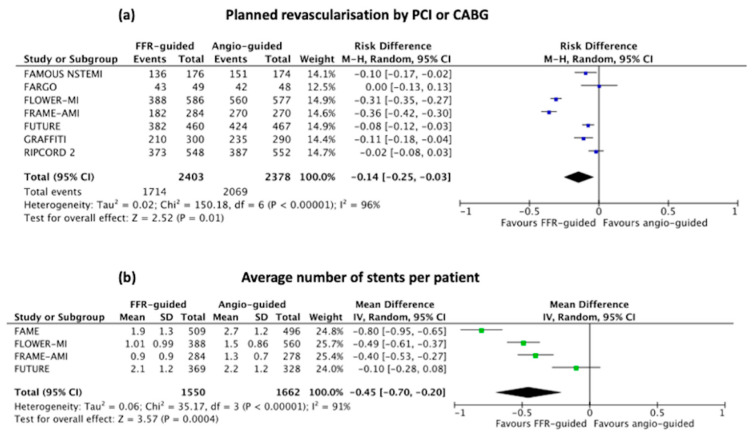
Background and Aims: Randomised controlled trials (RCTs) comparing outcomes after fractional flow reserve (FFR)-guided versus angiography-guided management for obstructive coronary artery disease (CAD) have produced conflicting results. We investigated the efficacy and safety of an FFR-guided versus angiography-guided management strategy among patients with obstructive CAD. Methods: A systematic electronic search of the major databases was performed from inception to September 2022. We included studies of patients presenting with angina or myocardial infarction (MI), managed with medications, percutaneous coronary intervention, or bypass graft surgery. A meta-analysis was performed by pooling the risk ratio (RR) using a random-effects model. The endpoints of interest were all-cause mortality, MI and unplanned revascularisation. Results: Eight RCTs, with outcome data from 5077 patients, were included. The weighted mean follow up was 22 months. When FFR-guided management was compared to angiography-guided management, there was no difference in all-cause mortality [3.5% vs. 3.7%, RR: 0.99 (95% confidence interval (CI) 0.62−1.60), p = 0.98, heterogeneity (I2) 43%], MI [5.3% vs. 5.9%, RR: 0.93 (95%CI 0.66−1.32), p = 0.69, I2 42%], or unplanned revascularisation [7.4% vs. 7.9%, RR: 0.92 (95%CI 0.76−1.11), p = 0.37, I2 0%]. However, the number patients undergoing planned revascularisation by either stent or surgery was significantly lower with an FFR-guided strategy [weighted mean difference: 14 (95% CI 3 to 25)%, p =< 0.001]. Conclusion: In patients with obstructive CAD, an FFR-guided management strategy did not impact on all-cause mortality, MI and unplanned revascularisation, when compared to an angiography-guided management strategy, but led to up to a quarter less patients needing revascularisation.
Keywords: angiography; coronary artery bypass graft surgery; coronary artery disease; fractional flow reserve; percutaneous coronary intervention.
Conflict of interest statement
NC reports receiving unrestricted research grants from Boston Scientific (RIPCORD2) and HeartFlow (FORECAST).
Figures
References
-
- Lawton J.S., Tamis-Holland J.E., Bangalore S., Bates E.R., Beckie T.M., Bischoff J.M., Bittl J.A., Cohen M.G., DiMaio J.M., Don C.W., et al. 2021 ACC/AHA/SCAI Guideline for Coronary Artery Revascularization: Executive Summary: A Report of the American College of Cardiology/American Heart Association Joint Committee on Clinical Practice Guidelines. Circulation. 2022;145:e4–e17. doi: 10.1161/CIR.0000000000001039. - DOI - PubMed
-
- van Nunen L.X., Zimmermann F.M., Tonino P.A.L., Barbato E., Baumbach A., Engstrøm T., Klauss V., A MacCarthy P., Manoharan G., Oldroyd K.G., et al. Fractional flow reserve versus angiography for guidance of PCI in patients with multivessel coronary artery disease (FAME): 5-year follow-up of a randomised controlled trial. Lancet. 2015;386:1853–1860. doi: 10.1016/S0140-6736(15)00057-4. - DOI - PubMed
-
- Hahn J.Y. FFR vs. Angiography-guided PCI in AMI with multivessel disease—FRAME-AMI trial; Proceedings of the European Society of Cardiology Conference; Barcelona, Spain. 27–31 August 2022.
-
- Stables R.H., Mullen L.J., Elguindy M., Nicholas Z., Aboul-Enien Y.H., Kemp I., O’Kane P., Hobson A., Johnson T.W., Khan S.Q., et al. Routine Pressure Wire Assessment Versus Conventional Angiography in the Management of Patients with Coronary Artery Disease: The RIPCORD 2 Trial. Circulation. 2022;146:687–698. doi: 10.1161/CIRCULATIONAHA.121.057793. - DOI - PubMed
-
- Thuesen A.L., Riber L., Veien K.T., Christiansen E.H., Jensen S.E., Modrau I.S., Andreasen J.J., Junker A., Mortensen P.E., Jensen L.O. Fractional Flow Reserve Versus Angiographically-Guided Coronary Artery Bypass Grafting. J. Am. Coll. Cardiol. 2018;72:2732–2743. doi: 10.1016/j.jacc.2018.09.043. - DOI - PubMed
Publication types
LinkOut - more resources
Full Text Sources
Miscellaneous
