Review
. 2022 Nov 24;23(23):14663.
doi: 10.3390/ijms232314663.

Modulation of the Inflammatory Response in Polycystic Ovary Syndrome (PCOS)-Searching for Epigenetic Factors

Affiliations
Review

Modulation of the Inflammatory Response in Polycystic Ovary Syndrome (PCOS)-Searching for Epigenetic Factors

Dariusz Szukiewicz et al. Int J Mol Sci. .

Abstract

Polycystic ovary syndrome (PCOS) is the most common endocrine disorder in women of reproductive age. Despite its incidence, the syndrome is poorly understood and remains underdiagnosed, and female patients are diagnosed with a delay. The heterogenous nature of this complex disorder results from the combined occurrence of genetic, environmental, endocrine, and behavioral factors. Primary clinical manifestations of PCOS are derived from the excess of androgens (anovulation, polycystic ovary morphology, lack of or scanty, irregular menstrual periods, acne and hirsutism), whereas the secondary manifestations include multiple metabolic, cardiovascular, and psychological disorders. Dietary and lifestyle factors play important roles in the development and course of PCOS, which suggests strong epigenetic and environmental influences. Many studies have shown a strong association between PCOS and chronic, low-grade inflammation both in the ovarian tissue and throughout the body. In the vast majority of PCOS patients, elevated values of inflammatory markers or their gene markers have been reported. Development of the vicious cycle of the chronic inflammatory state in PCOS is additionally stimulated by hyperinsulinemia and obesity. Changes in DNA methylation, histone acetylation and noncoding RNA levels are presented in this review in the context of oxidative stress, reactive oxygen species, and inflammatory signaling in PCOS. Epigenetic modulation of androgenic activity in response to inflammatory signaling is also discussed.

Keywords: androgenic activity modulation; epigenetic factors; inflammatory response; insulin resistance; mitochondrial dysfunction; oxidative stress; polycystic ovary syndrome.


Conflict of interest statement

The authors declare no conflict of interest.

Figures
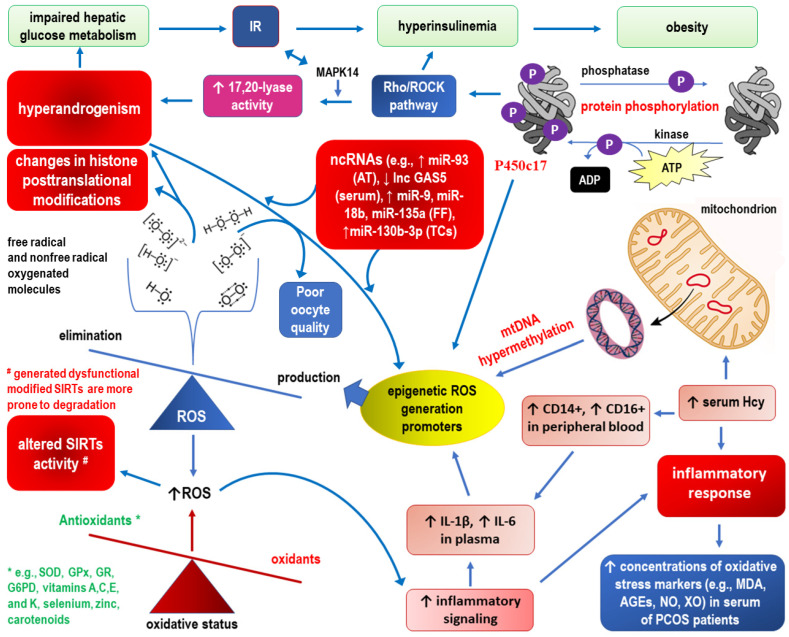
Figure 3
Figure 3
Epigenetic landscape related to ROS formation in PCOS. See the main text (Section 2.1) for detailed explanations.
Figure 4
Figure 4
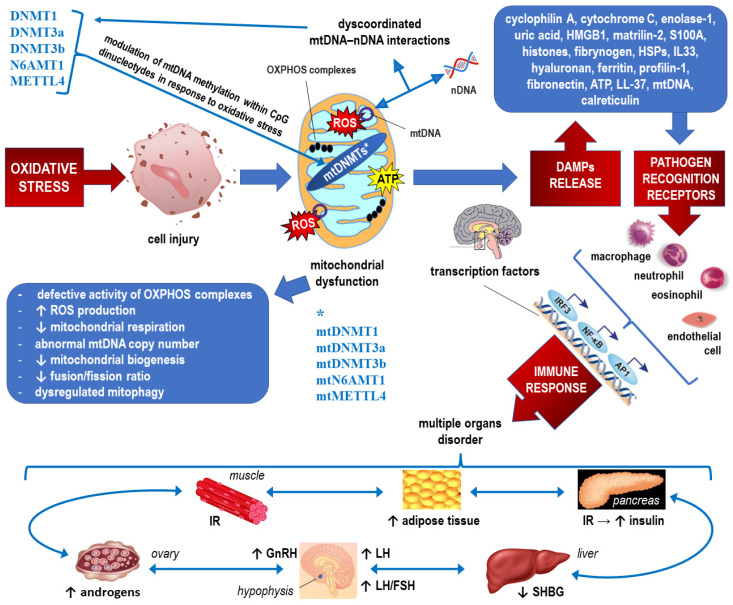
Epigenetics of mitochondrial dysfunction in PCOS. See the main text (Section 2.2) for detailed explanations. PCOS is caused by a vicious cycle of androgen excess, insulin resistance, low-grade inflammation, obesity and increased oxidative stress [91]. * Mitochondrial DNA methyltransferase 1, DNA methyltransferase 3 alpha, DNA methyltransferase 3 beta, N-6 adenine-specific DNA methyltrasferase 1, and methyltransferase 4, respectively.
Figure 1
Figure 1
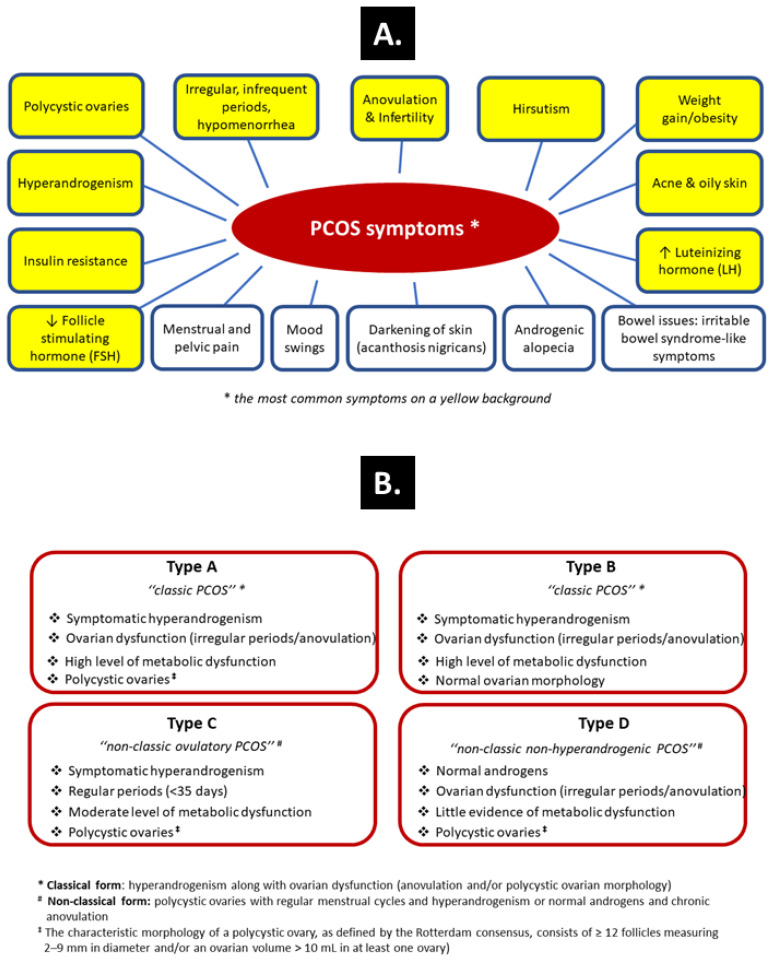
Symptoms of PCOS (A) and the simple clinical classification taking into account the phenotypes of PCOS (B) [6].
Figure 2
Figure 2
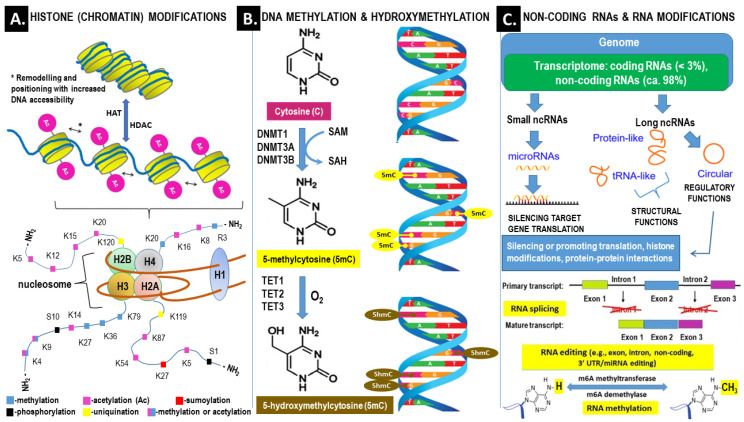
Overview of the main epigenetic mechanisms that regulate gene expression and may establish potentially heritable changes in gene expression without altering the underlying DNA nucleotide sequence. (A) Histone (chromatin) modifications. At the top. Chromatin remodeling is the dynamic modification of chromatin architecture to allow access of condensed genomic DNA to the regulatory transcription machinery proteins, and thereby control gene expression. For example, histone acetylation by HAT (histone acetyl transferase) increases DNA (chromatin) accessibility because acetylated histones cannot pack as well together as deacetylated histones. HDAC–histone deacetylase; At the bottom. Each nucleosome consists of two subunits, both made of histones H2A, H2B, H3 and H4, also known as core histones, with the linker histone H1 acting as a stabilizer. Histone post-translational modifications are covalent modifications of histones by phosphorylation on serine or threonine residues, methylation on lysine or arginine, acetylation and deacetylation of lysines, ubiquitylation of lysines and sumoylation of lysines. Histone modifications affect chromosome structure and function, especially during transcription and chromatin remodeling processes. (B) DNA methylation and hydroxymethylation. DNA can be modified at cytosine and adenine residues by the addition of chemical groups. Cytosines can be modified by methylation (5mc) or hydroxymethylation (5hmC), while adenines are modified by methylation. CpG islands (regions of the genome that contain a large numer of CpG dunucleotide repeats) are DNA methylations regions in promoters known to regulate gene expression through transcriptional silencing of the corresponding gene. DNA methylation at CpG islands is crucial for gene expression and tissue-specific processes. DNMT–DNA methyltransferase; SAM–S-adenosylmethionine; SAH–S-adenosylhomo-cysteine; TET–ten-eleven-translocation (methylcytosine dioxygenase). (C) Non-coding RNAs (ncRNAs) and RNA modifications–ncRNAs play an important role in transcription regulation by epigenetic machinery. Within RNA-induced silencing complexes (RISCs), miRNAs mediate the recognition and binding of RNAs that become targeted for degradation. lncRNAs are associated with other complexes and can activate or repress transcription-Alternative splicing (AS) of pre–mRNAs serves as an additional regulatory process for gene expression after transcription, and it generates distinct mRNA species, and even noncoding RNAs (ncRNAs), from one primary transcript. AS contributes to the diversity of proteins in eukaryotes as cells respond to signals from the environment. AS may lead to generation of ncRNAs, especially long noncoding RNAs (lncRNAs). RNA modifications, such as the RNA N6-methyladenosine (m6A) modification, have been found to regulate AS–RNA editing is an important mechanism of genetic regulation that amplifies genetic plasticity by allowing the production of alternative protein products from a single gene. RNA editing involves the post-transcriptional insertion and deletion of nucleotides (e.g., uridylate–UMP) within nascent transcripts. RNA editing has been observed in mRNAs, tRNAs, and rRNAs, in mitochondrial and chloroplast encoded RNAs, as well as in nuclear encoded RNAs–RNA methylaton is a post-transcriptional level of regulation. At present, more than 150 kinds of RNA modifications have been identified. They are widely distributed in messenger RNA (mRNA), transfer RNA (tRNA), ribosomal RNA (rRNA), noncoding small RNA (sncRNA) and long-chain non-coding RNA (lncRNA).

References

    1. Azziz R. Introduction. Fertil. Steril. 2016;106:4–5. doi: 10.1016/j.fertnstert.2016.05.009. - DOI - PubMed
    1. Liu J., Wu Q., Hao Y., Jiao M., Wang X., Jiang S., Han L. Measuring the global disease burden of polycystic ovary syndrome in 194 countries: Global Burden of Disease Study 2017. Hum. Reprod. 2021;36:1108–1119. doi: 10.1093/humrep/deaa371. - DOI - PMC - PubMed
    1. Pundir C.S., Deswal R., Narwal V., Dang A. The Prevalence of Polycystic Ovary Syndrome: A Brief Systematic Review. J. Hum. Reprod. Sci. 2020;13:261–271. doi: 10.4103/jhrs.JHRS_95_18. - DOI - PMC - PubMed
    1. Joham A.E., Piltonen T., Lujan M.E., Kiconco S., Tay C.T. Challenges in diagnosis and understanding of natural history of polycystic ovary syndrome. Clin. Endocrinol. 2022;97:165–173. doi: 10.1111/cen.14757. - DOI - PMC - PubMed
    1. Louwers Y.V., Laven J.S. Characteristics of polycystic ovary syndrome throughout life. Ther. Adv. Reprod. Health. 2020;14 doi: 10.1177/2633494120911038. - DOI - PMC - PubMed