


Dyslipidemia and Inflammation as Hallmarks of Oxidative Stress in COVID-19: A Follow-Up Study
- PMID: 36499671
- PMCID: PMC9736368
- DOI: 10.3390/ijms232315350
Dyslipidemia and Inflammation as Hallmarks of Oxidative Stress in COVID-19: A Follow-Up Study
Abstract
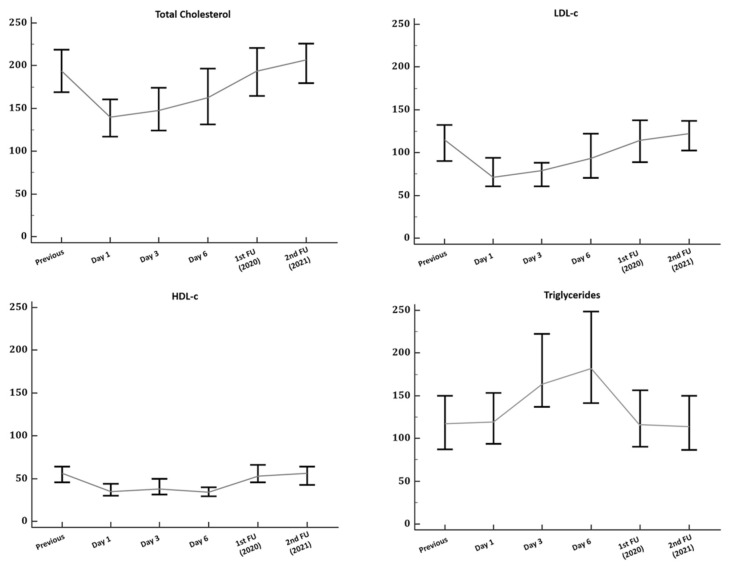
Recent works have demonstrated a significant reduction in cholesterol levels and increased oxidative stress in patients with coronavirus disease 2019 (COVID-19). The cause of this alteration is not well known. This study aimed to comprehensively evaluate their possible association during the evolution of COVID-19. This is an observational prospective study. The primary endpoint was to analyze the association between lipid peroxidation, lipid, and inflammatory profiles in COVID-19 patients. A multivariate regression analysis was employed. The secondary endpoint included the long-term follow-up of lipid profiles. COVID-19 patients presented significantly lower values in their lipid profile (total, low, and high-density lipoprotein cholesterol) with greater oxidative stress and inflammatory response compared to the healthy controls. Lipid peroxidation was the unique oxidative parameter with a significant association with the total cholesterol (OR: 0.982; 95% CI: 0.969-0.996; p = 0.012), IL1-RA (OR: 0.999; 95% CI: 0.998-0.999; p = 0.021) IL-6 (OR: 1.062; 95% CI: 1.017-1.110; p = 0.007), IL-7 (OR: 0.653; 95% CI: 0.433-0.986; p = 0.042) and IL-17 (OR: 1.098; 95% CI: 1.010-1.193; p = 0.028). Lipid abnormalities recovered after the initial insult during long-term follow-up (IQR 514 days); however, those with high LPO levels at hospital admission had, during long-term follow-up, an atherogenic lipid profile. Our study suggests that oxidative stress in COVID-19 is associated with derangements of the lipid profile and inflammation. Survivors experienced a recovery in their lipid profiles during long-term follow-up, but those with stronger oxidative responses had an atherogenic lipid profile.
Keywords: COVID-19; inflammation; lipid peroxidation; lipoproteins; oxidative stress; total cholesterol.
Conflict of interest statement
The authors declare no conflict of interest.
Figures
References
-
- Singh A.K., Gillies C.L., Singh R., Singh A., Chudasama Y., Coles B., Seidu S., Zaccardi F., Davies M.J., Khunti K. Prevalence of Comorbidities and Their Association with Mortality in Patients with COVID-19: A Systematic Review and Meta-analysis. Diabetes Obes. Metab. 2020;22:1915–1924. doi: 10.1111/dom.14124. - DOI - PMC - PubMed
-
- Kalem A.K., Kayaaslan B., Neselioglu S., Eser F., Hasanoglu İ., Aypak A., Akinci E., Akca H.N., Erel O., Guner R. A Useful and Sensitive Marker in the Prediction of COVID-19 and Disease Severity: Thiol. Free Radic. Biol. Med. 2021;166:11–17. doi: 10.1016/j.freeradbiomed.2021.02.009. - DOI - PMC - PubMed
Publication types
MeSH terms
Substances
Grants and funding
LinkOut - more resources
Full Text Sources
Medical
