Review
. 2022 Nov 25;22(23):9151.
doi: 10.3390/s22239151.

Piezoelectric Micromachined Ultrasonic Transducers (PMUTs): Performance Metrics, Advancements, and Applications

Affiliations
Review

Piezoelectric Micromachined Ultrasonic Transducers (PMUTs): Performance Metrics, Advancements, and Applications

Yumna Birjis et al. Sensors (Basel). .

Abstract

With the development of technology, systems gravitate towards increasing in their complexity, miniaturization, and level of automation. Amongst these systems, ultrasonic devices have adhered to this trend of advancement. Ultrasonic systems require transducers to generate and sense ultrasonic signals. These transducers heavily impact the system's performance. Advancements in microelectromechanical systems have led to the development of micromachined ultrasonic transducers (MUTs), which are utilized in miniaturized ultrasound systems. Piezoelectric micromachined ultrasonic transducers (PMUTs) exhibit higher capacitance and lower electrical impedance, which enhances the transducer's sensitivity by minimizing the effect of parasitic capacitance and facilitating their integration with low-voltage electronics. PMUTs utilize high-yield batch microfabrication with the use of thin piezoelectric films. The deposition of thin piezoelectric material compatible with complementary metal-oxide semiconductors (CMOS) has opened novel avenues for the development of miniaturized compact systems with the same substrate for application and control electronics. PMUTs offer a wide variety of applications, including medical imaging, fingerprint sensing, range-finding, energy harvesting, and intrabody and underwater communication links. This paper reviews the current research and recent advancements on PMUTs and their applications. This paper investigates in detail the important transduction metrics and critical design parameters for high-performance PMUTs. Piezoelectric materials and microfabrication processes utilized to manufacture PMUTs are discussed. Promising PMUT applications and outlook on future advancements are presented.

Keywords: CMOS integration; acoustic pressure; acoustic sensing; bandwidth; electromechanical coupling; microelectromechanical systems; microfabrication; micromachined ultrasonic transducers; pulse-echo imaging; resonant frequency.


Conflict of interest statement

The authors declare no conflict of interest.

Figures
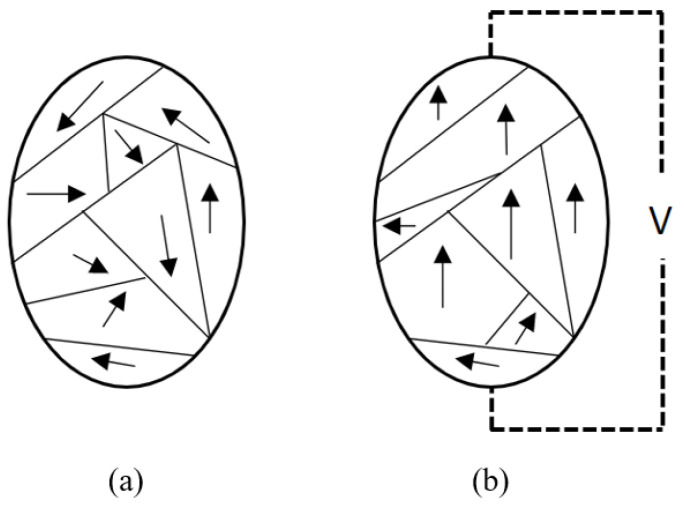
Figure 1
Figure 1
Schematic view of Electric dipole moments in (a) unpolarized piezoelectric material and (b) polarized piezoelectric material in the presence of an electric field.
Figure 2
Figure 2
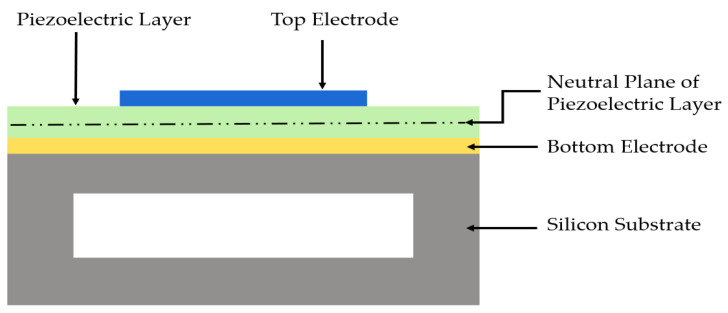
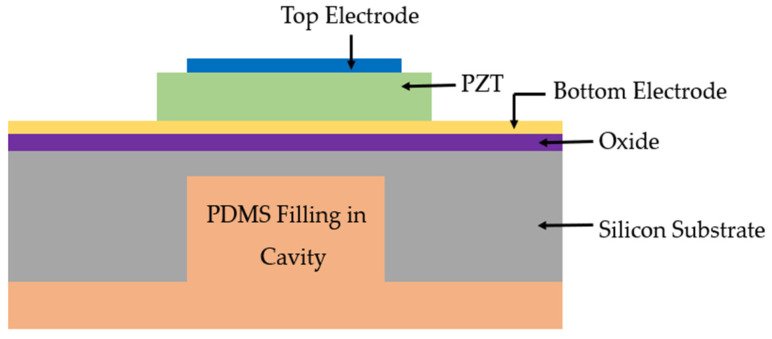
Schematic side view of a piezoelectric micromachined ultrasonic transducer (PMUT) cell.
Figure 3
Figure 3
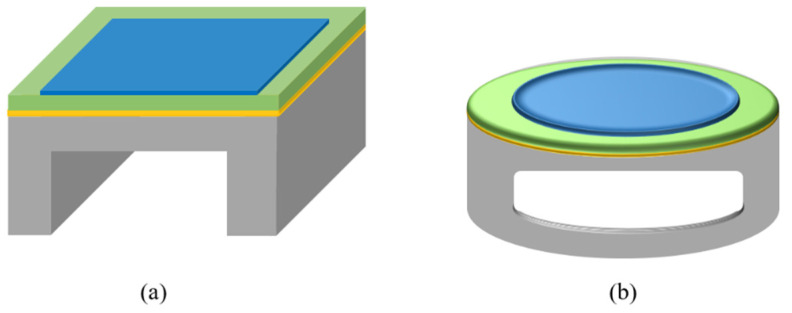
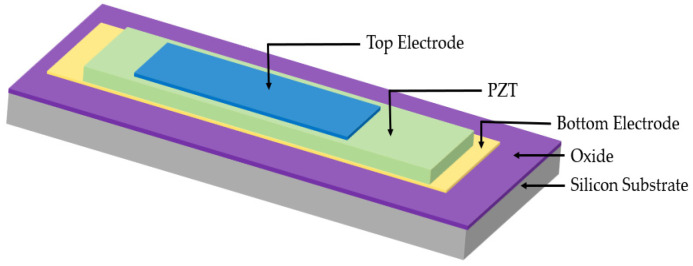
(a,b) Three-dimensional perspectives of PMUT cell.
Figure 4
Figure 4
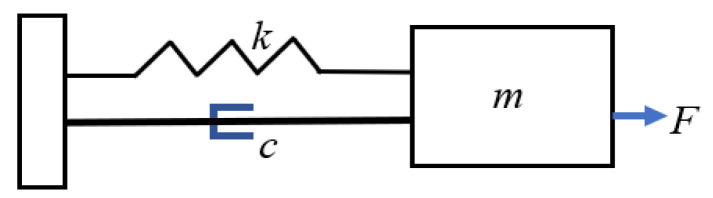
Mass–spring–damper system.
Figure 5
Figure 5
PMUT-equivalent circuit model.
Figure 6
Figure 6
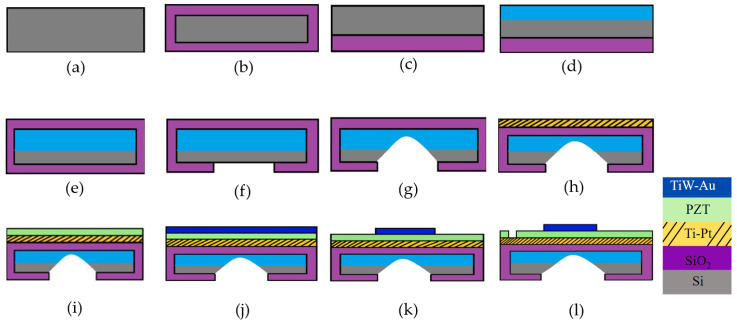
PMUT fabrication using the back-side etching process. (a) (100) Si wafer as a substrate, (b) Wet oxidation, (c) SiO2 etching using BOE, (d) Boron diffusion, (e) Formation of sacrificial layer by LTO, (f) Oxide etch using BOE, (g) Si etching by EDP, (h) Bottom electrode Ti–Pt deposition by e-beam evaporation, (i) PZT deposition by sol-gel technique, (j) Top electrode TiW–Au deposition by sputtering, (k) Top electrode etching using KI3 and H2, (l) PZT etching using HCl:HF:H2O.
Figure 7
Figure 7
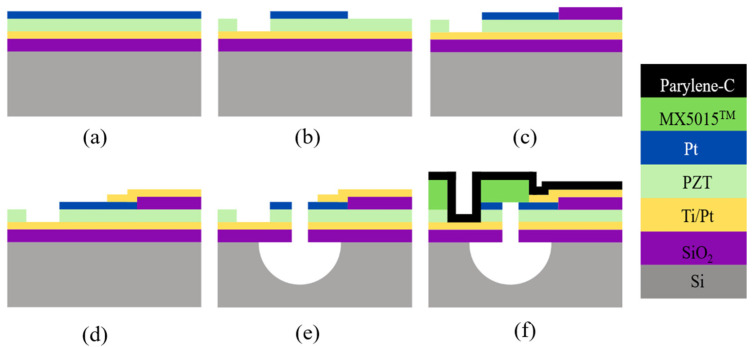
PMUT fabrication procedure for defining diaphragm via front-side etching technique. (a) RF sputter deposition applies a thick coat of PZT and a Pt electrode top-layer on a silicon wafer layered with SiO2 and Ti/Pt. (b) Reactive ion etching (RIE) exposes the Ti/Pt electrode and patterns the Pt top-layer along with contact lithography. (c) A layer of SiO2 is applied as an insulation pad via sputter deposition and lift-off to prepare for the fabrication of the electrode fan-out. (d) A conformal connection is formed using sputtered and patterned Ti/Pt. (e) Access to the bottom Si layer diaphragm is created by means of an etch via through the Pt, PZT, Ti/Pt, and SiO2 stack. (f) The diaphragm is then laminated with negative photoresist film (MX5015) and coated with parylene to seal the vias.
Figure 8
Figure 8
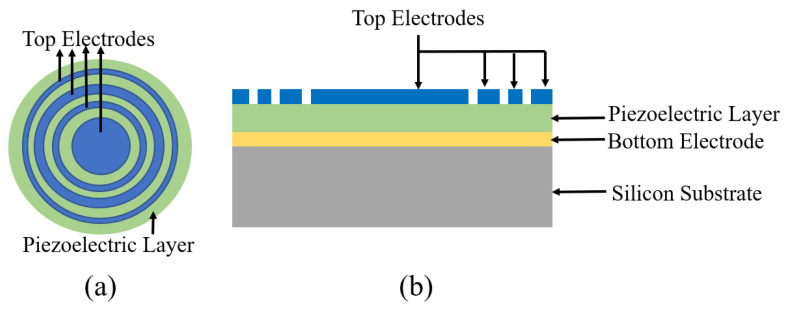
Multiple-electrode PMUT. (a) Top view of four-electrode PMUT, (b) Cross section side view of four-electrode PMUT.
Figure 9
Figure 9
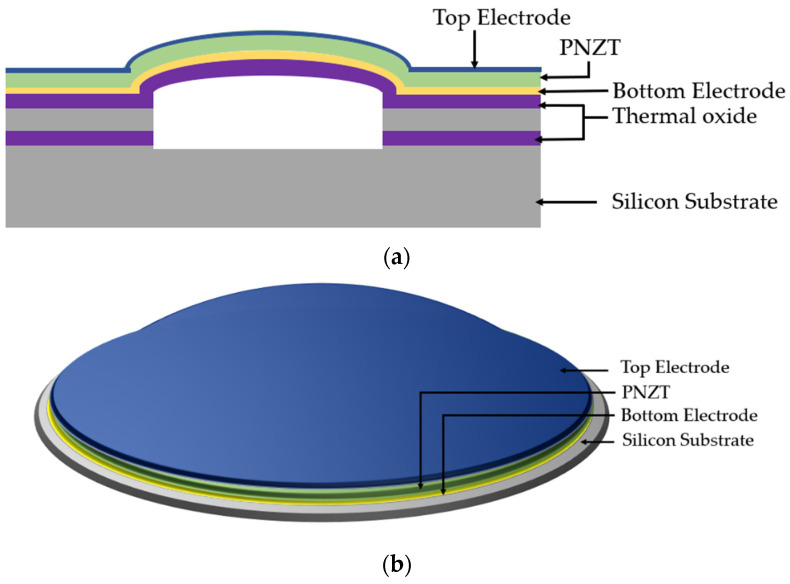
(a) Cross-sectional side view of dome-shaped PMUT; (b) 3D view of dome-shaped PMUT.
Figure 10
Figure 10
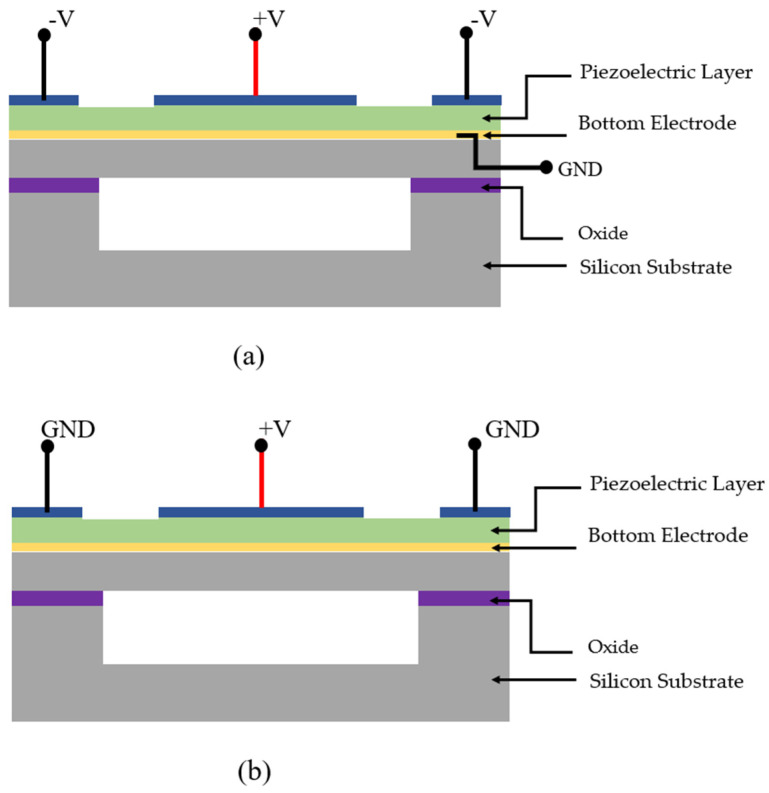
(a) PMUT with differential transduction; (b) PMUT with series transduction.
Figure 11
Figure 11
Rectangular PMUT with a large aspect ratio (mode-merging PMUT).
Figure 12
Figure 12
Three-dimensional cross-sectional side view of PMUT with backing layer.
Figure 13
Figure 13
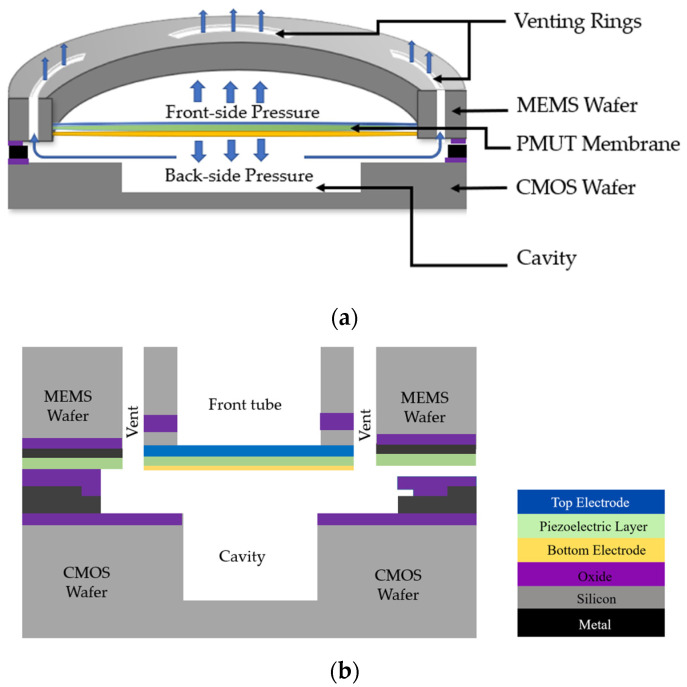
(a) Three-dimensional cross-sectional view of PMUT with venting rings. (b) Cross-sectional view of PMUT with venting rings with MEMS bond on CMOS.
Figure 14
Figure 14
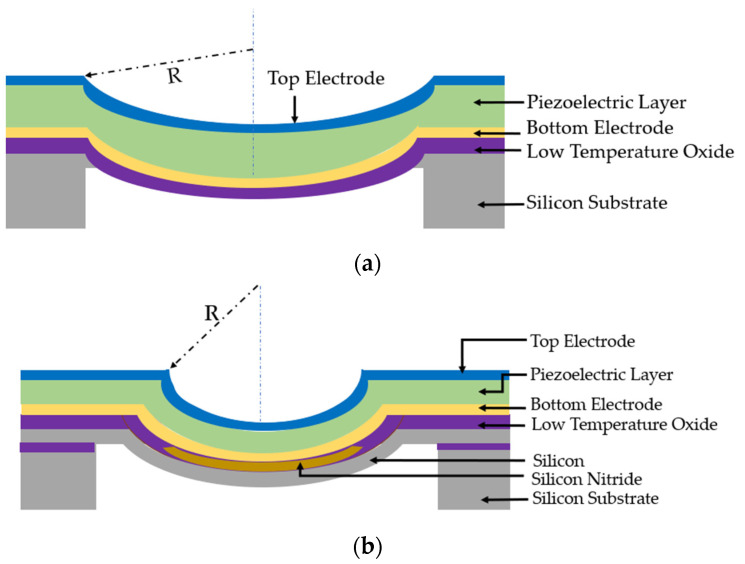
(a) Cross-sectional view of curved PMUT with concave diaphragm. (b) Cross-sectional view of stress engineered self-curved PMUT with concave diaphragm.
Figure 15
Figure 15
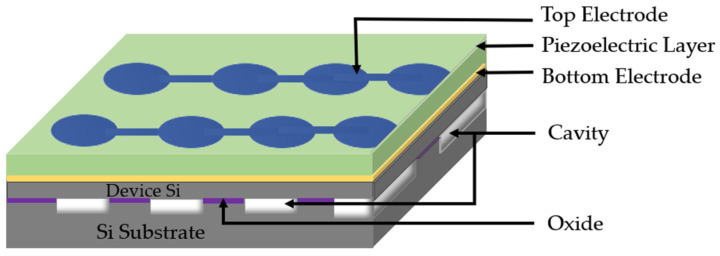
Three-dimensional schematic of a PMUT array based on cavity SOI.
Figure 16
Figure 16
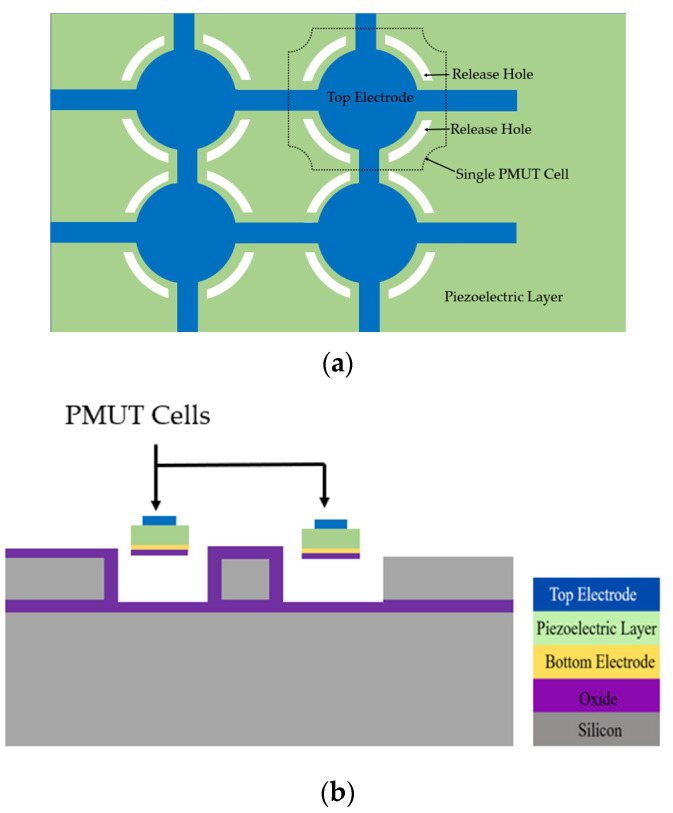
(a) Top view of PMUT cells with release holes on the edges, (b) cross-sectional view of fabricated PMUT cells with SOI substrate.
Figure 17
Figure 17
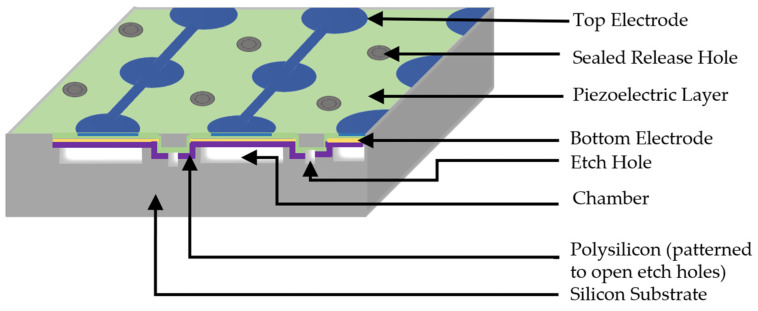
Three-dimensional cross-sectional view of PMUT array illustrating structure details and magnified view of etch holes.
Figure 18
Figure 18
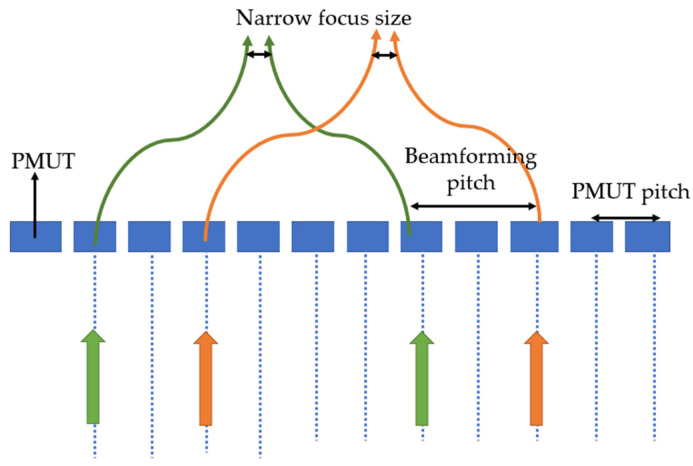
Beamforming using sub-array groups of 15 PMUT elements.
Figure 19
Figure 19
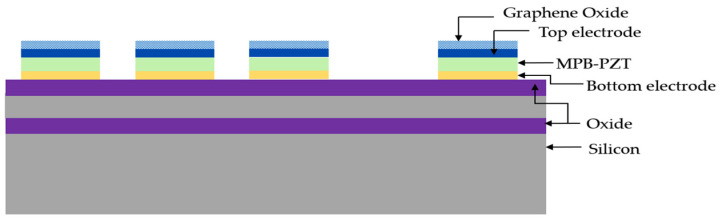
Schematic view of a PMUT array structure functionalized with a graphene oxide sensing layer.
Figure 20
Figure 20
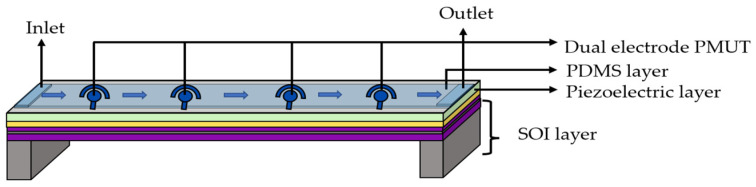
Schematic view of a PDMS-microchannel-integrated structure comprising dual-electrode PMUT elements.

References

    1. Lethiecq M., Levassort F., Certon D., Tran-Huu-Hue L.P. Piezoelectric and Acoustic Materials for Transducer Applications. Springer; Berlin/Heidelberg, Germany: 2008. Piezoelectric Transducer Design for Medical Diagnosis and NDE.
    1. Akasheh F., Myers T., Fraser J.D., Bose S., Bandyopadhyay A. Development of Piezoelectric Micromachined Ultrasonic Transducers. Sens. Actuators A Phys. 2004;111:275–287. doi: 10.1016/j.sna.2003.11.022. - DOI
    1. Aldrich J.E. Basic Physics of Ultrasound Imaging. Crit. Care Med. 2007;35:S131–S137. doi: 10.1097/01.CCM.0000260624.99430.22. - DOI - PubMed
    1. Zhou Q., Lam K.H., Zheng H., Qiu W., Shung K.K. Piezoelectric Single Crystal Ultrasonic Transducers for Biomedical Applications. Prog. Mater. Sci. 2014;66:87–111. doi: 10.1016/j.pmatsci.2014.06.001. - DOI - PMC - PubMed
    1. Muralt P., Baborowski J. Micromachined Ultrasonic Transducers and Acoustic Sensors Based on Piezoelectric Thin Films. Volume 12 Kluwer Academic Publishers; Alphen aan den Rijn, The Netherlands: 2004.

LinkOut - more resources