Determining Gaps in Publicly Shared SARS-CoV-2 Genomic Surveillance Data by Analysis of Global Submissions
- PMID: 36502409
- PMCID: PMC9745223
- DOI: 10.3201/eid2813.220780
Determining Gaps in Publicly Shared SARS-CoV-2 Genomic Surveillance Data by Analysis of Global Submissions
Abstract
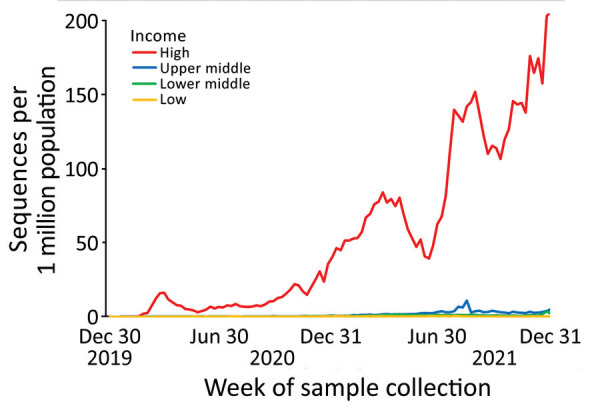
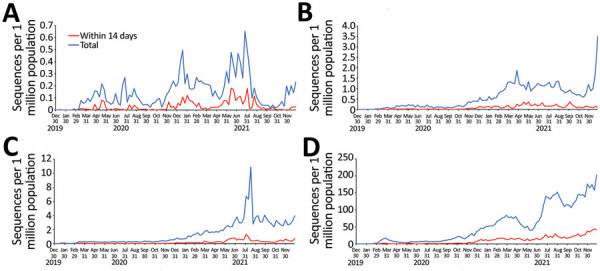
Viral genomic surveillance has been a critical source of information during the COVID-19 pandemic, but publicly available data can be sparse, concentrated in wealthy countries, and often made public weeks or months after collection. We used publicly available viral genomic surveillance data submitted to GISAID and GenBank to examine sequencing coverage and lag time to submission during 2020-2021. We compared publicly submitted sequences by country with reported infection rates and population and also examined data based on country-level World Bank income status and World Health Organization region. We found that as global capacity for viral genomic surveillance increased, international disparities in sequencing capacity and timeliness persisted along economic lines. Our analysis suggests that increasing viral genomic surveillance coverage worldwide and decreasing turnaround times could improve timely availability of sequencing data to inform public health action.
Keywords: COVID-19; SARS-CoV-2; coronavirus disease; pandemic; respiratory infections; severe acute respiratory syndrome coronavirus 2; vaccine-preventable diseases; viral surveillance; viruses; zoonoses.
Figures
References
-
- World Health Organization. Tracking SARS-CoV-2 variants [cited 2022 Mar 15]. https://www.who.int/en/activities/tracking-SARS-CoV-2-variants - PubMed
-
- World Health Organization. Policy statement on data sharing by WHO in the context of public health emergencies (as of 2016 Apr 13). Wkly Epidemiol Rec. 2016;18:237–40 https://apps.who.int/iris/handle/10665/254439. - PubMed
-
- World Health Organization. Global health surveillance strategy for pathogens with pandemic and epidemic potential, 2022–2032. https://www.who.int/publications/i/item/9789240046979 - PMC - PubMed
-
- The International Association of National Public Health Institutes. How NPHIs can improve genomic surveillance of SARS-CoV-2. July 13, 2021. [cited 2022 Mar 21]. https://ianphi.org/news/2021/webinar-genomic-surveillance.html
MeSH terms
LinkOut - more resources
Full Text Sources
Medical
Miscellaneous