Population-level contribution of interpersonal discrimination to psychological distress among Australian Aboriginal and Torres Strait Islander adults, and to Indigenous-non-Indigenous inequities: cross-sectional analysis of a community-controlled First Nations cohort study
- PMID: 36502846
- PMCID: PMC9807286
- DOI: 10.1016/S0140-6736(22)01639-7
Population-level contribution of interpersonal discrimination to psychological distress among Australian Aboriginal and Torres Strait Islander adults, and to Indigenous-non-Indigenous inequities: cross-sectional analysis of a community-controlled First Nations cohort study
Abstract
Background: International and population-specific evidence identifies elevated psychological distress prevalence among those experiencing interpersonal discrimination. We aim to quantify the potential whole-of-population contribution of interpersonal discrimination to psychological distress prevalence and Indigenous-non-Indigenous gaps in Australia.
Methods: We did a cross-sectional analysis of data from Mayi Kuwayu: the National Study of Aboriginal and Torres Strait Islander Wellbeing. Baseline surveys were completed between June 8, 2018, and Sept 28, 2022. We analysed responses from participants who were aged 18 years or older at survey completion, whose surveys were processed between Oct 1, 2018, and May 1, 2021. Sample weights were developed on the basis of national population benchmarks. We measured everyday discrimination using an eight-item measure modified from the Everyday Discrimination Scale and classified experiences as racial discrimination if participants attributed these experiences to their Indigeneity. Psychological distress was measured using a validated, modified Kessler-5 scale. Applying logistic regression, we calculated unadjusted odds ratios (ORs), to approximate incident rate ratios (IRRs), for high or very high psychological distress in relation to everyday discrimination and everyday racial discrimination across age-gender strata. Population attributable fractions (PAFs), under the hypothetical assumption that ORs represent causal relationships, were calculated using these ORs and population-level exposure prevalence. These PAFs were used to quantify the contribution of everyday racial discrimination to psychological distress gaps between Indigenous and non-Indigenous adults.
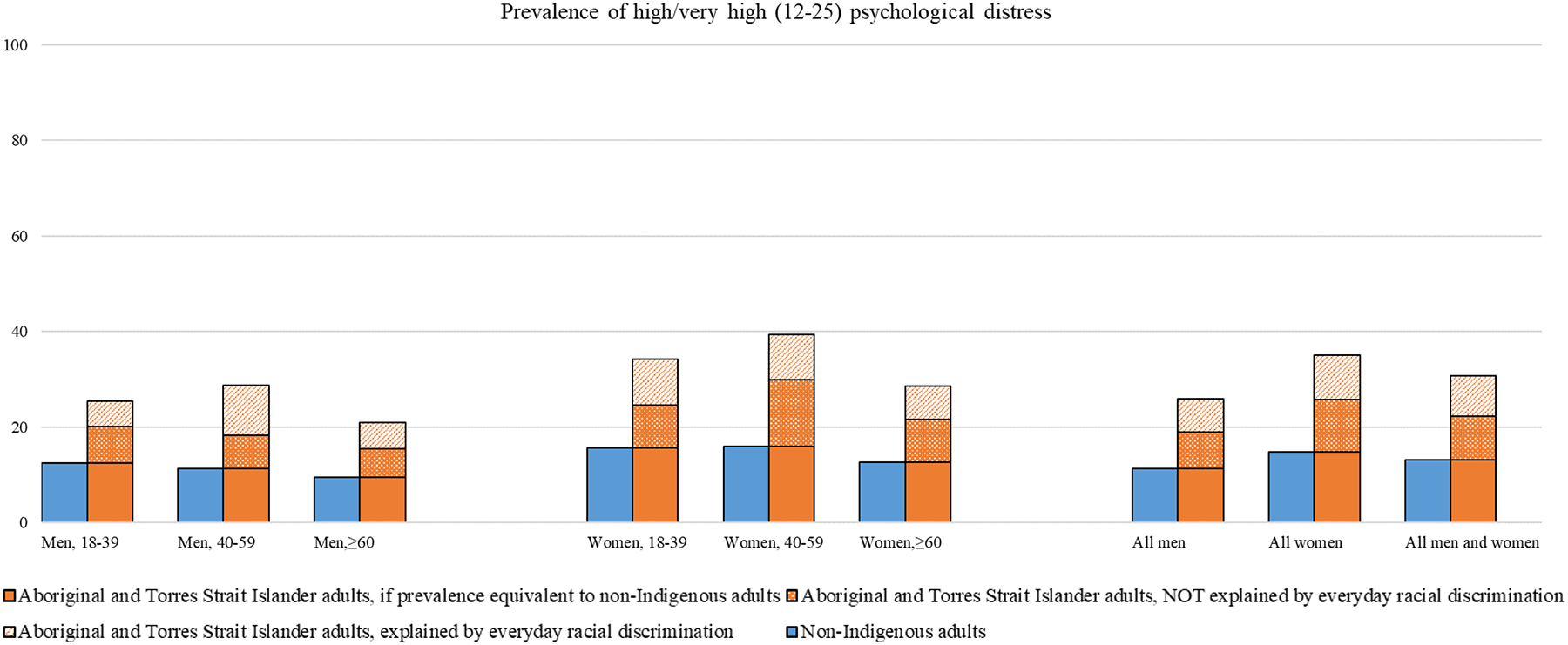
Findings: 9963 survey responses were eligible for inclusion in our study, of which we analysed 9951 (99·9%); 12 were excluded due to responders identifying as a gender other than man or woman (there were too few responses from this demographic to be included as a category in stratified tables or adjusted analyses). The overall prevalence of psychological distress was 48·3% (95% CI 47·0-49·6) in those experiencing everyday discrimination compared with 25·2% (23·8-26·6) in those experiencing no everyday discrimination (OR 2·77 [95% CI 2·52-3·04]) and psychological distress prevalence was 49·0% (95% CI 47·3-50·6) in those experiencing everyday racial discrimination and 31·8% (30·6-33·1) in those experiencing no everyday racial discrimination (OR 2·06 [95% CI 1·88-2·25]. Overall, 49·3% of the total psychological distress burden among Aboriginal and Torres Strait Islander adults could be attributable to everyday discrimination (39·4-58·8% across strata) and 27·1% to everyday racial discrimination. Everyday racial discrimination could explain 47·4% of the overall gap in psychological distress between Indigenous and non-Indigenous people (40·0-60·3% across strata).
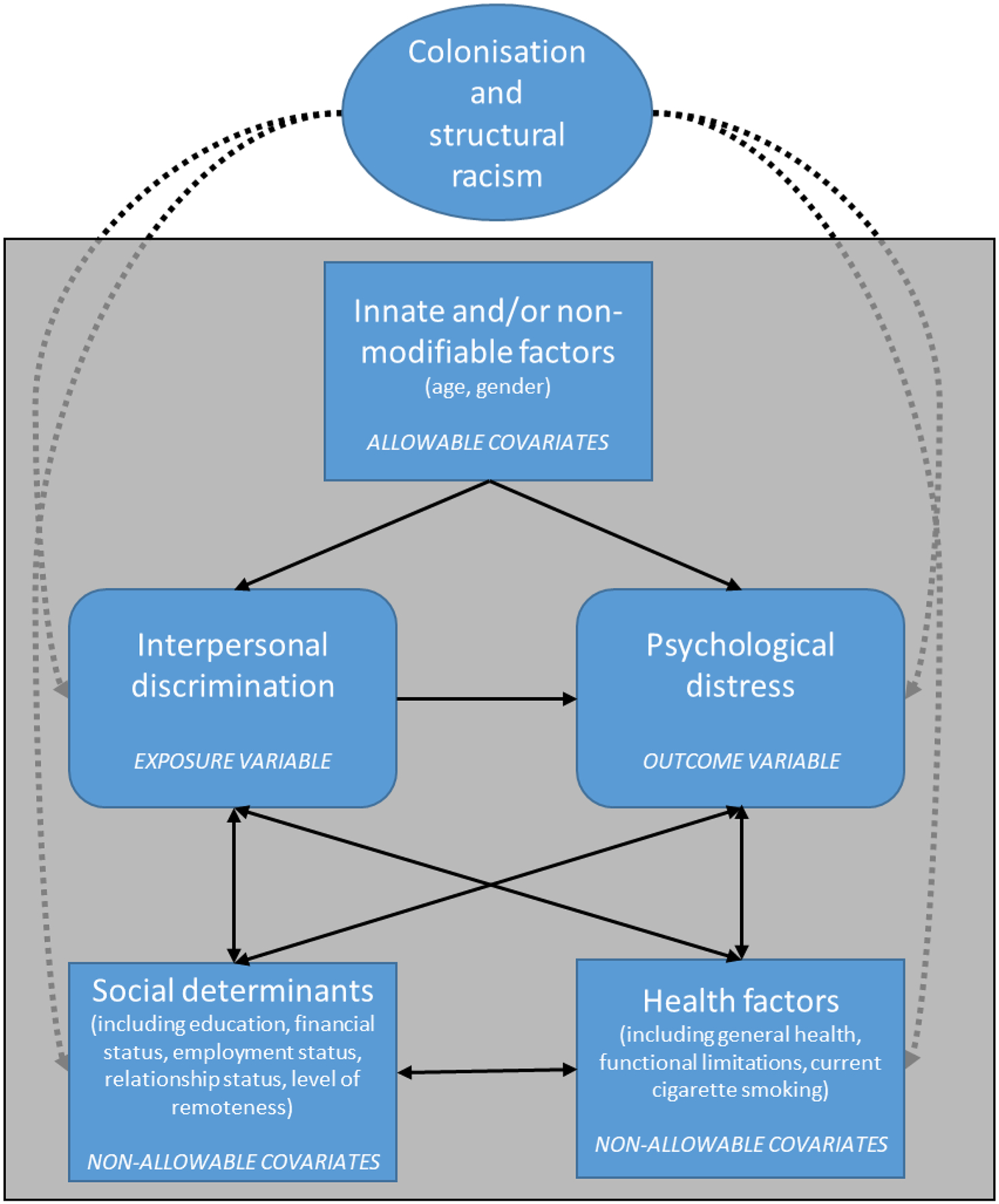
Interpretation: Our findings show that interpersonal discrimination might contribute substantially to psychological distress among Aboriginal and Torres Strait Islander adults, and to inequities compared with non-Indigenous adults. Estimated PAFs include contributions from social and health disadvantage, reflecting contributions from structural racism. Although not providing strictly conclusive evidence of causality, this evidence is sufficient to indicate the psychological harm of interpersonal discrimination. Findings add weight to imperatives to combat discrimination and structural racism at its core. Urgent individual and policy action is required of non-Indigenous people and colonial structures, directed by Aboriginal and Torres Strait Islander peoples.
Funding: National Health and Medical Research Council of Australia, Ian Potter Foundation, Australian Research Council, US National Institutes of Health, and Sierra Foundation.
Copyright © 2022 Elsevier Ltd. All rights reserved.
Conflict of interest statement
Declaration of interests We declare no competing interests.
Figures
References
-
- Borch M. Rethinking the origins of terra nullius. Australian Historical Studies 2001; 32(117): 222–39.
-
- Spiller G. The Mentality of the Australian Aborigines. The Sociological Review 1913; a6(4): 348–53.
-
- Watego C, Singh D & Macoun A Partnership for Justice in Health: Scoping Paper on Race, Racism and the Australian Health System. 2021; Discussion Paper.
MeSH terms
Grants and funding
LinkOut - more resources
Full Text Sources
Miscellaneous