Review
. 2022 Nov 28;28(44):6249-6257.
doi: 10.3748/wjg.v28.i44.6249.

Development of Epstein-Barr virus-associated gastric cancer: Infection, inflammation, and oncogenesis

Affiliations
Review

Development of Epstein-Barr virus-associated gastric cancer: Infection, inflammation, and oncogenesis

Hisashi Iizasa et al. World J Gastroenterol. .

Abstract

Epstein-Barr virus (EBV)-associated gastric cancer (EBVaGC) cells originate from a single-cell clone infected with EBV. However, more than 95% of patients with gastric cancer have a history of Helicobacter pylori (H. pylori) infection, and H. pylori is a major causative agent of gastric cancer. Therefore, it has long been argued that H. pylori infection may affect the development of EBVaGC, a subtype of gastric cancer. Atrophic gastrointestinal inflammation, a symptom of H. pylori infection, is observed in the gastric mucosa of EBVaGC. Therefore, it remains unclear whether H. pylori infection is a cofactor for gastric carcinogenesis caused by EBV infection or whether H. pylori and EBV infections act independently on gastric cancer formation. It has been reported that EBV infection assists in the onco-genesis of gastric cancer caused by H. pylori infection. In contrast, several studies have reported that H. pylori infection accelerates tumorigenesis initiated by EBV infection. By reviewing both clinical epidemiological and experimental data, we reorganized the role of H. pylori and EBV infections in gastric cancer formation.

Keywords: Coreceptor; Epstein-Barr virus; Epstein-Barr virus-associated gastric cancer; Helicobacter pylori; Inflammation; Oncogenesis.


Conflict of interest statement

Conflict-of-interest statement: All the authors report no relevant conflicts of interest for this article.

Figures
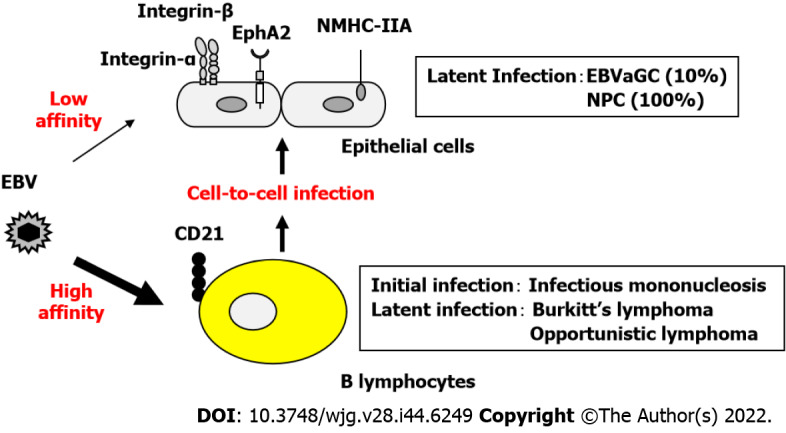
Figure 1
Figure 1
Epstein-Barr virus infects B lymphocytes and epithelial cells to form tumors. Epstein-Barr virus (EBV) infects B lymphocytes and epithelial cells via the CD21 receptor and co-receptors, respectively. Although the efficiency of epithelial cell infection is extremely low, approximately 1000000 times lower than that of B lymphocytes, cell-to-cell EBV infection by B lymphocytes increased the efficiency of EBV infection by more than 1000-fold. The squares show the EBV infection status and disease names that are established differently depending on the cell type. EBV: Epstein-Barr virus; EBVaGC: Epstein-Barr virus-associated gastric cancer; NPC: Nasopharyngeal carcinoma.
Figure 2
Figure 2
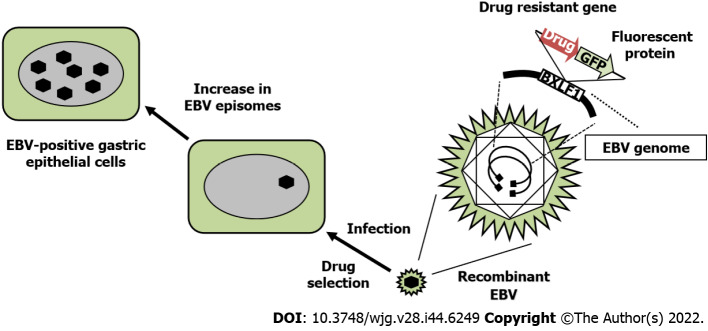
Isolation of recombinant Epstein-Barr virus-infected gastric epithelial cells. A drug resistant gene and fluorescent protein gene were inserted into the viral genome (BXLF1) using gene recombination technique. BXLF1 is an EBV gene that does not affect viral production or infectivity by disruption through the insertion of marker genes. It is possible to isolate only recombinant virus-infected cells by infecting cells with a recombinant virus and selecting them for a drug. When recombinant virus-infected cells are cultured in the presence of the drug, the viral plasmid copy number in the nucleus of infected cells increases[52]. EBV: Epstein-Barr virus; GFP: Green fluorescent protein.
Figure 3
Figure 3
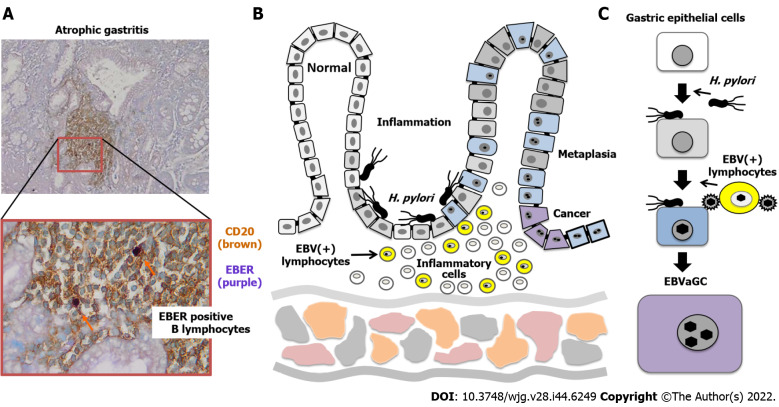
Interaction of Helicobacter pylori and Epstein-Barr virus in the formation of Epstein-Barr virus-associated gastric cancer. A: Infiltration of Epstein-Barr virus (EBV)-infected B lymphocytes in non-tumor areas of EBV-associated gastric cancer. Numerous CD20-positive B lymphocytes infiltrate the submucosal lesions of atrophic gastritis. CD20 is stained brown and EBV-encoded RNA (EBER) is stained purple. EBER-positive B lymphocytes are indicated by arrows. Chronic gastritis in the background is counterstained by Hematoxylin-Eosin staining; B: Induction of inflammatory cytokine production by bacterial adhesion to epithelial cells and tumorigenesis of EBV-infected epithelial cells. Helicobacter pylori adhesion induces production of inflammatory cytokines from gastric epithelial cells. Inflammation of gastric mucosa leads to an accumulation of various immune cells. EBV-positive B lymphocytes localized in the submucosa are activated by inflammation and transition from latent to lytic EBV infection. The viral particles produced are transferred to gastric epithelial cells, and the infected epithelial cells eventually form tumors; C: EBV transfer infection and tumorigenesis of epithelial cells via activated EBV-positive B lymphocytes. Infectious viral particles produced during inflammation adhere to CD21-positive B lymphocytes and transferred to epithelial cells expressing EBV coreceptors. Thus, gastric epithelial cells infected with EBV form Epstein-Barr virus-associated gastric cancers over time. EBV: Epstein-Barr virus; EBVaGC: Epstein-Barr virus-associated gastric cancer; Helicobacter pylori: H. pylori; EBER: EBV-encoded RNA.

References

    1. Stanfield BA, Luftig MA. Recent advances in understanding Epstein-Barr virus. F1000Res. 2017;6:386. - PMC - PubMed
    1. Shannon-Lowe C, Rickinson A. The global landscape of EBV-associated tumors. Front Oncol. 2019;9:713. - PMC - PubMed
    1. Cancer Genome Atlas Research Network. Comprehensive molecular characterization of gastric adenocarcinoma. Nature. 2014;513:202–209. - PMC - PubMed
    1. Matsusaka K, Funata S, Fukuyo M, Seto Y, Aburatani H, Fukayama M, Kaneda A. Epstein-Barr virus infection induces genome-wide de novo DNA methylation in non-neoplastic gastric epithelial cells. J Pathol. 2017;242:391–399. - PubMed
    1. Matsusaka K, Kaneda A, Nagae G, Ushiku T, Kikuchi Y, Hino R, Uozaki H, Seto Y, Takada K, Aburatani H, Fukayama M. Classification of Epstein-Barr virus-positive gastric cancers by definition of DNA methylation epigenotypes. Cancer Res. 2011;71:7187–7197. - PubMed