Antidepressant Fill and Dose Trajectories in Pregnant Women with Depression and/or Anxiety: A Norwegian Registry Linkage Study
- PMID: 36506004
- PMCID: PMC9733444
- DOI: 10.2147/CLEP.S379370
Antidepressant Fill and Dose Trajectories in Pregnant Women with Depression and/or Anxiety: A Norwegian Registry Linkage Study
Abstract
Background: Few studies investigated longitudinal antidepressant exposure during pregnancy and included dosage in the assessment.
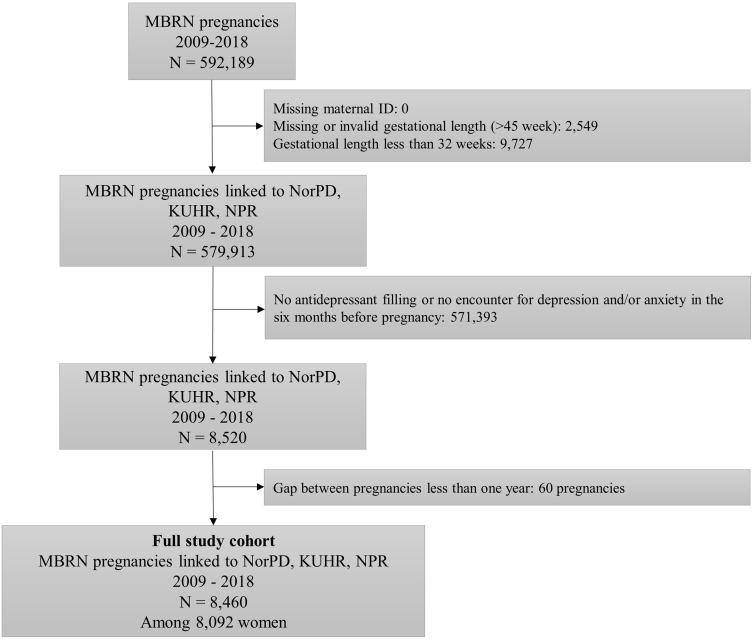
Methods: We conducted a nationwide, registry-linkage study in Norway using data on antidepressant prescription fills in pregnancies lasting ≥32 weeks in women with a delivery between 2009 and 2018 who had a depression/anxiety diagnosis and antidepressant fills prior to pregnancy. Information on antidepressant exposure by week (measured by filled prescriptions) and prescribed average daily dose was used in longitudinal k-means trajectory modelling for a 108-week time window from six months prior to pregnancy to one year after delivery. Factors associated with trajectory group membership were examined using multinomial logistic regression models.
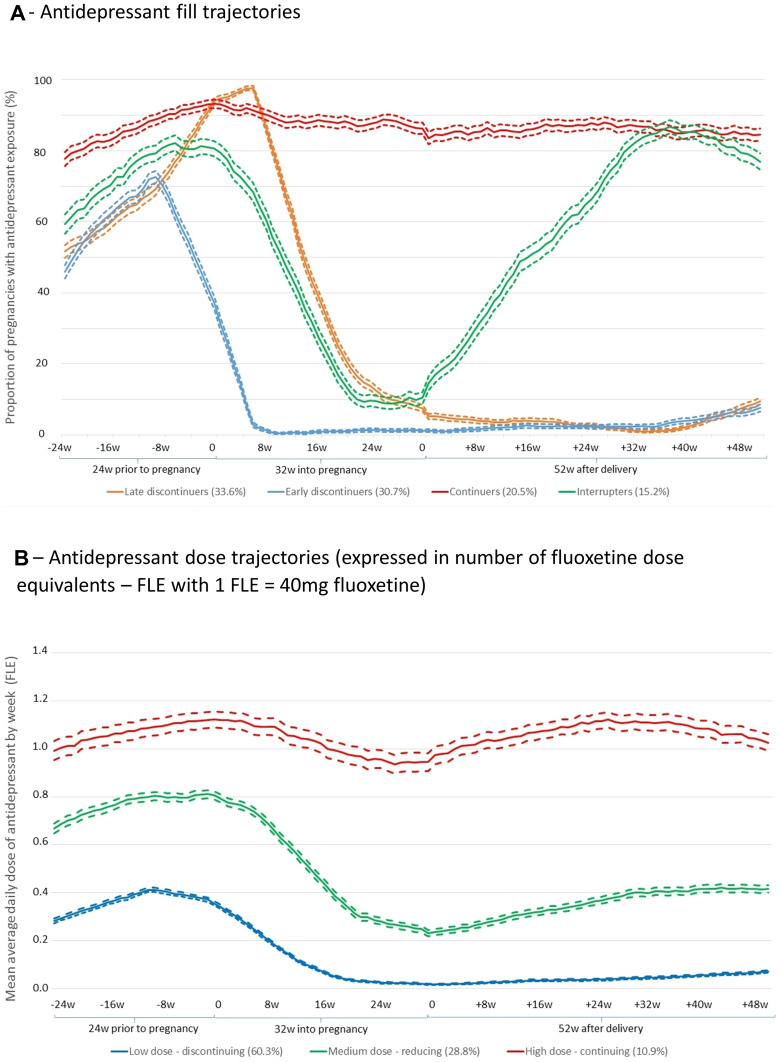
Results: We included 8,460 pregnancies in 8,092 women. Four antidepressant fill trajectories were identified based on filled antidepressant prescriptions: two distinct discontinuing patterns, one at around the start of pregnancy (30.4%) and one around the end of pregnancy (33.8%); one continuing pattern (20.6%); and one interrupting pattern (15.2%). Using average usual daily dose, we identified low dose discontinuing (60.3%), medium dose reducing (20.6%) and high dose continuing (15.2%) patterns. The multinomial logistic regressions showed that the fill trajectory group membership was strongly associated with: antidepressant type and dose prior to pregnancy and co-medication prior to pregnancy, maternal age, marital status, parity, previous pregnancy loss, and pregnancy planning.
Conclusion: Longitudinal trajectory modelling revealed distinct antidepressant fill and dosage patterns in the period around pregnancy. Knowledge about factors associated with utilization trajectories might be useful for health-care personnel counselling women about antidepressant use in pregnancy.
Keywords: antidepressant fill trajectories; anxiety; depression; drug utilization; longitudinal k-means trajectory modelling; pregnancy.
© 2022 Trinh et al.
Conflict of interest statement
Kristin Palmsten receives research grants from AbbVie and GSK that are unrelated to this study. The other authors declared no conflicts of interest in relation to this work. No financial relationships with any organizations that might have an interest in the submitted work in the previous three years, no other relationships or activities that could appear to have influenced the submitted work. The funders had no role in the design and conduct of the study; the analysis and interpretation of the data; preparation; the review or approval of the manuscript.
Figures