Review
. 2023 Feb;31(1):77-87.
doi: 10.1007/s10787-022-01092-x. Epub 2022 Dec 12.

Psoriatic arthritis: review of potential biomarkers predicting response to TNF inhibitors

Affiliations
Review

Psoriatic arthritis: review of potential biomarkers predicting response to TNF inhibitors

Anaïs Makos et al. Inflammopharmacology. 2023 Feb.

Abstract

Psoriatic arthritis (PsA) is a chronic and painful inflammatory immune-mediated disease. It affects up to 40% of people with psoriasis and it is associated with several comorbidities such as obesity, diabetes, metabolic syndrome, and hypertension. PsA is difficult to diagnose because of its diverse symptoms, namely axial and peripheral arthritis, enthesitis, dactylitis, skin changes, and nail dystrophy. Different drugs exist to treat the inflammation and pain. When patients do not respond to conventional drugs, they are treated with biologic drugs. Tumour necrosis factor inhibitors (TNFi's) are commonly given as the first biologic drug; beside being expensive, they also lack efficacy in 50% of patients. A biomarker predicting individual patient's response to TNFi would help treating them earlier with an appropriate biologic drug. This study aimed to review the literature to identify potential biomarkers that should be investigated for their predictive ability. Several such biomarkers were identified, namely transmembrane TNFα (tmTNF), human serum albumin (HSA) and its half-life receptor, the neonatal Fc receptor (FcRn) which is also involved in IgG lifespan; calprotectin, high mobility group protein B1 (HMGB1) and advanced glycation end products (AGEs) whose overexpression lead to excessive production of pro-inflammatory cytokines; lymphotoxin α (LTα) which induces inflammation by binding to TNF receptor (TNFR); and T helper 17 (Th17) cells which induce inflammation by IL-17A secretion.

Keywords: Biologics; Biomarkers; Psoriatic arthritis; Resistance; Tumor necrosis factor inhibitor.


Conflict of interest statement

The authors have no relevant financial or non-financial interests to disclose.

Figures
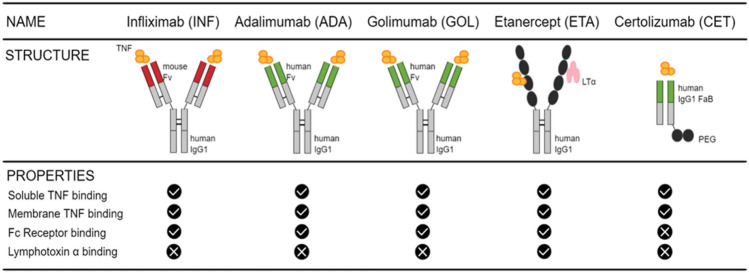
Fig. 1
Fig. 1
Structure of the common TNFi and their binding properties. Common TNFi administered to treat PsA are infliximab, adalimumab, golimumab, etanercept, and certolizumab. The schematic structure of each Ab is represented as well as their capacity to bind sTNF and tmTNF, FcR and LTα. Modified from Sedger and McDermott (2014)
Fig. 2
Fig. 2
Alarmin’s sources and targets. Alarmins are danger molecules actively secreted by activated immune cells or passively released by necrotic cells. They can bind to their receptor at the surface of cells (immune cells and endothelial cells mainly) to induce the production of pro-inflammatory cytokines and enhance the inflammatory process. They can also recruit immature DCs so they can present antigen to T cells, leading to their polarization to either amplify the inflammatory process or have protective effects. (Modified from Nefla et al. (2016)
Fig. 3
Fig. 3
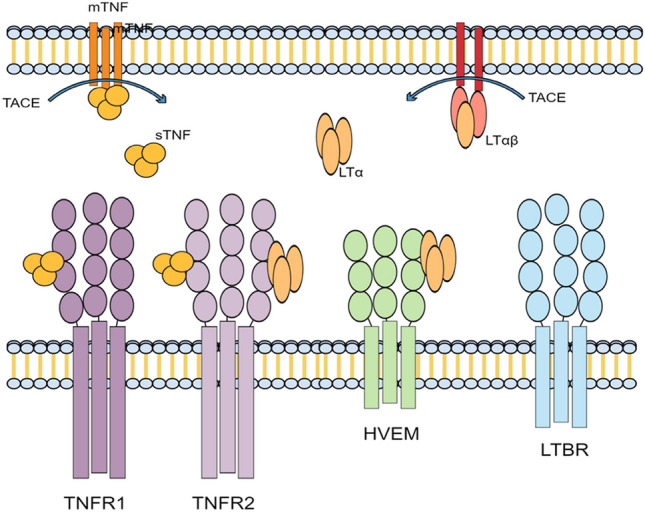
TNF receptors and their ligands. Membrane-bound TNF (mTNF), soluble TNF (sTNF), and LTα can bind to TNF receptor 1 and 2 (TNFR1 and 2). Tumour necrosis factor-alpha converting enzyme (TACE) cleaves mTNF to produce sTNF; it can bind TNFR1 and 2. LTα can be found as a homotrimer and/or in association with membrane-bound LT-β. The homotrimer LTα can bind TNFR1 and the Herpes virus entry mediator (HVEM). Modified from Sedger and McDermott (2014)
Fig. 4
Fig. 4
Th17 cells differentiation, amplification, and stabilization. Naïve CD4 + T cells are activated and differentiated into Th17 cells in the presence of TGFβ and IL-6. Th17 secrete IL-17 and IL-21 that amplify Th17 generation in an autocrine manner. IL-21 also induces the IL-23 receptor expression on Th17 cells and makes them responsive to IL-23 stimulation (95). Modified from Murugaiyan and Saha (2009)

References

    1. Ademowo OS, et al. Discovery and confirmation of a protein biomarker panel with potential to predict response to biological therapy in psoriatic arthritis. Ann Rheum Dis. 2016;75(1):234–241. doi: 10.1136/annrheumdis-2014-205417. - DOI - PubMed
    1. Anandarajah AP, Ritchlin CT. Etanercept in psoriatic arthritis. Expert Opin Biol Ther. 2003;3(1):169–177. doi: 10.1517/14712598.3.1.169. - DOI - PubMed
    1. Andersson U, Tracey KJ. HMGB1 is a therapeutic target for sterile inflammation and infection. Annu Rev Immunol. 2011;29:139–162. doi: 10.1146/annurev-immunol-030409-101323. - DOI - PMC - PubMed
    1. Aochi S, et al. Markedly elevated serum levels of calcium-binding S100A8/A9 proteins in psoriatic arthritis are due to activated monocytes/macrophages. J Am Acad Dermatol. 2011;64(5):879–887. doi: 10.1016/j.jaad.2010.02.049. - DOI - PubMed
    1. Arias MT, et al. A panel to predict long-term outcome of infliximab therapy for patients with ulcerative colitis. Clin Gastroenterol Hepatol. 2015;13(3):531–538. doi: 10.1016/j.cgh.2014.07.055. - DOI - PubMed

MeSH terms