. 2022 Dec 20;119(51):e2209816119.
doi: 10.1073/pnas.2209816119. Epub 2022 Dec 12.

No evidence for persistent natural plague reservoirs in historical and modern Europe

Affiliations

No evidence for persistent natural plague reservoirs in historical and modern Europe

Nils Chr Stenseth et al. Proc Natl Acad Sci U S A. .

Abstract

Caused by Yersinia pestis, plague ravaged the world through three known pandemics: the First or the Justinianic (6th-8th century); the Second (beginning with the Black Death during c.1338-1353 and lasting until the 19th century); and the Third (which became global in 1894). It is debatable whether Y. pestis persisted in European wildlife reservoirs or was repeatedly introduced from outside Europe (as covered by European Union and the British Isles). Here, we analyze environmental data (soil characteristics and climate) from active Chinese plague reservoirs to assess whether such environmental conditions in Europe had ever supported "natural plague reservoirs". We have used new statistical methods which are validated through predicting the presence of modern plague reservoirs in the western United States. We find no support for persistent natural plague reservoirs in either historical or modern Europe. Two factors make Europe unfavorable for long-term plague reservoirs: 1) Soil texture and biochemistry and 2) low rodent diversity. By comparing rodent communities in Europe with those in China and the United States, we conclude that a lack of suitable host species might be the main reason for the absence of plague reservoirs in Europe today. These findings support the hypothesis that long-term plague reservoirs did not exist in Europe and therefore question the importance of wildlife rodent species as the primary plague hosts in Europe.

Keywords: Europe; Yersinia pestis; environmental conditions; natural plague reservoirs; rodent diversity.


Conflict of interest statement

The authors declare a competing interest, the authors have additional information to disclose, D.W. and N.C.S. are coauthors on a 2020 review article.

Figures
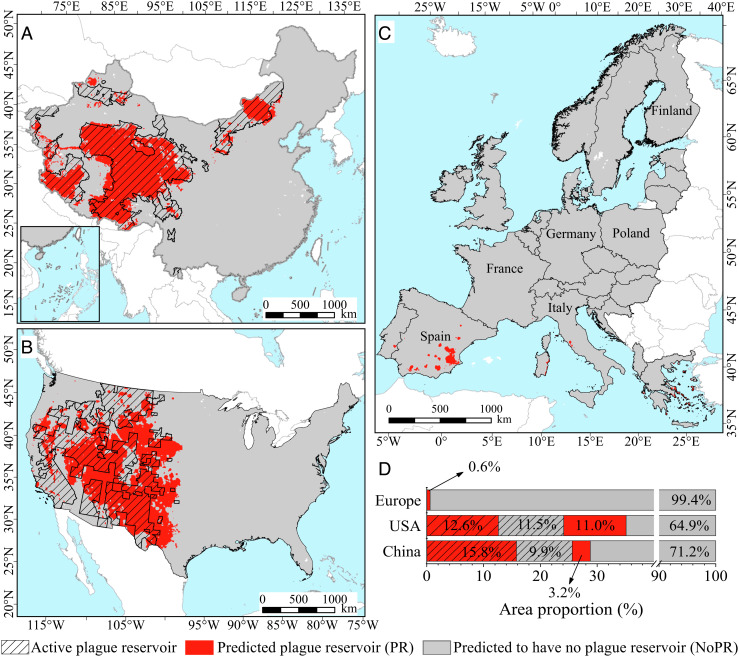
Fig. 1.
Fig. 1.
Spatial distribution of predicted plague reservoirs (in red) and areas predicted to have no plague reservoirs (in gray) in China (A), the United States (B), and Europe (C), and results of significance tests of estimated probabilities of current plague reservoirs compared with real surveillance data (D). The data from China, the United States, and Europe were used as the training set, the validation set, and the prediction set, respectively. In China, 74.4% of the areas are nonplague reservoirs (71.2% are correctly predicted and 3.2% incorrectly predicted) and 25.7% of the areas are plague reservoirs (15.8% are correctly predicted and 9.9% incorrectly predicted). (Note: The total of 100.1% is due to rounding errors.) In the United States, 24.1% of the areas are plague reservoirs (12.6% are correctly predicted and 11.5% incorrectly predicted) and 75.9% of the areas are nonplague reservoirs (64.9% were correctly predicted and 11.0% incorrectly predicted). Note that no data is available from Taiwan or the Balkans (excluding Croatia, Albania and Greece).
Fig. 2.
Fig. 2.
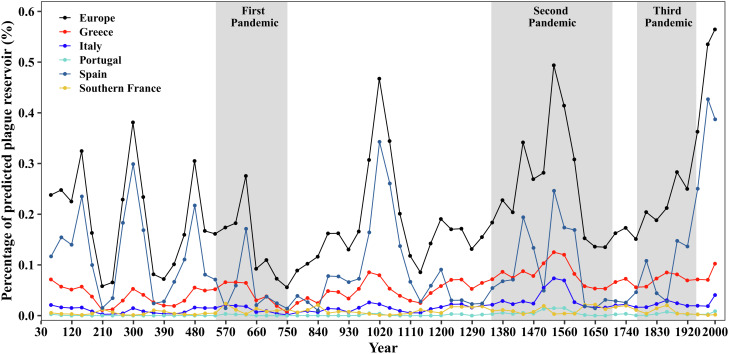
Area percentage of predicted plague reservoirs of Europe over the past 2,000 y, together with the percentage of predicted plague reservoirs in each country (i.e., France, Greece, Italy, Portugal, and Spain) with different countries indicated by different colors. (Note that the percentage values are averaged values for every 30 y.) The three historical plague pandemic periods—the First, Second, and Third Plague Pandemics—are marked in gray.
Fig. 3.
Fig. 3.
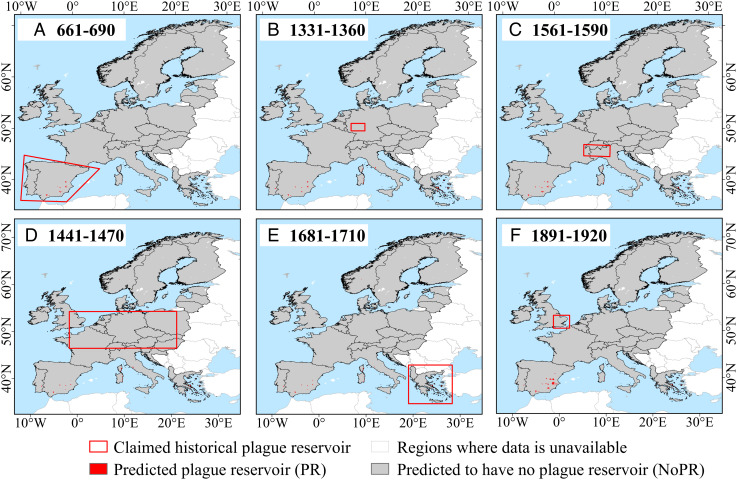
Marked in red are the regions in Europe proposed to have possessed historical plague reservoirs over the three pandemics and are compared with our predictions of environmental conditions suitable for the formation and persistence of plague reservoirs. (A) The earliest authenticated plague pandemic (the Justinianic Plague, late 6th – mid-8th century). Historians and scientists have claimed that plague reservoirs in Europe during the Second Plague Pandemic include (B) South–Central Germany (c.1349–c.1400), (C) Southern Alps (c.1348–c.1640), (D) Central Europe (c.1460–c.1640), (E) the Balkans (16th-early 19th century), and (F) England (c.1348–c.1500 and c.1906–1918) (see Table 1). Note that the years labeled in this figure are just 30-y periods which overlap with the beginning or activation of the putative reservoirs, rather than the entire periods during which the same reservoirs are hypothesised to have existed in Table 1.

References

    1. Mahmoudi A., et al. , Plague reservoir species throughout the world. Integr. Zool. 16, 820–833 (2021). - PubMed
    1. Schmid B. V., et al. , Climate-driven introduction of the Black Death and successive plague reintroductions into Europe. Proc. Natl. Acad. Sci. U.S.A. 112, 3020–3025 (2015). - PMC - PubMed
    1. Stenseth N. C., et al. , Plague: Past, present, and future. PLoS Med. 5, e3 (2008). - PMC - PubMed
    1. Haensch S., et al. , Distinct clones of Yersinia pestis caused the Black Death. PLoS Pathog. 6, e1001134 (2010). - PMC - PubMed
    1. Bos K. I., et al. , A draft genome of Yersinia pestis from victims of the Black Death. Nature 478, 506–510 (2011). - PMC - PubMed

Publication types