. 2022 Dec 12;22(1):330.
doi: 10.1186/s12906-022-03777-w.

Antimalarial and immunomodulatory potential of chalcone derivatives in experimental model of malaria

Affiliations

Antimalarial and immunomodulatory potential of chalcone derivatives in experimental model of malaria

Shweta Sinha et al. BMC Complement Med Ther. .

Abstract

Background: Malaria is a complex issue due to the availability of few therapies and chemical families against Plasmodium and mosquitoes. There is increasing resistance to various drugs and insecticides in Plasmodium and in the vector. Additionally, human behaviors are responsible for promoting resistance as well as increasing the risk of exposure to infections. Chalcones and their derivatives have been widely explored for their antimalarial effects. In this context, new derivatives of chalcones have been evaluated for their antimalarial efficacy.

Methods: BALB/c mice were infected with P. berghei NK-65. The efficacy of the three most potent chalcone derivations (1, 2, and 3) identified after an in vitro compound screening test was tested. The selected doses of 10 mg/kg, 20 mg/kg, and 10 mg/kg were studied by evaluating parasitemia, changes in temperature, body weights, organ weights, histopathological features, nitric oxide, cytokines, and ICAM-1 expression. Also, localization of parasites inside the two vital tissues involved during malaria infections was done through a transmission electron microscope.

Results: All three chalcone derivative treated groups showed significant (p < 0.001) reductions in parasitemia levels on the fifth and eighth days of post-infection compared to the infected control. These derivatives were found to modulate the immune response in a P. berghei infected malaria mouse model with a significant reduction in IL-12 levels.

Conclusions: The present study indicates the potential inhibitory and immunomodulatory actions of chalcones against the rodent malarial parasite P. berghei.

Keywords: Chalcones; Cytokine expression; ICAM-1; In vivo; Malaria; P. berghei.


Conflict of interest statement

The authors declare that they have no competing interests.

Figures

Fig. 1
Fig. 1
Experimental design of the study
Fig. 2
Fig. 2
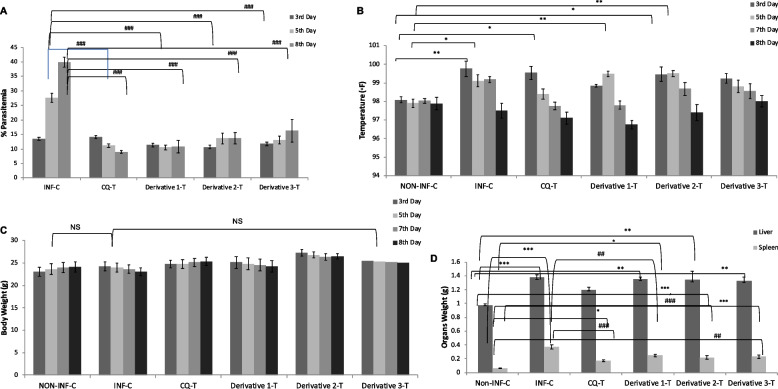
Effect of Chalcone derivatives 1 (10 mg/kg), 2 (20 mg/kg) and 3 (10 mg/kg) using Chloroquine diphosphate (10 mg/kg) as a standard chloroquine sensitive antimalarial drug for evaluating parasitemia (%) (parasitized RBC count) (A), on rectal temperature (◦F) (B), on body weights (g) (C) and, organ weights (g) (D) in P. berghei NK-65 infected mouse model. Data are represented as mean ± SEM, n = 6 mice. *p < 0.05, **p < 0.01, ***p < 0.001 (*Group represents INF-C, CQ-T, Chalcone derivatives 1, 2 and 3 compared to NON-INF-C Control group) and #p < 0.05, # # p < 0.01, # # # p < 0.001 (#Group represents CQ-T, chalcone derivatives 1, 2, and 3 compared to infected Control group); NS: non-significant. Abbreviation Used: NON-INF-C: Non-infected control, INF-C: Infected Control, CQ-T: Chloroquine Treated
Fig. 3
Fig. 3
Effect of Chalcone derivatives 1 (10 mg/kg), 2 (20 mg/kg) and 3 (10 mg/kg) using Chloroquine diphosphate (10 mg/kg) as a standard chloroquine sensitive antimalarial drug on nitric oxide level (μg/mL) in P. berghei NK-65 infected mouse model. Data are represented as mean ± SEM, n = 6 mice. NS: non-significant. Abbreviation Used: NON-INF-C: Non-infected control, INF-C: Infected Control, CQ-T: Chloroquine Treated
Fig. 4
Fig. 4
Effect of Chalcone derivatives 1 (10 mg/kg), 2 (20 mg/kg) and 3 (10 mg/kg) using Chloroquine diphosphate (10 mg/kg) as standard chloroquine sensitive antimalarial drug on Cytokines expression (pg/mL) in P. berghei NK-65 infected mouse model. Data are represented as mean ± SEM, n = 5 mice. *p < 0.05, **p < 0.01, ***p < 0.001 (*Group represents INF-C, CQ-T, Chalcone derivatives 1, 2 and 3 compared to NON-INF-C Control group) and #p < 0.05, # # p < 0.01, # # # p < 0.001 (#Group represents CQ-T, chalcone derivatives 1, 2, and 3 compared to infected Control group); NS: non-significant. Abbreviation Used: NON-INF-C: Non-infected control, INF-C: Infected Control, CQ-T: Chloroquine Treated
Fig. 5
Fig. 5
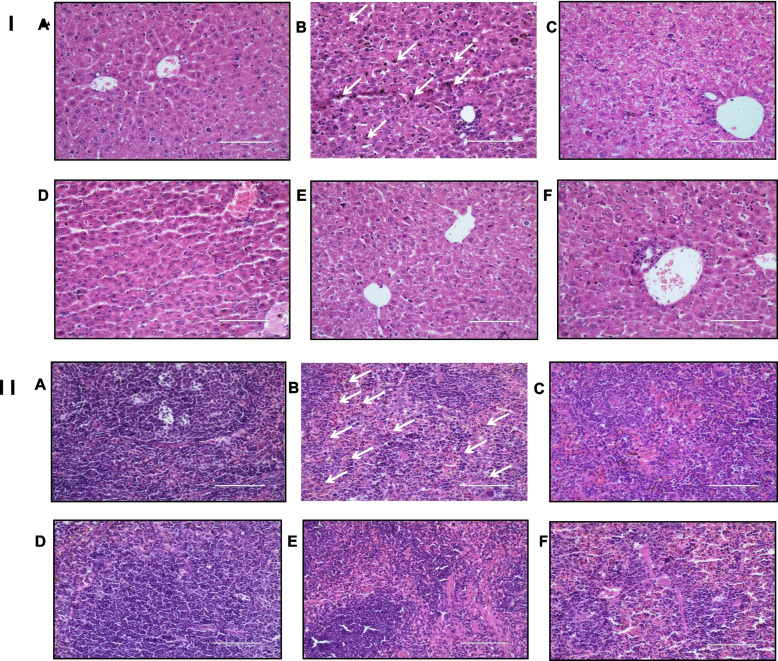
Photomicrographs depicting Hematoxylin & Eosin stained Liver (I) and Spleen (II) sections at 400X magnifications of mice treated with Chalcone derivatives 1 (10 mg/kg), 2 (20 mg/kg) and 3 (10 mg/kg) using Chloroquine diphosphate (10 mg/kg) as standard chloroquine sensitive antimalarial drug in P. berghei NK-65 infected mouse model for five days. A Non-infected Control, B Infected Control C Chloroquine-Treated (10 mg/kg) D Derivative 1 Treated (10 mg/kg), E Derivative 2 Treated (20 mg/kg) and F Derivative 3 Treated (10 mg/kg). Arrows in I and II B indicates deposition of hemozoin pigment. Bar scale represent 100 μm
Fig. 6
Fig. 6
Photomicrographs depicting ICAM-1 stained liver sections at 400X magnifications (I A) and, ICAM-1 stained spleen sections at 200X magnifications (II A) of mice treated with Chalcone derivatives 1 (10 mg/kg), 2 (20 mg/kg) and 3 (10 mg/kg) using Chloroquine diphosphate (10 mg/kg) as standard chloroquine sensitive antimalarial drug in P. berghei NK-65 infected mouse model for five days. Biotin-conjugated secondary antibody and streptavidin-conjugated horseradish peroxidase from DAB Substrate kit ( Scy Tek) were applied to sections to amplify the antigen signal for subsequent 3,3-diaminobenzidine staining, which produces a permanent brown color. a) Non-infected Control, b) Infected Control c) Chloroquine-Treated (10 mg/kg) d) Chalcone Derivative 1 Treated (10 mg/kg), e) Derivative 2 Treated (20 mg/kg) and f) Derivative 3 Treated (20 mg/kg). Bar scale represent 100 μm. (I B & II B) ICAM-1 expression in liver section of mice and, ICAM-1 expression in spleen section of mice. Pearson Chi-square, contingency co-efficient, correlations test was applied for statistical significance (*p < 0.05)
Fig. 7
Fig. 7
Electron micrograph of (I) Liver section and (II) Spleen section of P. berghei infected mouse model depicting effect of Chalcone derivative (10 mg/kg) using Chloroquine diphosphate (10 mg/kg) as standard antimalarial drug in P. berghei NK-65 infected mouse model for five days. A Infected Control, B CQ-Treated (10 mg/kg) and C) Chalcone Derivative-Treated (10 mg/kg). Arrows indicates malaria parasite
Fig. 8
Fig. 8
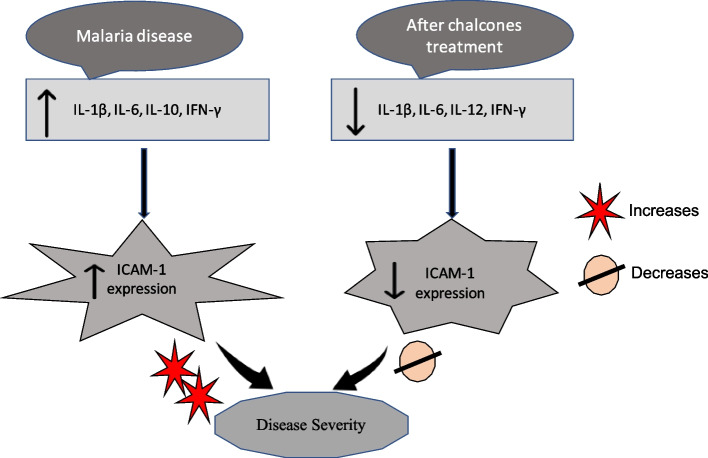
Immunomodulatory Potential of Chalcones

References

    1. Zekar L, Sharman T. Plasmodium Falciparum Malaria. [Updated 2022 Aug 8]. In: StatPearls [Internet]. Treasure Island (FL): StatPearls Publishing; 2022. Available from: https://www.ncbi.nlm.nih.gov/books/NBK555962/. - PubMed
    1. Meibalan E, Marti M. Biology of malaria transmission. Cold Spring Harb Perspect Med. 2017;7(3):a025452. doi: 10.1101/cshperspect.a025452. - DOI - PMC - PubMed
    1. Milner DA., Jr Malaria pathogenesis. Cold Spring Harb Perspect Med. 2018;8(1):a025569. doi: 10.1101/cshperspect.a025569. - DOI - PMC - PubMed
    1. Popa GL, Popa MI. Recent advances in understanding the inflammatory response in malaria: a review of the dual role of cytokines. J Immunol Res. 2021;2021:7785180. doi: 10.1155/2021/7785180. - DOI - PMC - PubMed
    1. World malaria report 2021. Geneva: World Health Organization; 2021. Licence: CC BY-NC-SA 3.0 IGO. Available from: https://www.who.int/teams/global-malaria-programme/reports/world-malaria....