


Key predictors of undernutrition among children 6-59 months in the Buea Health District of the Southwest region of Cameroon: a cross sectional community-based survey
- PMID: 36514089
- PMCID: PMC9745983
- DOI: 10.1186/s40795-022-00646-0
Key predictors of undernutrition among children 6-59 months in the Buea Health District of the Southwest region of Cameroon: a cross sectional community-based survey
Abstract
Background: According to the 2018 Demographic and Health Survey, undernutrition remains a public health problem among Cameroonian children under-five. This varies across the country, greatest in areas with ongoing humanitarian crisis, such as the Southwest region. However, data on the burden of undernutrition in the Southwest region is sparse. This study aimed to assess the prevalence and predictors of undernutrition among children under-five in the Buea health district of the Southwest region of Cameroon.
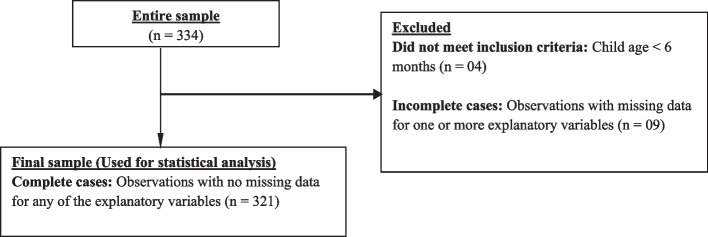
Methods: This was a community based cross-sectional study of 321 children under-five/caretaker pairs, surveyed from households selected using multistage randomized sampling. Data were collected by trained data collectors, with the aid of a structured, pre-tested questionnaire that captured information on sociodemographic characteristics, food security, dietary diversity and anthropometric measurements. The weight, height/length and mid upper arm circumference (MUAC) were measured using standardized instruments. Stunting, Wasting and Underweight of children were calculated from Z-scores of Height-for-age (HAZ), Weight-for-height (WHZ) and Weight-for-age (WAZ) based on 2006 WHO standards. Data was analysed using SPSS version 27.0. Predictors of malnutrition were obtained using multivariate logistic regression, adjusting for potential confounders.
Results: Overall, 31.8% (102/321) of the children were undernourished (26.5% stunted, 1.6% underweight, 3.7% wasted). Drinking water from inappropriate sources (OR: 2.32, 95% CI: 1.30-4.15) and a Dietary Diversity Score < 4 (OR: 2.59, 95%CI: 1.46-4.61) were independently associated with increased risk of stunting. Children of the male sex were more likely to be wasted than females (OR: 5.34, 95%CI: 1.09-26.14).
Conclusion: Childhood undernutrition, particularly stunting is common in the Buea Health District. Risk factors of undernutrition identified are potentially modifiable, highlighting the need for nutrition specific and sensitive interventions to improve dietary diversity, and the need to improve access to safe drinking water, and educate caretakers on the importance of clean potable water, good sanitation and hygiene for the proper growth and development of their children.
Keywords: Buea-Cameroon; Children under-five; Drinking water; Poor dietary diversity; Predictors; Prevalence; Undernutrition.
© 2022. The Author(s).
Conflict of interest statement
The authors have no competing interests to declare.
Figures
References
-
- UNICEF / WHO / World Bank Group. Levels and Trends in Childhood malnutrition. Key findings of the 2021 edition. Geneva; 2021. Available from: https://www.who.int/publications/i/item/9789240025257
-
- Fact sheets - Malnutrition. Available from: https://www.who.int/news-room/fact-sheets/detail/malnutrition. [cited 7 Mar 2022].
-
- National Institute of Statistics (Cameroon) and ICF . Cameroon demographic and health survey 2018. Yaoundé and Rockville: NIS and ICF; 2020.
-
- MAL-ED Network Investigators The MAL-ED study: a multinational and multidisciplinary approach to understand the relationship between enteric pathogens, malnutrition, gut physiology, physical growth, cognitive development, and immune responses in infants and children up to 2 years of age in resource-poor environments. Clin Infect Dis. 2014;59(suppl_4):S193–S206. doi: 10.1093/cid/ciu653. - DOI - PubMed
LinkOut - more resources
Full Text Sources
Medical