


Safety, effectiveness, and adherence of a short and all-oral treatment regimen for the treatment of rifampicin-resistant tuberculosis in Niger: a study protocol of a pragmatic randomised clinical trial with stratified block randomisation
- PMID: 36514153
- PMCID: PMC9746149
- DOI: 10.1186/s13063-022-06912-7
Safety, effectiveness, and adherence of a short and all-oral treatment regimen for the treatment of rifampicin-resistant tuberculosis in Niger: a study protocol of a pragmatic randomised clinical trial with stratified block randomisation
Abstract
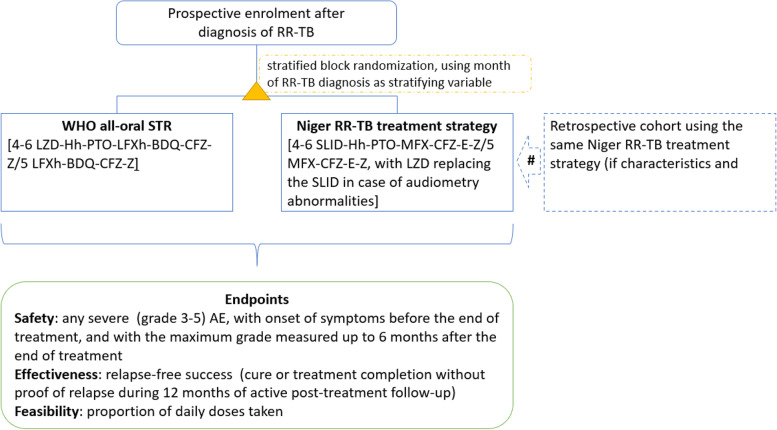
Background: Rifampicin-resistant tuberculosis (RR-TB) treatment requires combination treatment, which frequently causes serious adverse events and globally results in not much more than 60% treatment success. In Niger, a high cure rate was obtained with a RR-TB treatment strategy based on a second-line injectable drug (SLID)-containing Short Treatment Regimen (STR), with linezolid replacing the SLID in patients with ototoxicity. Given the availability of novel anti-tuberculosis drugs, WHO recommends all-oral RR-TB treatment. Considering the high level of success with the Niger treatment strategy, it would only be justified to replace it in case robust evidence shows that the WHO all-oral bedaquiline/linezolid (BDQ/LZD)-containing STR (experimental arm) performs better than the Niger RR-TB treatment strategy, (control arm) in terms of safety, effectiveness and adherence.
Methods: A pragmatic randomised clinical trial (RCT) using stratified block randomisation, conducted between April 2021 and March 2024, prospectively enrols participants diagnosed with RR-TB in one of the four RR-TB units of the nation. Depending of the month in which patients are diagnosed with RR-TB, patients with FQ-susceptible RR-TB are enrolled in either the experimental arm or control arm.
Discussion: To increase the feasibility of conducting a RCT, embedded in routine activities of all Niger's RR-TB Units, we used a creative trial design. We randomised by monthly blocks, whereby the regimen used changes every month, using the month of RR-TB diagnosis as stratifying variable. This approach was deemed feasible for Niger's national tuberculosis programme, as it simplifies the work of the clinicians running the RR-TB units. Our creative design may serve as an example for other national programs. Findings will inform national and international RR-TB treatment guidelines, and will also strengthen the evidence-base on how to develop robust RR-TB treatment regimens.
Trial registration: Pan African Clinical Trial Register PACTR202203645724919 . Registered on 15 March 2022.
Keywords: All oral treatment; New anti-tuberculosis drugs; Niger; Rifampicin resistance tuberculosis.
© 2022. The Author(s).
Conflict of interest statement
The authors declare that they have no competing interests.
Figures
References
-
- World Health Organization (WHO) Companion handbook. 2014.
-
- World Health Organization (WHO) Global tuberculosis report. Geneva: WHO; 2016.
-
- D. M. K. Mayara Lisboa Soares de Bastos, Gregory J Fox, Rebecca Harris, Anneke Hesseling, Faiz Khan, “WHO treatment guidelines for drug- resistant tuberculosis 2016,” World Heal. Organ., 2016.
Publication types
MeSH terms
Substances
LinkOut - more resources
Full Text Sources
Miscellaneous
