


Speech Illusions in People at Clinical High Risk for Psychosis Linked to Clinical Outcome
- PMID: 36516396
- PMCID: PMC10016413
- DOI: 10.1093/schbul/sbac163
Speech Illusions in People at Clinical High Risk for Psychosis Linked to Clinical Outcome
Abstract
Background and hypothesis: Around 20% of people at clinical high risk (CHR) for psychosis later develop a psychotic disorder, but it is difficult to predict who this will be. We assessed the incidence of hearing speech (termed speech illusions [SIs]) in noise in CHR participants and examined whether this was associated with adverse clinical outcomes.
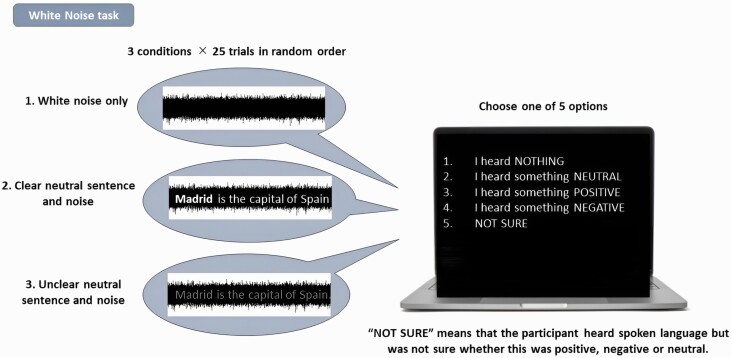
Study design: At baseline, 344 CHR participants and 67 healthy controls were presented with a computerized white noise task and asked whether they heard speech, and whether speech was neutral, affective, or whether they were uncertain about its valence. After 2 years, we assessed whether participants transitioned to psychosis, or remitted from the CHR state, and their functioning.
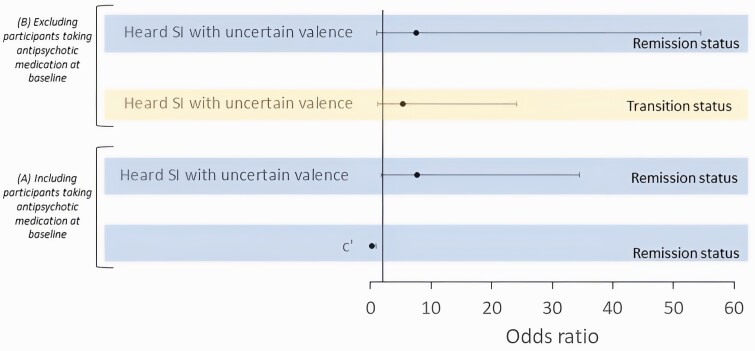
Study results: CHR participants had a lower sensitivity to the task. Logistic regression revealed that a bias towards hearing targets in stimuli was associated with remission status (OR = 0.21, P = 042). Conversely, hearing SIs with uncertain valence at baseline was associated with reduced likelihood of remission (OR = 7.72. P = .007). When we assessed only participants who did not take antipsychotic medication at baseline, the association between hearing SIs with uncertain valence at baseline and remission likelihood remained (OR = 7.61, P = .043) and this variable was additionally associated with a greater likelihood of transition to psychosis (OR = 5.34, P = .029).
Conclusions: In CHR individuals, a tendency to hear speech in noise, and uncertainty about the affective valence of this speech, is associated with adverse outcomes. This task could be used in a battery of cognitive markers to stratify CHR participants according to subsequent outcomes.
Keywords: remission; signal-detection; transition; uncertainty; white noise task.
© The Author(s) 2022. Published by Oxford University Press on behalf of the Maryland Psychiatric Research Center.
Figures
References
Publication types
MeSH terms
Substances
Grants and funding
LinkOut - more resources
Full Text Sources
Medical
