. 2022 Oct 31;4(6):fcac279.
doi: 10.1093/braincomms/fcac279. eCollection 2022.

Intellectual enrichment and genetic modifiers of cognition and brain volume in Huntington's disease

Collaborators, Affiliations

Intellectual enrichment and genetic modifiers of cognition and brain volume in Huntington's disease

Marina Papoutsi et al. Brain Commun. .

Abstract

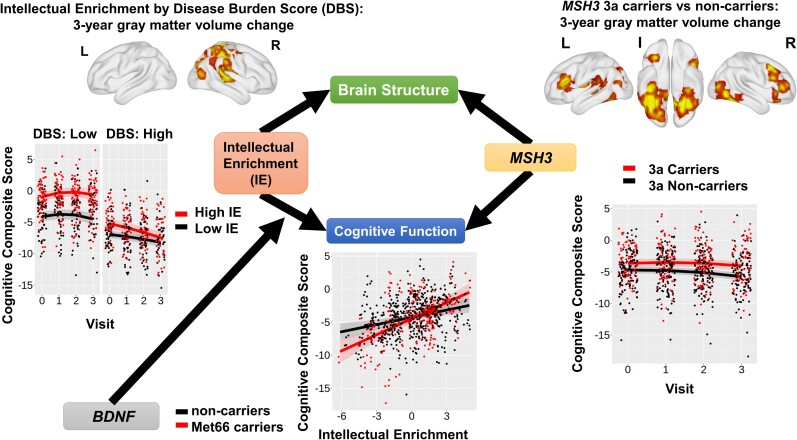
An important step towards the development of treatments for cognitive impairment in ageing and neurodegenerative diseases is to identify genetic and environmental modifiers of cognitive function and understand the mechanism by which they exert an effect. In Huntington's disease, the most common autosomal dominant dementia, a small number of studies have identified intellectual enrichment, i.e. a cognitively stimulating lifestyle and genetic polymorphisms as potential modifiers of cognitive function. The aim of our study was to further investigate the relationship and interaction between genetic factors and intellectual enrichment on cognitive function and brain atrophy in Huntington's disease. For this purpose, we analysed data from Track-HD, a multi-centre longitudinal study in Huntington's disease gene carriers and focused on the role of intellectual enrichment (estimated at baseline) and the genes FAN1, MSH3, BDNF, COMT and MAPT in predicting cognitive decline and brain atrophy. We found that carrying the 3a allele in the MSH3 gene had a positive effect on global cognitive function and brain atrophy in multiple cortical regions, such that 3a allele carriers had a slower rate of cognitive decline and atrophy compared with non-carriers, in agreement with its role in somatic instability. No other genetic predictor had a significant effect on cognitive function and the effect of MSH3 was independent of intellectual enrichment. Intellectual enrichment also had a positive effect on cognitive function; participants with higher intellectual enrichment, i.e. those who were better educated, had higher verbal intelligence and performed an occupation that was intellectually engaging, had better cognitive function overall, in agreement with previous studies in Huntington's disease and other dementias. We also found that intellectual enrichment interacted with the BDNF gene, such that the positive effect of intellectual enrichment was greater in Met66 allele carriers than non-carriers. A similar relationship was also identified for changes in whole brain and caudate volume; the positive effect of intellectual enrichment was greater for Met66 allele carriers, rather than for non-carriers. In summary, our study provides additional evidence for the beneficial role of intellectual enrichment and carrying the 3a allele in MSH3 in cognitive function in Huntington's disease and their effect on brain structure.

Keywords: Huntington’s disease; MSH3; brain-derived neurotrophic factor; cognitive modifiers; intellectual enrichment.


Figures

Graphical abstract
Graphical abstract
Figure 1
Figure 1
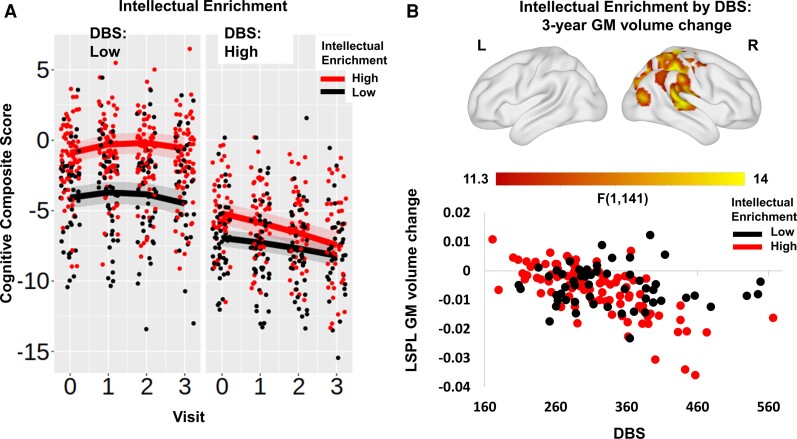
Intellectual enrichment, cognitive function and brain volume. (A) Association between intellectual enrichment and DBS with global cognitive function [t(225.1) = −3.596, P < 0.001] and (B) T-map of 3-year GM volume change. In (A) regression lines are generated from a mixed linear model at high (1SD above mean; red) and low (1SD below mean; black) intellectual enrichment. For visualization purposes, results are split into high (above mean) and low (below mean) DBS. The bands around the regression lines are 95% confidence intervals. Data points show the raw data residualized against age, site, sex and use of antipsychotic medication and have been jittered to minimize overlap. In B, significant clusters are overlaid on the ICBM152 template mesh (top). Maps are thresholded at P < 0.001 uncorrected at voxel level and P < 0.05 family-wise error corrected at cluster level. Shown in a scatter plot (bottom) are the extracted values averaged across the significant cluster. For visualization purposes, data are grouped by high (above mean—red) and low (below mean—black) intellectual enrichment. Data points show the raw data residualized against age, DBS, site, sex and TIV. LSPL, left superior parietal lobe.
Figure 2
Figure 2
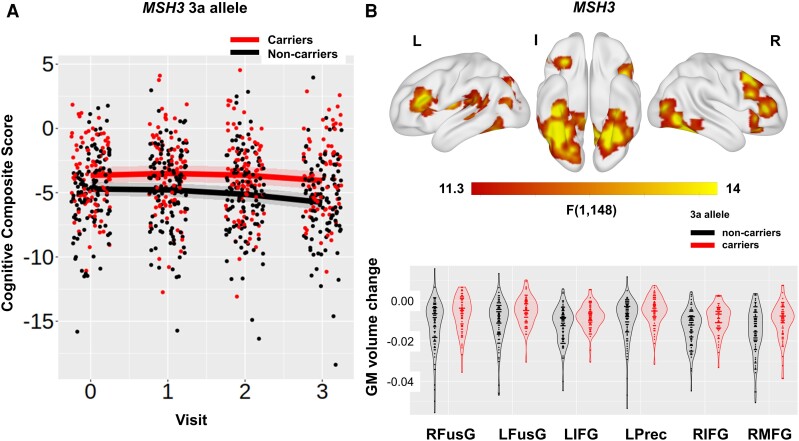
MSH3, cognitive function and brain volume. (A) Association between the MSH3 predictor and global cognitive function [t(198.7) = 2.637, P = 0.009] and (B) T-map of 3-year GM volume change. In A, regression lines show the predicted effect of carrying (red) and not carrying (black) the 3a allele from a mixed linear model. The bands around the regression lines are 95% confidence intervals. Data points show the raw data residualized against age, site, sex and use of antipsychotic medication and have been jittered to minimize overlap. In B, significant clusters are overlaid on the ICBM152 template mesh (top). Maps are thresholded at P < 0.001 uncorrected at voxel level and P < 0.05 family-wise error corrected at cluster level. Shown in violin plots (bottom) are the extracted values averaged across the significant clusters for carriers (red) and non-carriers (black) of the 3a allele. Individual data points are shown in black dots. Data points show the raw data residualized against age, DBS, site, sex and TIV. RFusG and LFusG, right and left fusiform gyrus; LIFG and RIFG, left and right inferior frontal gyrus; LPrec, left precuneus; RMFG, right middle frontal gyrus.
Figure 3
Figure 3
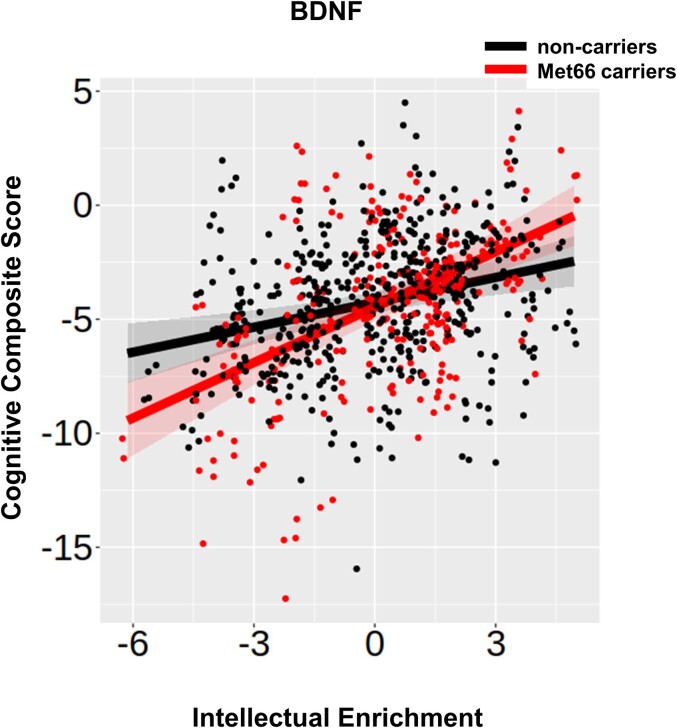
BDNF, intellectual enrichment and cognitive function. Association between the BDNF predictor and intellectual enrichment with global cognitive function [t(203.5) = 2.760, P = 0.006]. Regression lines show the predicted effect of carrying (red) and not carrying (black) the Met66 allele. The bands around the regression lines are 95% confidence intervals. Data points show the raw data residualized against age, site, sex and use of antipsychotic medication.

References

    1. Snowden JS. The neuropsychology of Huntington’s disease. Arch Clin Neuropsychol. 2017;32(7):876–887. - PubMed
    1. Duff K, Paulsen J, Mills J, et al. . Mild cognitive impairment in prediagnosed Huntington disease. Neurology. 2010;75(6):500–507. - PMC - PubMed
    1. Nyberg L, Lövdén M, Riklund K, Lindenberger U, Bäckman L. Memory aging and brain maintenance. Trends Cogn Sci. 2012;16(5):292–305. - PubMed
    1. Stern Y. Cognitive reserve. Neuropsychologia. 2009;47(10):2015–2028. - PMC - PubMed
    1. Vemuri P, Lesnick TG, Przybelski SA, et al. . Association of lifetime intellectual enrichment with cognitive decline in the older population. JAMA Neurol. 2014;71(8):1017–1024. - PMC - PubMed

LinkOut - more resources