. 2023 Mar 17;4(1):101930.
doi: 10.1016/j.xpro.2022.101930. Epub 2022 Dec 13.

Streamlined high-throughput cloning protocol to generate arrayed mutant libraries

Affiliations

Streamlined high-throughput cloning protocol to generate arrayed mutant libraries

Kerry T Sun et al. STAR Protoc. .

Abstract

Large-scale, site-directed mutagenesis enables rapid characterization of the biochemical and biological properties of proteins. Here, we present a cost-effective and adaptable cloning pipeline to generate arrayed gene libraries for a construct of interest. We detail steps to use an open access web app to automate the design of mutagenesis primers optimized for our cloning protocols in a 96-well plate format. The protocol allows most molecular biology labs to clone 96 mutants (from PCR to sequence ready plasmid) in 3 days.

Keywords: Genetics; High Throughput Screening; Molecular Biology; Sequencing.


Conflict of interest statement

Declaration of interests The authors declare no competing interests.

Figures

None
Graphical abstract
Figure 1
Figure 1
Primer design using the mutagenesis primer program, Primutant (A) Image of primer program submission page with example input text. (B) Example of .csv output file generated by Primutant.
Figure 2
Figure 2
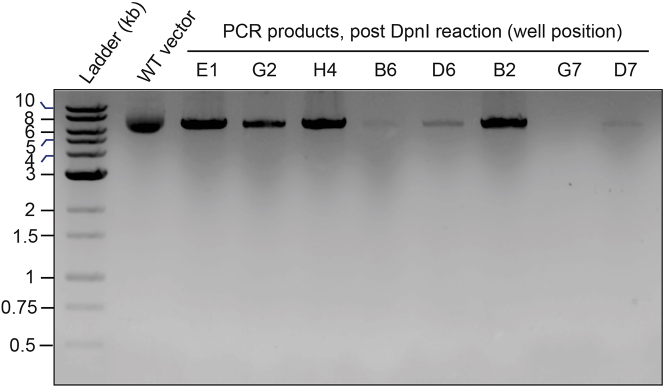
Verification of amplified products following site-directed mutagenesis PCR and DpnI digestion Samples of selected PCR+DpnI reactions using WT pET28a-0N4R tau vector template (6,493 bp) and mutagenesis primer pairs. A sample of WT pET28a-0N4R tau (WT vector) is run for reference. The intensity of the expected full-length PCR product can vary across the plate. Note: All presented reactions except for well G7 gave rise to clones with the desired mutation.
Figure 3
Figure 3
Representative results of plated colonies following bacterial transformation (A) A schematic demonstrating organization system for plating transformations - deep well transformation plate with highlighted wells (left) and corresponding locations of positive transformants after plating on LB agar plates (right). Created with Biorender.com (B) A representative example of plated transformants following overnight incubation (16–18 h). Note: the plated “transformation spots” contain separated single colonies suitable for plasmid purification.
Figure 4
Figure 4
Reference well position system between 96 well plates and 48 well plates used for growth of bacterial cultures for plasmid purification A schematic of a 96 well plate containing PCR+DpnI reactions (left) and the corresponding wells arranged in two 48 well plates, both rotated 90 degrees (right). Created with Biorender.com
Figure 5
Figure 5
Compiled results for generation of an arrayed site-saturation mutagenesis library Mutagenesis targets were four residues (G272, N279, P301, S352) in the 0N4R tau coding sequence of pET28a-0N4R tau. (A) The results for all targeted mutant reactions after the first run-through of the cloning procedure. (B–E) Results indicating the stage within the cloning pipeline when a positive clone was isolated for a targeted mutant within the target set (n=76) but partitioned according to sequence features. (B) Overall results, no partitioning. (C) Results arranged according to WT residue (left to right) and mutation cloned. White, hatched boxes indicate a match with the WT residue in which case no primer pair was generated. (D) By number of nucleotide mismatches in the primer sequence. (E) By GC content (%) of the primer.
Figure 6
Figure 6
Compiled results for generation of an arrayed phosphomimetic mutagenesis library Targeted mutation of serine and threonine residues in the human 0N4R tau coding sequence to glutamate (vector = pET28a-0N4R tau). (A) Schematic showing the relative location of serine and threonine residues in the human 0N4R tau coding sequence. Proline-rich and repeat domains (R1-R4) associated with the microtubule-binding region are indicated. Numbering of the 0N4R tau sequence is based on standard convention using the longest tau isoform, 2N4R. The grey hatched box indicates the residues present in the 2N4R tau isoform sequence but lacking in 0N4R tau. (B) The results for all targeted mutant reactions after the first run-through of the cloning procedure. (C–G) Results indicating the stage within the cloning pipeline when a positive clone was isolated for a targeted mutant within the group (n=66) but partitioned according to sequence features. (C) Overall results, no partitioning. (D) By identity of the WT residue, serine (S) or threonine (T). (E) By number of nucleotide mismatches in the primer sequence. (F) By location of the targeted residue within the 0N4R sequence. The grey hatched segment indicates residues present in the 2N4R tau isoform sequence but lacking in 0N4R. (G) By GC content (%) of the primer.
Figure 7
Figure 7
Compiled results for generation of an arrayed custom scanning mutagenesis library Residues 78–169 of the human DNAJA2 coding sequence were targeted for mutation to alanine (vector = pMCSG7-His-TEV-DNAJA2). (A) The results for all targeted mutant reactions after the first run-through of the cloning procedure. (B–E) Results indicating the stage within the cloning pipeline when a positive clone was isolated for a targeted mutant within the group (n=82) but partitioned according to sequence features. (B) Overall results, no partitioning. (C) By number of nucleotide mismatches in the primer sequence. (D) By location of the targeted residue within the human DNAJA2 coding sequence. (E) By GC content (%) of the primer.

References

    1. Inoue H., Nojima H., Okayama H. High efficiency transformation of Escherichia coli with plasmids. Gene. 1990;96:23–28. doi: 10.1016/0378-1119(90)90336-. - DOI - PubMed
    1. Sambrook J., Russell D.W. 3rd ed. Cold Spring Harbor Laboratory Press; 2001. Molecular Cloning: A Laboratory Manual.
    1. Mok S.-A., Condello C., Freilich R., Gillies A., Arhar T., Oroz J., Kadavath H., Julien O., Assimon V.A., Rauch J.N., et al. Mapping interactions with the chaperone network reveals factors that protect against tau aggregation. Nat. Struct. Mol. Biol. 2018;25:384–393. doi: 10.1038/s41594-018-0057-1. - DOI - PMC - PubMed
    1. Thompson A.D., Scaglione K.M., Prensner J., Gillies A.T., Chinnaiyan A., Paulson H.L., Jinwal U.K., Dickey C.A., Gestwicki J.E. Analysis of the tau-associated proteome reveals that exchange of Hsp70 for Hsp90 is involved in tau degradation. ACS Chem. Biol. 2012;7:1677–1686. doi: 10.1021/cb3002599. - DOI - PMC - PubMed
    1. Rauch J.N., Gestwicki J.E. Binding of human nucleotide exchange factors to heat shock protein 70 (Hsp70) generates functionally distinct complexes in vitro. J. Biol. Chem. 2014;289:1402–1414. doi: 10.1074/jbc.M113.521997. - DOI - PMC - PubMed

Publication types

LinkOut - more resources