Characteristics and outcomes of hepatocellular carcinoma patients with macrovascular invasion following surgical resection: a meta-analysis of 40 studies and 8,218 patients
- PMID: 36523924
- PMCID: PMC9745615
- DOI: 10.21037/hbsn-21-419
Characteristics and outcomes of hepatocellular carcinoma patients with macrovascular invasion following surgical resection: a meta-analysis of 40 studies and 8,218 patients
Abstract
Background: Guidelines recommend that hepatocellular carcinoma (HCC) patients with portal vein tumor thrombosis (PVTT) and/or hepatic vein tumor thrombosis (HVTT) should undergo systemic therapy. However, recent data suggest that surgical resection may be beneficial in selected cases, but outcomes are heterogenous. We aimed to estimate pooled overall survival (OS), recurrence free survival (RFS) and complication rates in HCC patients with macrovascular invasion (MVI) following surgical resection.
Methods: In this systematic review and meta-analysis, two investigators independently searched PubMed, Embase, and Cochrane databases from inception to Nov 10, 2020, without language restrictions, for studies reporting outcomes of adult HCC patients with MVI who underwent liver resection with curative intent.
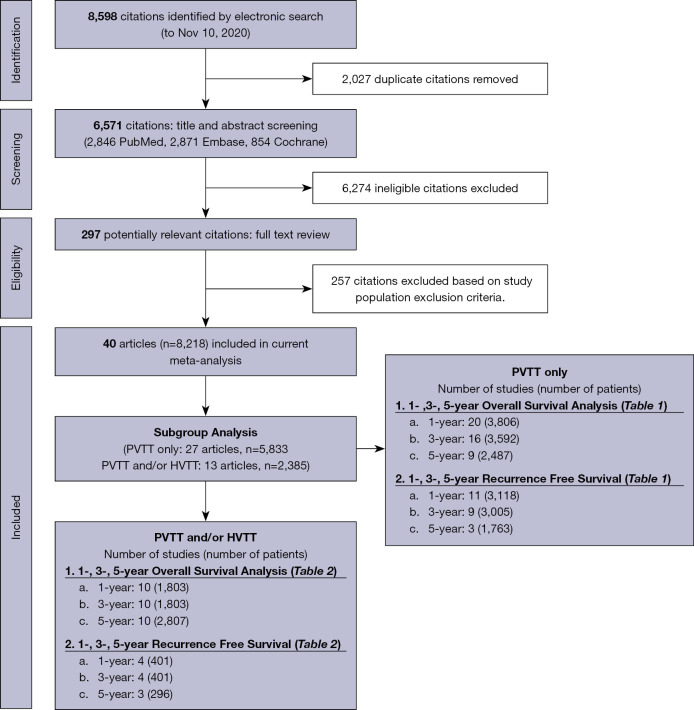
Results: We screened 8,598 articles and included 40 studies involving 8,218 patients. Among all patients with MVI, the pooled median OS was 14.39 months [95% confidence interval (CI): 10.99-18.84], 1-year OS was 54.47% (95% CI: 46.12-62.58%) and 3-year OS was 23.20% (95% CI: 16.61-31.42%). Overall, 1- and 3-year RFS were 27.70% (95% CI: 21.00-35.57%) and 10.06% (95% CI: 6.62-15.01%), respectively. Among patients with PVTT, median OS was 20.41 months in those with segmental/2nd order involvement compared to 12.91 months if 1st order branch was involved and 6.41 months if the main trunk was involved. The pooled rate of major complications was 6.17% (95% CI: 3.53-10.56%).
Conclusions: Overall median survival was 14.39 months for HCC patients with MVI following resection. Median survival was higher in PVTT with segmental/2nd order involvement at 20.41 versus 6.41 months if the main trunk was involved.
Keywords: Hepatocellular carcinoma (HCC); macrovascular invasion (MVI); portal vein; recurrence; resection.
2022 Hepatobiliary Surgery and Nutrition. All rights reserved.
Conflict of interest statement
Conflicts of Interest: All authors have completed the ICMJE uniform disclosure form (available at https://hbsn.amegroups.com/article/view/10.21037/hbsn-21-419/coif). MHN has received research grants from Glycotest, Gilead, B. K. Kee Foundation, and National Cancer Institute; MHN serves on the Advisory Board of Intercept, Laboratory of Advanced Medicine, Bayer, Eisai, Gilead, Novartis, Janssen, Eli Lilly, and Exact Sciences. DQH has received a research grant from the National Medical Research Council [Singapore (MOH-000595-01)] and the Exxon-Mobil NUS Scholarship for Clinicians (MOH-000595-01); DQH serves on the Advisory Board of Eisai. The other authors have no conflicts of interest to declare.
Figures
Comment in
-
Hepatocellular carcinoma with macrovascular invasion: need a personalized medicine for this complicated event.Hepatobiliary Surg Nutr. 2024 Feb 1;13(1):188-190. doi: 10.21037/hbsn-23-653. Epub 2024 Jan 16. Hepatobiliary Surg Nutr. 2024. PMID: 38322215 Free PMC article. No abstract available.
References
-
- GLOBOCAN 2020: Global Cancer Observatory. International Agency for Research on Cancer. 2020.
LinkOut - more resources
Full Text Sources