. 2022 Dec 17;12(1):21813.
doi: 10.1038/s41598-022-26082-5.

Residual ST-segment elevation to predict long-term clinical and CMR-derived outcomes in STEMI

Affiliations

Residual ST-segment elevation to predict long-term clinical and CMR-derived outcomes in STEMI

Héctor Merenciano-González et al. Sci Rep. .

Abstract

Residual ST-segment elevation after ST-segment elevation myocardial infarction (STEMI) has traditionally been considered a predictor of left ventricular (LV) dysfunction and ventricular aneurism. However, the implications in terms of long-term prognosis and cardiac magnetic resonance (CMR)-derived structural consequences are unclear. A total of 488 reperfused STEMI patients were prospectively included. The number of Q wave leads with residual ST-segment elevation > 1 mm (Q-STE) at pre-discharge ECG was assessed. LV ejection fraction (LVEF, %) and infarct size (IS, % of LV mass) were quantified in 319 patients at 6-month CMR. Major adverse cardiac events (MACE) were defined as all-cause death and/or re-admission for acute heart failure (HF), whichever occurred first. During a mean follow-up of 6.1 years, 92 MACE (18.9%), 39 deaths and 53 HF were recorded. After adjustment for baseline characteristics, Q-STE (per lead with > 1 mm) was independently associated with a higher risk of long-term MACE (HR 1.24 [1.07-1.44] per lead, p = 0.004), reduced (< 40%) LVEF (HR 1.36 [1.02-1.82] per lead, p = 0.04) and large (> 30% of LV mass) IS (HR 1.43 [1.11-1.85] per lead, p = 0.006) at 6-month CMR. Patients with Q-STE ≥ 2 leads (n = 172, 35.2%) displayed lower MACE-free survival, more depressed LVEF, and larger IS at 6-month CMR (p < 0.001 for all comparisons). Residual ST-segment elevation after STEMI represents a universally available tool that predicts worse long-term clinical and CMR-derived structural outcomes.


Conflict of interest statement

The authors declare no competing interests.

Figures
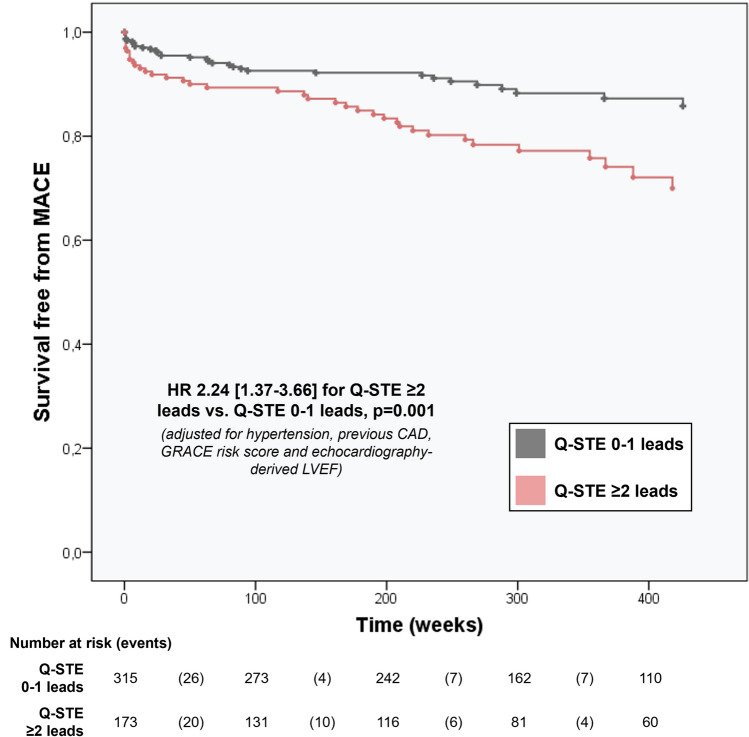
Figure 1
Figure 1
MACE-free survival by Q-STE category. Survival curves adjusted for predictors of MACE other than Q-STE (hypertension, previous CAD, GRACE risk score and echocardiography-derived LVEF). Abbreviations: CAD = coronary artery disease. GRACE = Global Registry of Acute Coronary Events. HR = hazard ratio. LVEF = Left ventricular ejection fraction. MACE = major adverse cardiovascular events. Q-STE = Q wave and residual STE > 1 mm.
Figure 2
Figure 2
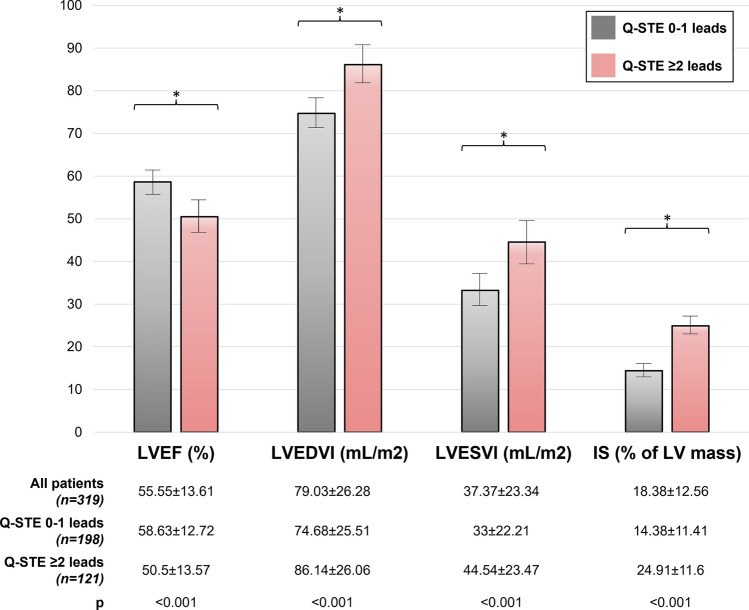
Structural changes at 6-month CMR according to Q-STE category. Variables are presented as mean ± standard deviation. * = p < 0.001. Abbreviations: CMR = cardiac magnetic resonance. IS = infarct size. LVEF = left ventricular ejection fraction. LVEDVI = left ventricular end-diastolic volume index. LVESVI = left ventricular end-systolic volume index. Q-STE = Q wave and residual STE > 1 mm.
Figure 3
Figure 3
Examples of Q-STE and structural changes at 6-month CMR. Pre-discharge ECG showing no Q-STE (A) and Q-STE in ≥ 2 leads (B). Short axis CMR in diastole (left) and systole (right) indicating preserved (C) and reduced (< 40%, D) LVEF at 6 months. Late gadolinium enhancement imaging depicting non-extensive (E) and extensive (> 30% of LV mass, F) IS. Abbreviations: CMR = cardiac magnetic resonance. IS = infarct size. LV = left ventricular. LVEF = left ventricular ejection fraction. Q-STE = Q wave and residual STE > 1 mm.
Figure 4
Figure 4
Pre-discharge Q-STE categories and structural changes at 6-month CMR. The number and percentage of patients with reduced (< 40%) LVEF and large (> 30% of LV mass) IS at 6-month CMR is shown in each Q-STE category (0–1 leads and ≥ 2 leads). Abbreviations: CMR = cardiac magnetic resonance. IS = infarct size. LV = left ventricular. LVEF = left ventricular ejection fraction. Q-STE = Q wave and residual STE > 1 mm.
Figure 5
Figure 5
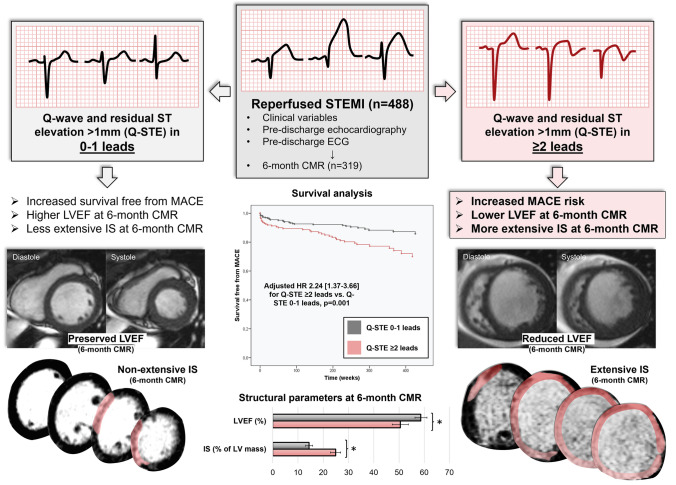
Visual summary depicting the most relevant findings of the study. Abbreviations: CMR = cardiac magnetic resonance. HR = hazard ratio. IS = infarct size. LV = left ventricular. LVEF = left ventricular ejection fraction. STEMI = ST-segment elevation myocardial infarction. Q-STE = Q wave and residual STE > 1 mm.

References

    1. Nabel EG, Braunwald E. A tale of coronary artery disease and myocardial infarction. N. Engl. J. Med. 2012;366:54–63. doi: 10.1056/NEJMra1112570. - DOI - PubMed
    1. Pedersen F, et al. Short- and long-term cause of death in patients treated with primary PCI for STEMI. J. Am. Coll. Cardiol. 2014;64:2101–2108. doi: 10.1016/j.jacc.2014.08.037. - DOI - PubMed
    1. Ibanez B, et al. 2017 ESC Guidelines for the management of acute myocardial infarction in patients presenting with ST-segment elevation. Eur. Heart J. 2018;39:119–177. doi: 10.1093/eurheartj/ehx393. - DOI - PubMed
    1. McLeod P, Adamson PD, Coffey S. Do we need early risk stratification after ST-elevation myocardial infarction? Heart. 2021 doi: 10.1136/heartjnl-2021-320030. - DOI - PubMed
    1. Mukherjee, J. T. et al. In-hospital measurement of left ventricular ejection fraction and one-year outcomes in acute coronary syndromes: Results from the IMMEDIATE Trial. Cardiovasc. Ultrasound14 (2016). - PMC - PubMed

Publication types