. 2023 Aug;30(7-8):603-611.
doi: 10.1038/s41434-022-00374-x. Epub 2022 Dec 19.

Glyco-binding domain chimeric antigen receptors as a new option for cancer immunotherapy

Affiliations

Glyco-binding domain chimeric antigen receptors as a new option for cancer immunotherapy

Anna-Katharina Franke et al. Gene Ther. 2023 Aug.

Abstract

In the last decade, treatment using Chimeric Antigen Receptor (CAR) are largely studied and demonstrate the potential of immunotherapeutic strategies, as seen mainly for blood related cancers. Still, efficient CAR-T cell approaches especially for the treatment of solid tumors are needed. Tn- and Sialyl-Tn antigens are tumor associated carbohydrate antigens correlating with poor prognosis and tumor metastasis on a variety of tumor entities. These glycans can be recognized by CD301 (CLEC10A, MGL), which is a surface receptor found primarily on immune cells. In the present study, we hypothesized, that it is possible to use newly generated CD301-bearing CARs, enabling cytotoxic effector cells to recognize and eliminate breast cancer cells. Thus, we genetically modified human NK92 cells with different chimeric receptors based on the carbohydrate recognition domain (CRD) of human CD301. We assessed their cytotoxic activity in vitro demonstrating the specific recognition of CD301 ligand positive cell lines. These results were confirmed by degranulation assays and in cytokine release assays. Overall, this study demonstrates CD301-CARs represent a cost-effective and fast alternative to conventional scFv CARs for cancer immunotherapy.


Conflict of interest statement

The authors declare no competing interests.

Figures

Fig. 1
Fig. 1. CD301-based CAR construction and expression in NK92 cells.
A To generate the CD301 CAR, we used the Moloney murine leukemia virus-derived retroviral pBullet expression vector [25] and exchanged the scFv-sequences with the CRD of CD301. The newly generated fusion protein contained the kappa leader sequence as a signal peptide (SP), the CD301-CRD, the human Fc-part of an IgG (hinge and hu IgG) the transmembrane and intracellular domain of human CD28 and the signaling domain of human CD3ζ. We additionally quipped the vector with a GFP linked by an IRES. B Schematic representation of the different CD301 based CARs: we generated the CD301 linker by addition of a [(G4S)3] linker downstream of the CRD to increase flexibility. C NK92 cells were retrovirally transduced and sorted based on the GFP expression. The expression of the CD301 CAR construct was measured by flow cytometry using antibody specific for the myc-tag and the CD301 CRD, respectively. D FACS analysis of transduced NK92 cells using anti-myc antibody. E Overlay histogram of CD301 CAR expressions.
Fig. 2
Fig. 2. Binding properties of CD301 CARs.
A Binding assay with fluorescently labeled PAA-glykoconjugates. NK92 cells expressing the respective CARs were incubated with biotinylated PAA-glycoconjugates premixed with Streptavidin-Alexa 647 and analyzed by flow cytometry. Binding of Tn- PAA, STn-PAA or the negative control (aminoglucitol) to NK92 cells are depicted as triplicates (WT: grey, CD301 CAR: green, CD301-linker: red, CD301-linker-myc: blue). B Evaluation of binding specificity. Binding of indicated PAA-glycoconjugates are shown as mean of fold binding compared to WT cells. Error bars showing standard deviation of triplicates. p < 0.05, p < 0.01 or p < 0.001 p < 0.0001 were indicated by *, **, *** or **** respectively.
Fig. 3
Fig. 3. CD301-CARs display specific cytotoxicity against breast cancer cell lines.
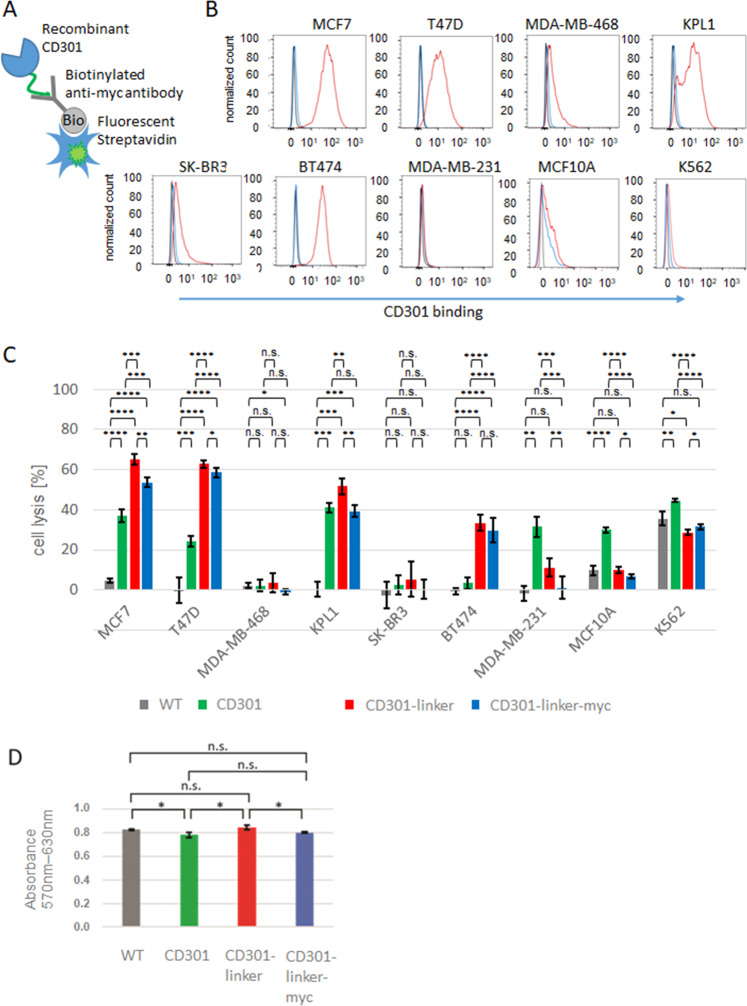
A Recombinant CD301 is equipped with a N-terminal myc and was fluorescently labeled with a biotinylated anti-myc antibody and Strepatividin-FITC. B Detection of CD301 ligands on target cells: breast cancer cell lines were stained with fluorescently labeled recombinant CD301 and analyzed by flow cytometry. C NK92 cells expressing the CD301-CAR, CD301-linker-CAR or CD301-linker-myc CAR were cocultured for 3 h with calcein labeled targets with an effector target ratio of 5:1 and measured as quadruplicates. D MTT assay of transduced - and WT NK92 cell. Columns represent the median of triplicates. Error bars show standard deviation. p < 0.05, p < 0.01 or p < 0.001 p < 0.0001 were indicated by *, **, *** or **** respectively.
Fig. 4
Fig. 4. CAR expression leads to enhanced degranulation of NK92 cells upon engagement with CD301 ligand-positive breast cancer cells.
A Degranulation of CD56+ NK92 CAR cells was analyzed by flow cytometry assessment of CD107a surface expression after 4 h of co-culture with MCF7, T47D, MDA-MB-468 or K562 cells (CD56-) (E:T 1:1). Parental NK92 cells were included for comparison. Unstimulated effector cells or stimulated with PMA/ionomycin served as basal and positive controls, respectively. B Evaluation of degranulation assay. Columns represent mean percentage of CD107a positive NK92 cells measured in triplicates. Error bars show standard deviation. p < 0.05, p < 0.01 or p < 0.001 p < 0.0001 were indicated by *, **, *** or **** respectively.
Fig. 5
Fig. 5. Ligand induced downregulation of CAR constructs.
Surface expression of CD301 CARs were analysed after 3 h or after 24 h of co-culture with MCF7, T47D, MDA-MB-46. PMA treated cells served as postiv control for activation. In parallel 50 µM TAPI-2, an inhibitor for MMPs and TACE, was added to PMA treated cells for 3 h. Error bars show standard deviation. Significance levels were calculated in relation to non-treated cells (n.t.) p < 0.05, p < 0.01 or p < 0.001 p < 0.0001 were indicated by *, **, *** or **** respectively.
Fig. 6
Fig. 6. Lytic activity of CD301-CAR expressing NK92 cells.
A Cytotoxicity of NK92 cell expressing CD301-CAR (green), CD301-linker-CAR (red) or CD301-linker-myc CAR (blue) in comparison to wildtype NK92 cells (grey) was investigated against MCF7, T47D, MDA-MB-468 cells and MCF10A, at different E:T ratios. B IFN-γ release was analyzed in supernatants of CAR expressing NK92 CAR or wildtype NK92 cells stimulated with MCF7, T47D, MDA-MB-468 cells and MCF10A (E:T 1:1), respectively. Untreated effector cells and effector cells treated with PMA/ionomycin served as controls. Results are reported as mean values ± SD of triplicates. p < 0.05, p < 0.01 or p < 0.001 p < 0.0001 were indicated by *, **, *** or **** respectively.

References

    1. Hakomori S. Glycosylation defining cancer malignancy: new wine in an old bottle. Proc Natl Acad Sci USA. 2002;99:10231–3. doi: 10.1073/pnas.172380699. - DOI - PMC - PubMed
    1. Dahr W, Uhlenbruck G, Gunson HH, van der Hart M. Studies on glycoproteins and glycopeptides from Tn-polyagglutinable erythrocytes. Vox Sang. 1975;28:249–52. doi: 10.1111/j.1423-0410.1975.tb02764.x. - DOI - PubMed
    1. Brockhausen I, Schachter H, Stanley P O-GalNAc Glycans. In: nd, Varki A, Cummings RD, Esko JD, Freeze HH, Stanley P, et al., editors. Essentials of Glycobiology. Cold Spring Harbor (NY) 2009. - PubMed
    1. Ju T, Otto VI, Cummings RD. The Tn antigen-structural simplicity and biological complexity. Angew Chem Int Ed Engl. 2011;50:1770–91. doi: 10.1002/anie.201002313. - DOI - PMC - PubMed
    1. Fu C, Zhao H, Wang Y, Cai H, Xiao Y, Zeng Y, et al. Tumor-associated antigens: Tn antigen, sTn antigen, and T antigen. HLA. 2016;88:275–86.. doi: 10.1111/tan.12900. - DOI - PubMed

Publication types

Substances