


Nomogram to Predict the Probability of Functional Dependence in Early Parkinson's Disease
- PMID: 36530091
- PMCID: PMC9912730
- DOI: 10.3233/JPD-223501
Nomogram to Predict the Probability of Functional Dependence in Early Parkinson's Disease
Abstract
Background: Early identification of Parkinson's disease (PD) patients at risk for becoming functionally dependent is important for patient counseling. Several models describing the relationship between predictors and outcome have been reported, however, most of these require computer software for practical use.
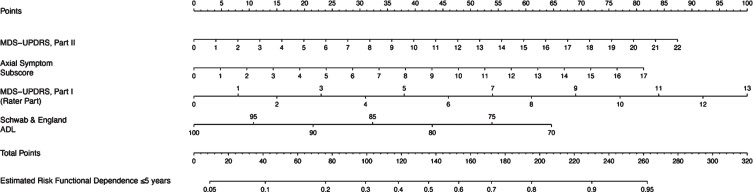
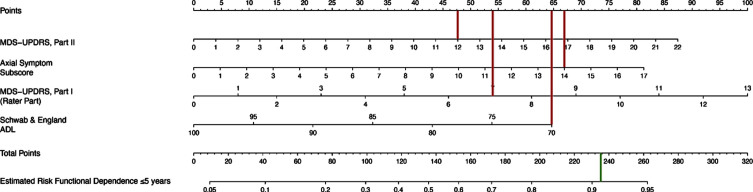
Objective: Here we report the development of a risk nomogram allowing an approximate graphical computation of the risk of becoming functionally dependent in early PD.
Methods: We analyzed data form the Parkinson's Progression Markers Initiative cohort of newly diagnosed PD patients from baseline through the first 5 years of follow-up. Functional dependence was defined as a score < 80 on the Schwab & England Activities of Daily Living scale. A binary logistic model was developed to estimate the risk of functional dependence and based on the results, a nomogram for the prediction of functional dependence was drawn in order to provide an easy-to-use tool in clinical and academic settings as a part of personalized medicine approach to PD treatment.
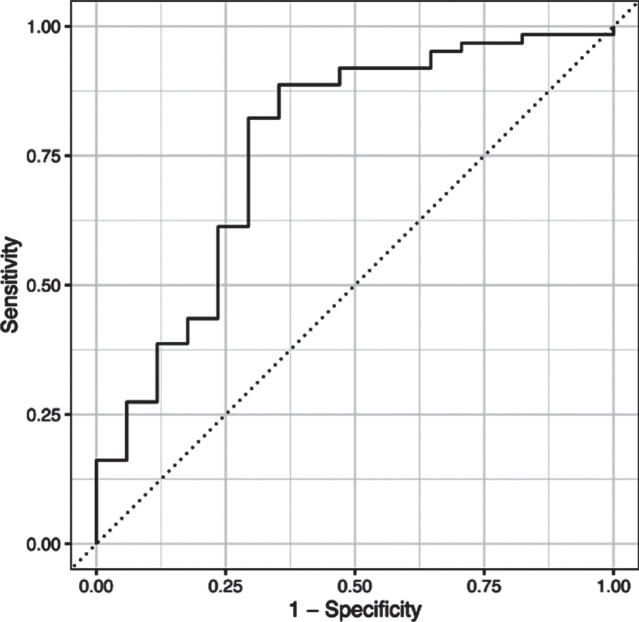
Results: At baseline, three patients and over the five-year follow-up, 85 (22%) out of 395 patients were functionally dependent as scored by the Schwab & England Activities of Daily Living rating scale. The binary logistic model showed that clinical parameters such as MDS-UPDRS I (rater part), MDS-UPDRS II, and MDS-UPDRS axial motor score were significant predictors for functional dependence within 5 years.
Conclusion: We here provide an easy-to-use tool to estimate the risk of functional dependence in PD patients based on the MDS-UPDRS part I, II and axial motor score.
Keywords: Parkinson’s disease; early diagnosis; functional status; nomograms; prognosis; risk.
Conflict of interest statement
The authors have no conflict of interest to report.
Figures
References
-
- Poewe W, Seppi K, Tanner CM, Halliday GM, Brundin P, Volkmann J, Schrag A-E, Lang AE (2017) Parkinson disease, Nat Rev Dis Prim 3, 17013. - PubMed
-
- Santos García D, de Deus Fonticoba T, Cores Bartolomé C, Naya Ríos L, García Roca L, Martínez Miró C, Canfield H, Jesús S, Aguilar M, Pastor P, Cosgaya M, García Caldentey J, Caballol N, Legarda I, Hernández Vara J, Cabo I, López Manzanares L, González Aramburu I, Ávila Rivera MA, Gómez Mayordomo V, Nogueira V, Puente V, Dotor J, Borrué C, Solano Vila B, Álvarez Sauco M, Vela L, Escalante S, Cubo E, Carrillo Padilla F, Martínez Castrillo JC, Sánchez Alonso P, Alonso Losada MG, López Ariztegui N, Gastón I, Kulisevsky J, Blázquez Estrada M, Seijo M, Rúiz Martínez J, Valero C, Kurtis M, de Fábregues O, González Ardura J, Alonso Redondo R, Ordás C, López Díaz LM, McAfee D, Martinez-Martin P, Mir P Coppadis Study Group (2021) Predictors of loss of functional independence in Parkinson’s disease: Results from the COPPADIS cohort at 2-year follow-up and comparison with a control group, Diagnostics 11, 1801. - PMC - PubMed
-
- Bjornestad A, Tysnes O-B, Larsen JP, Alves G (2016) Loss of independence in early Parkinson disease, Neurology 87, 1599–1606. - PubMed
Publication types
MeSH terms
LinkOut - more resources
Full Text Sources
Medical
Research Materials
Miscellaneous
