


Treatable Neurodegenerative Disorder: Cerebral Folate Transport Deficiency--Two Children from Southern India
- PMID: 36531775
- PMCID: PMC9757528
- DOI: 10.4103/jpn.JPN_76_20
Treatable Neurodegenerative Disorder: Cerebral Folate Transport Deficiency--Two Children from Southern India
Abstract
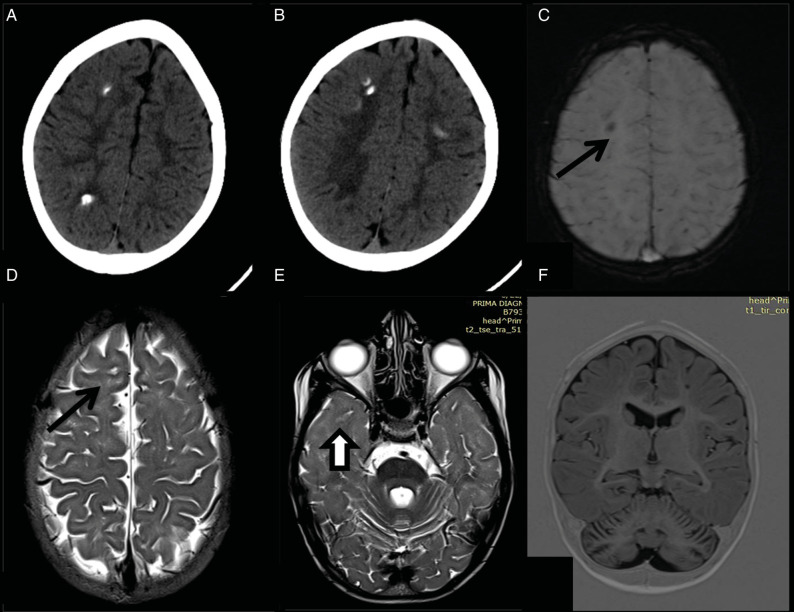
Cerebral folate transport deficiency results from impaired folate transport across the blood:choroid plexus:cerebrospinal fluid (CSF) barrier. This leads to low CSF 5-methyltetrahydrofolate (5MTHF), the active folate metabolite. We are reporting two children with this treatable cerebral folate transport deficiency. Case 1: Seventeen-year-old boy presented with delayed milestones followed by regression, seizures, and intention tremors. On examination child had pyramidal and cerebellar signs. Magnetic resonance imaging (MRI) of brain revealed diffuse cerebral and cerebellar atrophy. Targeted next generation sequencing revealed homozygous missense pathogenic variant in FOLR1 gene in exon 4 c.382C>T p.R128W, confirming the diagnosis of cerebral folate deficiency. Case 2: Six-year-old male child presented with delayed milestones, myoclonic jerks and cognitive regression from 3 years of age. Child had microcephaly with ataxia. Computed tomography (CT) of brain revealed multifocal calcifications. MRI brain revealed cerebellar atrophy with hyperintense T2 signal changes in the subcortical white matter of frontal and temporal lobes. Genetic testing revealed homozygous variant (c.493+2_493+6delTGAGG) in intron 4 of the FOLR1 gene which is a novel pathogenic variant. Both children started on folinic acid and there was a significant improvement in development, behavior, ataxia, and decrease in seizure frequency. In conclusion, cerebral folate transport deficiency should be suspected in every child with global developmental delay, epilepsy, ataxia and neuroimaging showing cerebellar atrophy and calcification. Response to folinic acid supplementation is partial if diagnosed late and treatment initiation is delayed.
Keywords: Cerebral transport defect; FOLR1; folic acid; folinic acid.
Copyright: © 2021 Journal of Pediatric Neurosciences.
Conflict of interest statement
There are no conflicts of interest.
Figures
References
-
- Ramaekers VT, Blau N. Cerebral folate deficiency. Dev Med Child Neurol. 2004;46:843–51. - PubMed
-
- Rosenblatt D. Inherited disorders of folate transport and metabolism. In: Scriver CR, Beaudet AL, Sly WS, Valle D, editors. The metabolic and molecular basis of inherited disease. 6th ed. New York: McGraw-Hill; 1995. pp. 3111–28.
-
- Suh JR, Herbig AK, Stover PJ. New perspectives on folate catabolism. Annu Rev Nutr. 2001;21:255–82. - PubMed
-
- Kamen BA, Smith AK. A review of folate receptor alpha cycling and 5-methyltetrahydrofolate accumulation with an emphasis on cell models in vitro. Adv Drug Deliv Rev. 2004;56:1085–97. - PubMed
-
- Sabharanjak S, Mayor S. Folate receptor endocytosis and trafficking. Adv Drug Deliv Rev. 2004;56:1099–109. - PubMed
Publication types
LinkOut - more resources
Full Text Sources