


Patient reported impact of symptoms in amyotrophic lateral sclerosis (PRISM-ALS): A national, cross-sectional study
- PMID: 36531982
- PMCID: PMC9755057
- DOI: 10.1016/j.eclinm.2022.101768
Patient reported impact of symptoms in amyotrophic lateral sclerosis (PRISM-ALS): A national, cross-sectional study
Abstract
Background: As novel therapeutic interventions are being developed and tested in the amyotrophic lateral sclerosis (ALS) population, there is a need to better understand the symptoms and issues that have the greatest impact on the lives of individuals with ALS. We aimed to determine the frequency and relative importance of symptoms experienced by adults in a national ALS sample and to identify factors that are associated with the greatest disease burden in this population.
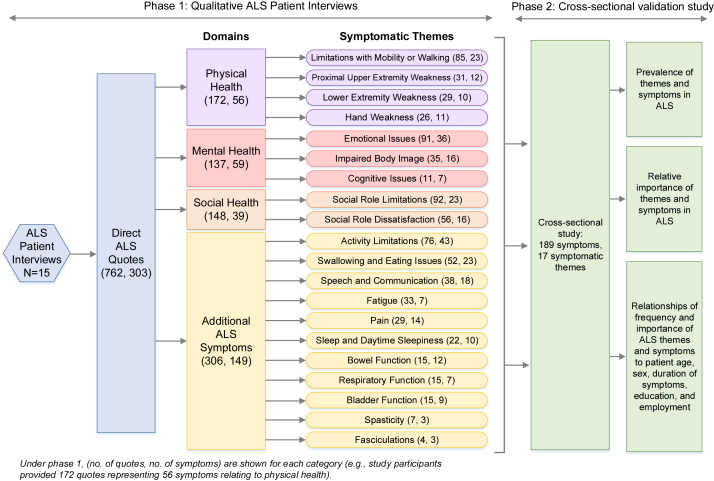
Methods: We conducted 15 qualitative interviews of individuals with varied ALS phenotypes and analyzed 732 quotes regarding the symptomatic disease burden of ALS between August 2018 and March 2019. We subsequently conducted a national, cross-sectional study of 497 participants with ALS and ALS variants through the Centers for Disease Control and Prevention's (CDC) National ALS Registry between July 2019 and December 2019. Participants reported on the prevalence and relative importance of 189 symptomatic questions representing 17 symptomatic themes that were previously identified through qualitative interviews. Analysis was performed to determine how age, sex, education, employment, time since onset of symptoms, location of symptom onset, feeding tube status, breathing status and speech status relate to symptom and symptomatic theme prevalence.
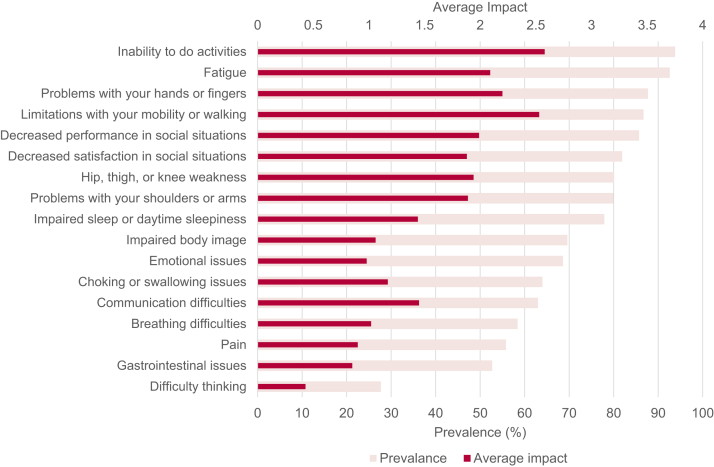
Findings: Symptomatic themes with the highest prevalence in our sample were an inability to do activities (93.8%), fatigue (92.6%), problems with hands or fingers (87.7%), limitations with mobility or walking (86.7%), and a decreased performance in social situations (85.7%). Participants identified inability to do activities and limitations with mobility or walking as having the greatest overall effect on their lives.
Interpretation: Individuals with ALS experience a variety of symptoms that affect their lives. The prevalence and importance of these symptoms differ among the ALS population. The most prevalent and important symptoms offer potential targets for improvements in future therapeutic interventions.
Funding: Research funding was provided by ALS Association.
Keywords: Amyotrophic lateral sclerosis; Disease burden; Motor neuron disease; PRISM; Patient-reported outcomes.
© 2022 The Authors.
Conflict of interest statement
CZ has previously provided consultation to Recursion Pharmaceuticals and reports no other disclosures. RB receives grants or contracts from the 10.13039/100000971ALS Association, Medicinova, Healey Center, and Orion with payments through 10.13039/100006510Duke University for various ALS projects and ALS trials. He receives book royalities through Demos Publishing. He provides consultation to ALS Association, Alexion, Amylyx, Apellis, Black Swan, Corcept, Cytokinetics, GenieUS, Guidepoint, ITF Pharma, New Biotic, Shinkei, and Woolsey Pharma. He has received payments for speaking on ALS from Amylyx. He has received payments for developing education materials on ALS from Projects in Knowledge and Medscape. He has participated on Data Safety Monitoring Boards for AB Science, Biogen, Brainstorm, Neurosense, and PTC. He has served on the scientific advisory board at GenieUS. VG is an employee of Biohaven Pharmaceuticals (his contribution to this work was done as part of his role at the University of Miami). He has received consultation/advisory board fees from Amylyx Pharmacuticals. JS has received grants or contracts from 10.13039/100000065NINDS (U01 ReSolve U01NS101944), NINDS (R21 CAPN3 R21TR003184), FSHD Canada (MOVE + FSHD), FSHD Society (MOVE FSHD), 10.13039/100004952MDA (MD CRNG), 10.13039/100012644Friends of FSH Research (MOVE FSHD). He has provided consultation and served on SAB with Avidity, Dyne, Fulcrum, Arrowhead, ML Bio, and Sarepta. He has provided consultation to MT Pharma, He has provided consultation and served on the advisory board for Amylyx. He has served on the steering committee at Roche. MB reports grants from 10.13039/100000971ALS Association (16-TACL-242 and 17-LGCA-331), 10.13039/100000002NIH (U54-NS092091, R01-NS105479 and U01- NS107027), and 10.13039/100005202Muscular Dystrophy Association (645863). He has received consulting fees from Alector, Biogen, Novartis, Sanofi, UCB, UniQure. The University of Miami has licensed intellectual property to Biogen to support design of the ATLAS study (UMIP142-A.) In addition, he has a provisional patent pending entitled ‘Determining Onset of Amyotrophic Lateral Sclerosis.’ He serves on the Board of Trustees for the ALS Association (unpaid). CH receives royalty payments through the University of Rochester for copyrighted patient reported outcome measures including one for ALS. He has provided consultation to Biogen Idec, Ionis Pharmaceuticals, aTyr Pharma, AMO Pharma, Acceleron Pharma, Cytokinetics, Expansion Therapeutics, Harmony Biosciences, Regeneron Pharmaceuticals, Astellas Pharmaceuticals, AveXis, Recursion Pharmaceuticals, IRIS Medicine, Inc., Takeda Pharmaceutical Company, Scholar Rock, Avidity Biosciences, Novartis Pharmaceuticals Corporation, SwanBio Therapeutics, Neurocrine Biosciences, and the Marigold Foundation. He is scheduled to have travel reimbursement to present at the upcoming Muscle Study Group Meeting. JS, SR, DA, EW, JSW, AV, ND, JH, JW, JC, and PM report no disclosures.
Figures
References
-
- Al-Chalabi A., Hardiman O., Kiernan M.C., Chiò A., Rix-Brooks B., van den Berg L.H. Amyotrophic lateral sclerosis: moving towards a new classification system. Lancet Neurol. 2016;15:1182–1194. - PubMed
-
- Brown R.H., Al-Chalabi A. Amyotrophic lateral sclerosis. N Engl J Med. 2017;377:162–172. - PubMed
-
- Talbott E.O., Malek A.M., Lacomis D. In: Handbook of Clinical Neurology. Aminoff M.J., Boller F., Swaab D.F., editors. Elsevier; 2016. Chapter 13 - the epidemiology of amyotrophic lateral sclerosis; pp. 225–238. - PubMed
-
- Prevalence of amyotrophic lateral sclerosis (ALS), United States. 2016. https://www.tandfonline.com/doi/epub/10.1080/21678421.2021.1949021?needA... - DOI - PubMed
Grants and funding
LinkOut - more resources
Full Text Sources
Research Materials
Miscellaneous
