


Leveraging livestock movements to urban slaughterhouses for wide-spread Rift Valley fever virus surveillance in Western Kenya
- PMID: 36532672
- PMCID: PMC9754961
- DOI: 10.1016/j.onehlt.2022.100457
Leveraging livestock movements to urban slaughterhouses for wide-spread Rift Valley fever virus surveillance in Western Kenya
Abstract
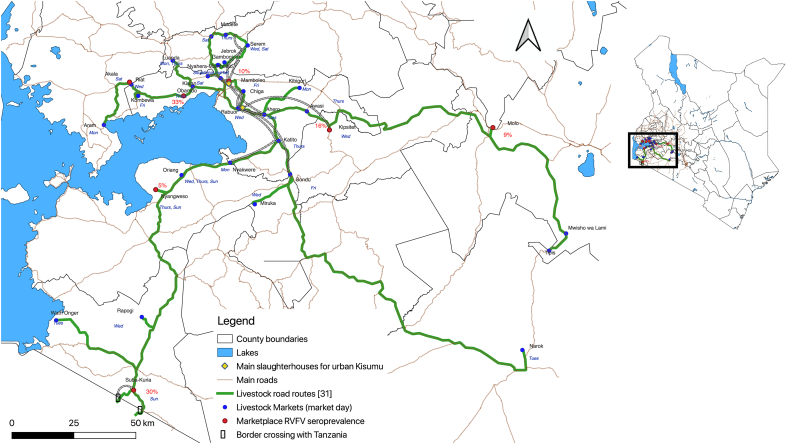
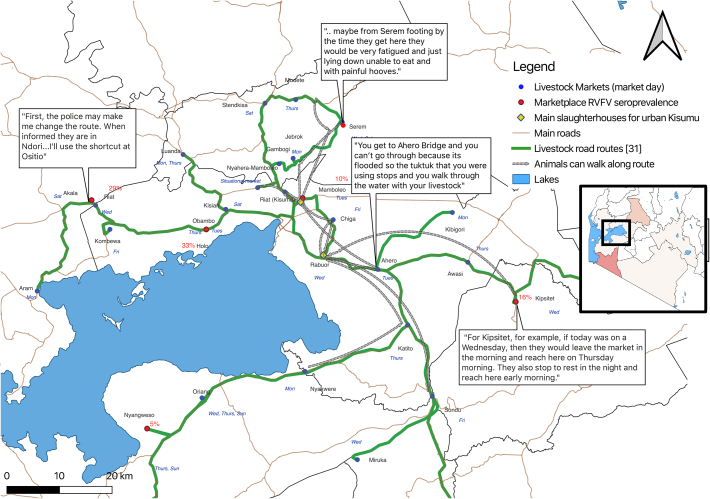
Rift Valley fever virus (RVFV) is an economically devastating, zoonotic arbovirus endemic across Africa with potential to cause severe disease in livestock and humans. Viral spread is primarily driven by movement of domestic ruminants and there is a high potential for transboundary spread. Despite influx of livestock to urban areas in response to the high demand for meat and animal products, RVFV has not been detected in any urban center. The objectives of this study were to determine the feasibility of assessing risk of RVFV introduction to urban Kisumu, Kenya, by testing slaughtered livestock for RVFV exposure and mapping livestock origins. Blood was collected from cattle, sheep, and goats directly after slaughter and tested for anti-RVFV IgG antibodies. Slaughterhouse businessmen responded to a questionnaire on their individual animals' origin, marketplace, and transport means. Thereafter, we mapped livestock flow from origin to slaughterhouse using participatory methods in focus group discussions with stakeholders. Qualitative data on route choice and deviations were spatially integrated into the map. A total of 304 blood samples were collected from slaughtered livestock in October and November 2021. Most (99%) of animals were purchased from 28 different markets across eight counties in Western Kenya. The overall RVFV seroprevalence was 9% (19% cattle, 3% in sheep, and 7% in goats). Migori County bordering Tanzania had the highest county-level seroprevalence (34%) and 80% of all seropositive cattle were purchased at the Suba Kuria market in Migori County. Road quality and animal health influenced stakeholders' decisions for choice of transport means. Overall, this proof-of-concept study offers a sampling framework for RVFV that can be locally implemented and rapidly deployed in response to regional risk. This system can be used in conjunction with participatory maps to improve active livestock surveillance and monitoring of RVFV in Western Kenya, and these methods could be extrapolated to other urban centers or livestock diseases.
Keywords: Livestock movement; RVFV epidemiology; RVFV, Rift Valley fever virus; Rift Valley fever virus transmission; Slaughterhouse surveillance; Urban RVFV; Urban vector-borne disease; Urban zoonoses.
© 2022 The Authors.
Conflict of interest statement
All authors included on of this manuscript declare that they have no conflicts of interest.
Figures



References
-
- WHO Rift Valley fever Fact Sheet [Internet] 2018. https://www.who.int/news-room/fact-sheets/detail/rift-valley-fever [cited 2021 Sep 16]. Available from:
-
- Gerken K.N., LaBeaud A.D., Mandi H., L’Azou Jackson M., Breugelmans J.G., King C.H. Paving the way for human vaccination against Rift Valley fever virus: A systematic literature review of RVFV epidemiology from 1999 to 2021. PLOS Neglected Tropical Diseases. 2022;16(1):e0009852. doi: 10.1371/journal.pntd.0009852. - DOI - PMC - PubMed
Grants and funding
LinkOut - more resources
Full Text Sources
